Department of Global Public Health, Equity and Health Policy Research Group, Karolinska Institutet, 17177, Stockholm, Sweden.
Region Stockholm, Centre for Epidemiology and Community Medicine, Box 45436, 104 31, Stockholm, Sweden.
Int J Equity Health. 2021 Sep 26;20(1):215. doi: 10.1186/s12939-021-01556-6.
Lack of control over life situations is an important social determinant that may negatively affect parental and child health. This study took place in an area of Stockholm, Sweden with high indications of socioeconomic disadvantage, a large part of the population with foreign background, as well as higher levels of poor health than the county average. It investigated staff perceptions of pathways from situations of low control, potentially leading to health inequities, affecting families enrolled in an early childhood home visiting programme during the Covid-19 pandemic.
Semi-structured interviews were carried out with 23 child health care nurses and parental advisors working in a home visiting programme. The data was analysed using Reflexive Thematic Analysis.
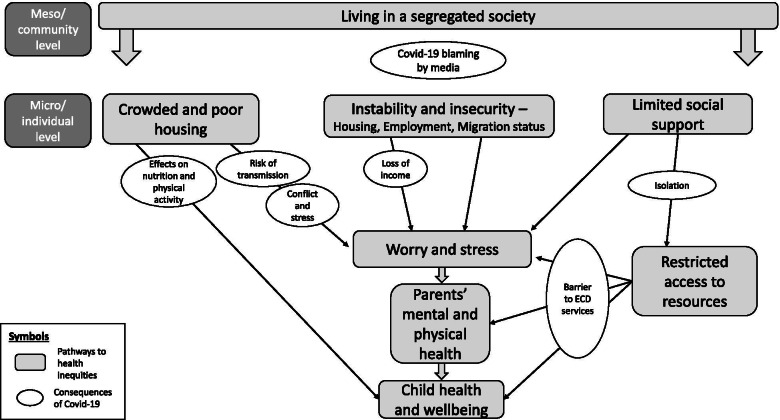
The analysis resulted in five pathways on two explanatory levels, affecting parents' health and parenting capacity and children's health and well-being, potentially damaging health and leading to health inequities. The first four pathways related to control at the personal explanatory level: Families facing instability and insecurity; Caring for children in crowded and poor housing conditions; Experiencing restricted access to resources; and Parenting with limited social support. The fifth pathway, Living in a segregated society, covered the collective experience of lack of control on community level. The Covid-19 pandemic was observed to negatively affect all pathways and thus potentially aggravate health inequities for this population. The pandemic has also limited the delivery of home visits to the families which creates further barriers in families' access to resources and increases isolation for parents with already limited social support.
The diversity of pathways connected to health inequities presented in this study highlights the importance of considering this variety of influences when designing interventions for socioeconomically disadvantaged areas. The additional negative consequences of Covid-19 indicate the need for sustainable preventive early childhood interventions for families in such areas. The study also emphasizes the need for further research as well as policy action on possible long-term effects of changing behaviours during the Covid-19 period on child health and health equity.
The study was retrospectively registered (11 August 2016) in the ISRCTN registry ( ISRCTN11832097 ).
生活状况无法掌控是一个重要的社会决定因素,可能会对父母和儿童的健康产生负面影响。本研究在瑞典斯德哥尔摩的一个地区进行,该地区社会经济劣势明显,人口中很大一部分来自国外,健康状况比全县平均水平差。该研究调查了工作人员对可能导致健康不平等的低控制状况的看法,这些不平等状况影响了在新冠疫情期间参加幼儿家访计划的家庭。
对参与家访计划的 23 名儿童保健护士和家长顾问进行了半结构化访谈。使用反思性主题分析对数据进行分析。
分析结果得出了两条解释水平上的五条途径,影响父母的健康和育儿能力以及儿童的健康和福祉,可能会损害健康并导致健康不平等。前四条途径与个人解释层面的控制有关:家庭面临不稳定和不安全;在拥挤和住房条件差的环境中照顾孩子;资源获取受限;以及在有限的社会支持下育儿。第五条途径“生活在一个隔离的社会”涵盖了社区层面缺乏控制的集体经验。新冠疫情被观察到对所有途径产生负面影响,因此可能会加剧该人群的健康不平等。疫情还限制了对这些家庭的家访服务,这在家庭获取资源方面造成了进一步的障碍,并增加了已经社会支持有限的父母的孤立感。
本研究中呈现的与健康不平等相关的多种途径强调了在为社会经济劣势地区设计干预措施时考虑这种多样性影响的重要性。新冠疫情的额外负面影响表明,需要为这些地区的家庭提供可持续的预防幼儿干预措施。该研究还强调了进一步研究以及政策行动的必要性,以了解新冠疫情期间行为变化对儿童健康和健康公平的可能长期影响。
该研究于 2016 年 8 月 11 日(ISRCTN82630306)在 ISRCTN 注册中心进行了回顾性注册。