Keles Sultan, Kocaturk Ozlem
Department of Pediatric Dentistry, Faculty of Dentistry, Adnan Menderes University, Aydın, Turkey.
Department of Oral and Maxillofacial Surgery, Division of Anesthesiology, Faculty of Dentistry, Adnan Menderes University, Aydın, Turkey.
Drug Des Devel Ther. 2018 Mar 28;12:647-653. doi: 10.2147/DDDT.S163828. eCollection 2018.
Premedication is the most common way to minimize distress in children entering the operating room and to facilitate the smooth induction of anesthesia and is accomplished using various sedative drugs before the children are being transferred to the operating room. The aim of this study was to compare the effect of oral dexmedetomidine (DEX) and oral midazolam (MID) on preoperative cooperation and emergence delirium (ED) among children who underwent dental procedures at our hospital between 2016 and 2017.
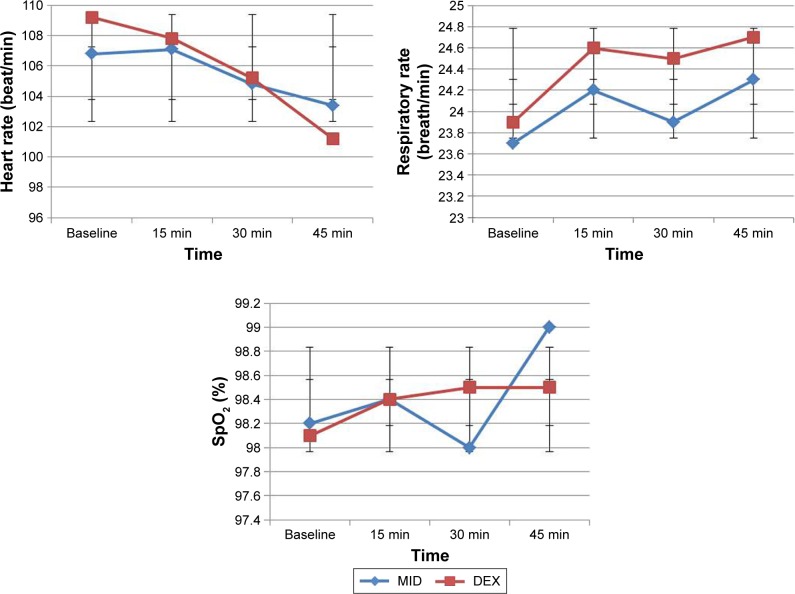
The medical records of 52 children, who were American Society of Anesthesiologists I, aged between 3 and 7 years, and who underwent full-mouth dental rehabilitation under general anesthesia (GA), were evaluated. Twenty-six patients were given 2 µg/kg of DEX, while another 26 patients were given 0.5 mg/kg of MID in apple juice as premedication agents. The patients' scores on the Ramsay Sedation Scale (RSS), Parental Separation Anxiety Scale (PSAS), Mask Acceptance Scale, Pediatric Anesthesia Emergence Delirium Scale (PAEDS), and hemodynamic parameters were recorded from patients' files. The level of sedation of children had been observed just before premedication and at 15, 30, and 45 min after premedication. The data were analyzed using a chi-square test, Fisher's exact test, Student's -test, and analysis of variance in SPSS.
The Mask Acceptance Scale and PSAS scores and RSS scores at 15, 30, and 45 min after premedication were not statistically different (>0.05) in both groups, whereas the PAEDS scores were significantly lower in the DEX group (<0.05).
Oral DEX provided satisfactory sedation levels, ease of parental separation, and mask acceptance in children in a manner similar to MID. Moreover, children premedicated with DEX experienced lesser ED than those premedicated with MID.
术前用药是将进入手术室的儿童的痛苦降至最低并促进麻醉平稳诱导的最常见方法,是在儿童被转移到手术室之前使用各种镇静药物来完成的。本研究的目的是比较口服右美托咪定(DEX)和口服咪达唑仑(MID)对2016年至2017年在我院接受牙科手术的儿童术前合作及苏醒期谵妄(ED)的影响。
评估了52例美国麻醉医师协会分级为I级、年龄在3至7岁、在全身麻醉(GA)下接受全口牙齿修复的儿童的病历。26例患者给予2μg/kg的DEX,另外26例患者给予0.5mg/kg的MID加在苹果汁中作为术前用药。从患者档案中记录患者的拉姆齐镇静评分(RSS)、父母分离焦虑量表(PSAS)、面罩接受量表、小儿麻醉苏醒期谵妄量表(PAEDS)得分及血流动力学参数。在术前用药前及用药后15、30和45分钟观察儿童的镇静水平。数据在SPSS中使用卡方检验、Fisher精确检验、Student's检验和方差分析进行分析。
两组患者术前用药后15、30和45分钟时的面罩接受量表、PSAS得分及RSS得分无统计学差异(>0.05),而DEX组的PAEDS得分显著更低(<0.05)。
口服DEX在儿童中提供了与MID相似的令人满意的镇静水平、便于父母分离及面罩接受度。此外,用DEX进行术前用药的儿童比用MID进行术前用药的儿童经历的ED更少。