Azizkhani Reza, Heydari Farhad, Ghazavi Mohammadreza, Riahinezhad Maryam, Habibzadeh Mohammadreza, Bigdeli Ali, Golshani Keihan, Majidinejad Saeid, Mohammadbeigi Abolfazl
Department of Emergency Medicine, Isfahan University of Medical Sciences, Isfahan, Iran.
Department of Pediatrics, Isfahan University of Medical Sciences, Isfahan, Iran.
J Pediatr Neurosci. 2020 Jul-Sep;15(3):245-251. doi: 10.4103/jpn.JPN_107_19. Epub 2020 Nov 6.
Pediatric anxiety and restlessness may create issues and difficulties in performing accurate diagnostic studies even noninvasive ones, such as radiological imaging. There are some agents that will help to get this goal. This study aimed to compare the intranasal effect of dexmedetomidine (DEX) and midazolam (MID) for sedation parameters of children undergoing computerized tomography (CT) imaging.
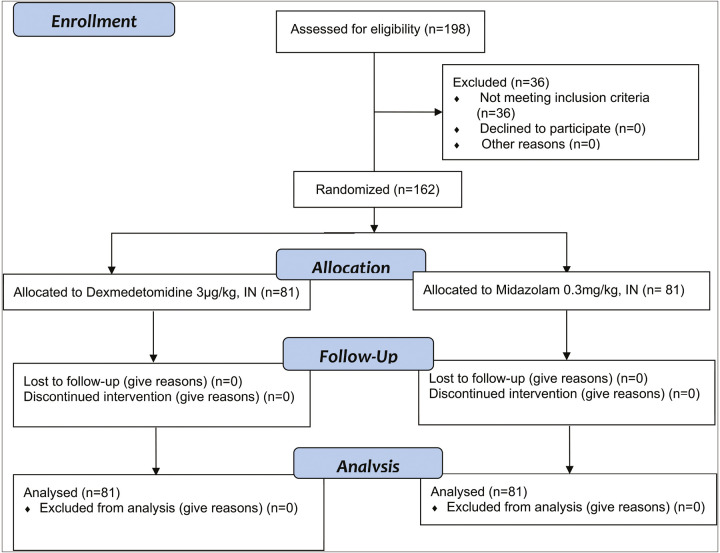
A double-blind clinical trial was conducted on 162 eligible children who underwent CT imaging. These patients were divided into two groups including MID ( = 81) with dose of 0.3 mg.kg and DEX ( = 81) with dose of 3 μg.kg, which was consumed intranasally. The mean blood pressure (MBP), respiratory rate (RR), heart rate (HR), and oxygen saturation (O2Sat) in children were recorded. Then, time of initiation, level of sedation, and duration effect of medication were measured at 0, 10, 20, and 30 min. Parents and clinician satisfaction score was asked. All data were analyzed using the Statistical Package for the Social Sciences (SPSS) software by test and chi-square test.
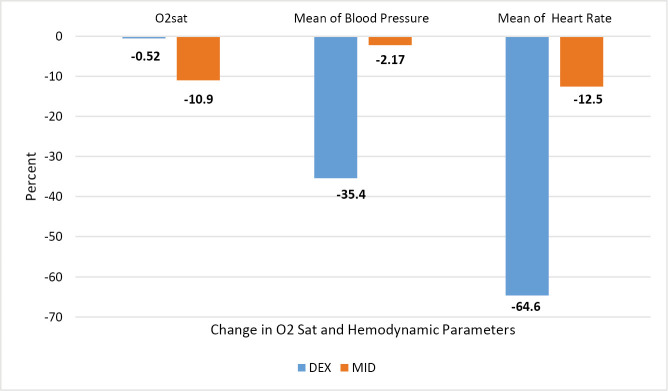
Decreasing in MBP and HR was higher in DEX group than MID group ( < 0.001), whereas decrease of O2Sat in MID group was higher than DEX group (0.009). Starting time of sedation (22.72 ± 11.64 vs. 33.38 ± 10.17, = 0.001) was lower in DEX group. Parents ( < 0.001) and physician ( < 0.001) satisfaction score was higher in DEX group than the MID group.
Using 3 μg/kg intranasal DEX for sedation of 1-6-year-old children was a suitable method to undergo noninvasive studies such as CT imaging. Intranasal DEX is superior to MID due to higher sedation satisfactory, faster starting effect of sedation, and lower side effects and complications. Nevertheless, in children with hemodynamic instability DEX is not an appropriate choice.
小儿焦虑和躁动可能会在进行准确的诊断检查时产生问题和困难,即使是无创检查,如放射影像学检查。有一些药物有助于实现这一目标。本研究旨在比较右美托咪定(DEX)和咪达唑仑(MID)经鼻给药对接受计算机断层扫描(CT)成像儿童的镇静参数的影响。
对162例符合条件且接受CT成像的儿童进行了一项双盲临床试验。这些患者被分为两组,包括咪达唑仑组(n = 81),剂量为0.3mg/kg,右美托咪定组(n = 81),剂量为3μg/kg,均经鼻给药。记录儿童的平均血压(MBP)、呼吸频率(RR)、心率(HR)和血氧饱和度(O2Sat)。然后,在0、10、20和30分钟时测量用药的起效时间、镇静水平和持续效果。询问家长和临床医生的满意度评分。所有数据均使用社会科学统计软件包(SPSS)软件进行t检验和卡方检验分析。
右美托咪定组MBP和HR的下降幅度高于咪达唑仑组(P < 0.001),而咪达唑仑组O2Sat的下降幅度高于右美托咪定组(P = 0.009)。右美托咪定组的镇静起效时间(22.72 ± 11.64 vs. 33.38 ± 10.17,P = 0.001)更低。右美托咪定组家长(P < 0.001)和医生(P < 0.001)的满意度评分高于咪达唑仑组。
采用3μg/kg经鼻右美托咪定对1 - 6岁儿童进行镇静是进行CT成像等无创检查的合适方法。经鼻右美托咪定由于镇静满意度更高、镇静起效更快、副作用和并发症更低,优于咪达唑仑。然而,对于血流动力学不稳定的儿童,右美托咪定不是合适的选择。