Popova Blagovesta, Kleinknecht Alexandra, Arendarski Patricia, Mischke Jasmin, Wang Dan, Braus Gerhard H
Department of Molecular Microbiology and Genetics and Göttingen Center for Molecular Biosciences (GZMB), Institute for Microbiology and Genetics, Universität Göttingen, Göttingen, Germany.
Center for Nanoscale Microscopy and Molecular Physiology of the Brain (CNMPB), Göttingen, Germany.
Front Mol Neurosci. 2018 Mar 27;11:94. doi: 10.3389/fnmol.2018.00094. eCollection 2018.
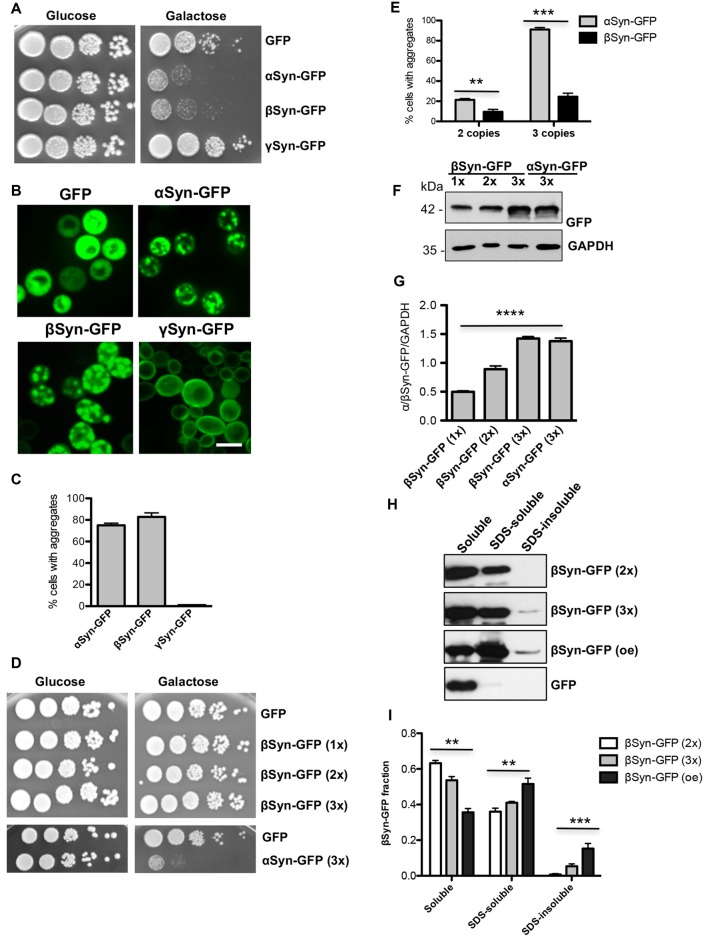
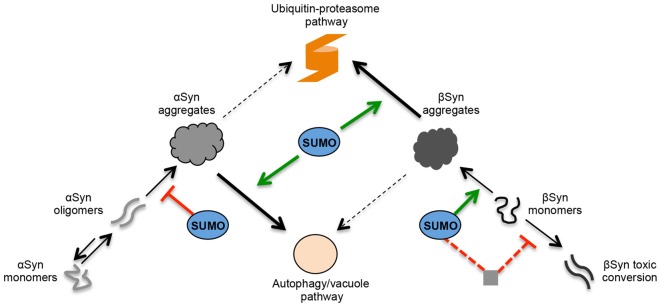
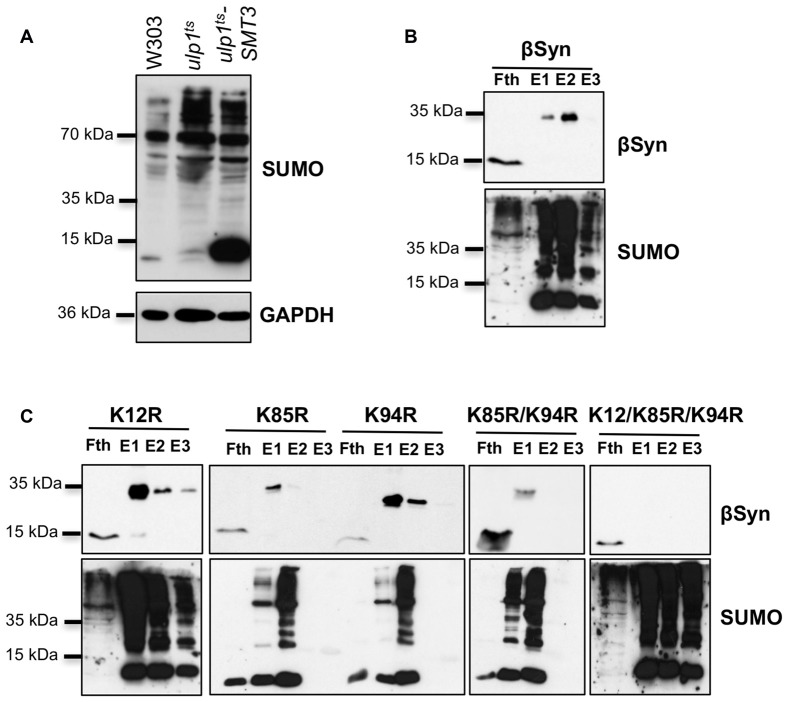
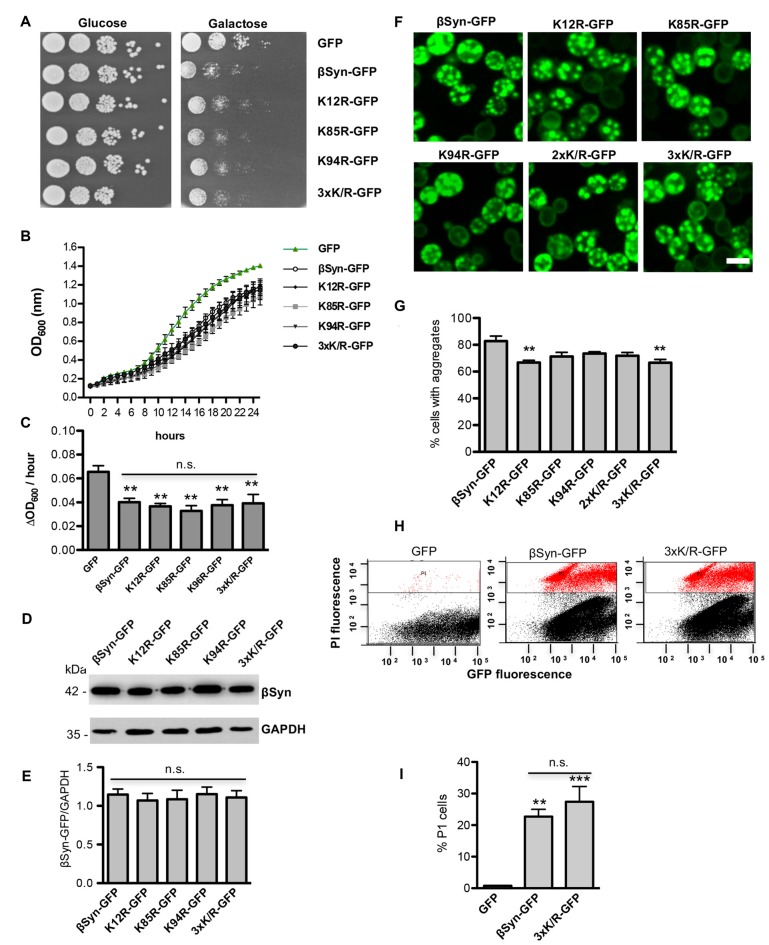
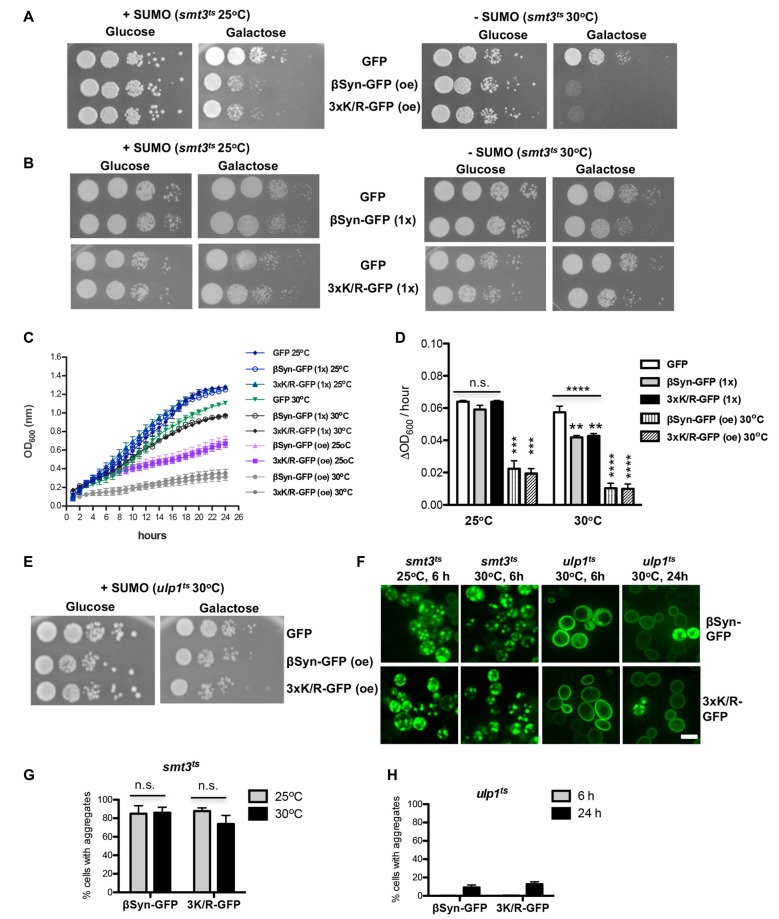
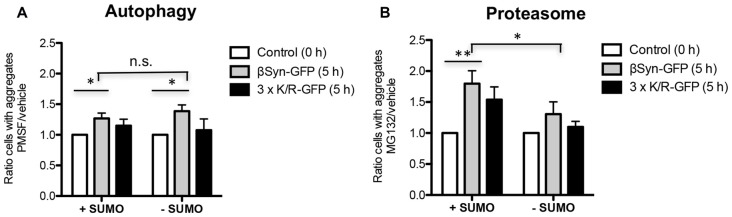
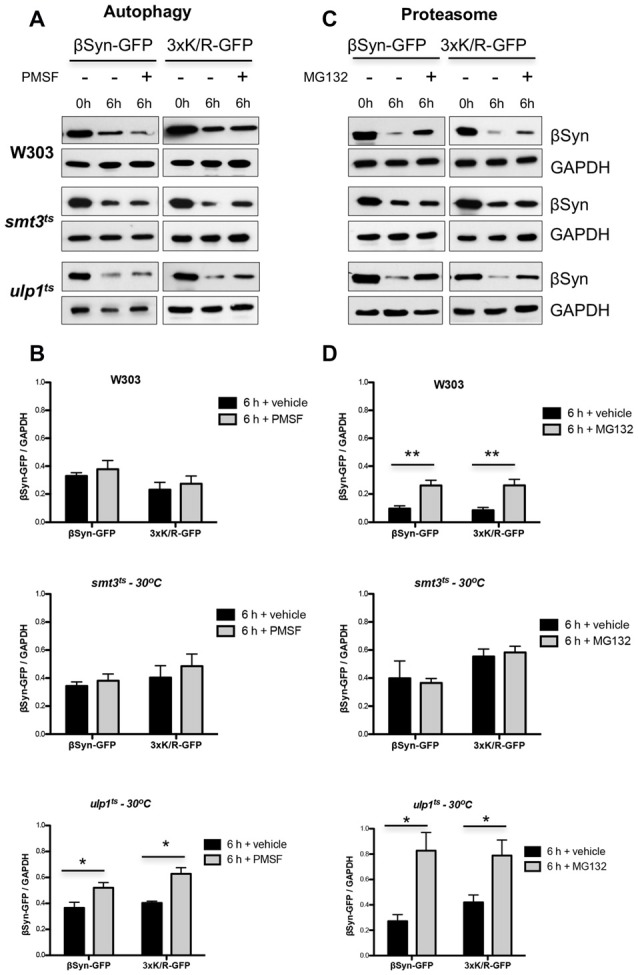
Aggregation of α-synuclein (αSyn) plays a central role in the pathogenesis of Parkinson's disease (PD). The budding yeast serves as reference cell to study the interplay between αSyn misfolding, cytotoxicity and post-translational modifications (PTMs). The synuclein family includes α, β and γ isoforms. β-synuclein (βSyn) and αSyn are found at presynaptic terminals and both proteins are presumably involved in disease pathogenesis. Similar to αSyn, expression of βSyn leads to growth deficiency and formation of intracellular aggregates in yeast. Co-expression of αSyn and βSyn exacerbates the cytotoxicity. This suggests an important role of βSyn homeostasis in PD pathology. We show here that the small ubiquitin-like modifier SUMO is an important determinant of protein stability and βSyn-induced toxicity in eukaryotic cells. Downregulation of sumoylation in a yeast strain, defective for the SUMO-encoding gene resulted in reduced yeast growth, whereas upregulation of sumoylation rescued growth of yeast cell expressing βSyn. This corroborates a protective role of the cellular sumoylation machinery against βSyn-induced toxicity. Upregulation of sumoylation significantly reduced βSyn aggregate formation. This is an indirect molecular process, which is not directly linked to βSyn sumoylation because amino acid substitutions in the lysine residues required for βSyn sumoylation decreased aggregation without changing yeast cellular toxicity. αSyn aggregates are more predominantly degraded by the autophagy/vacuole than by the 26S ubiquitin proteasome system. We demonstrate a vice versa situation for βSyn, which is mainly degraded in the 26S proteasome. Downregulation of sumoylation significantly compromised the clearance of βSyn by the 26S proteasome and increased protein stability. This effect is specific, because depletion of functional SUMO did neither affect βSyn aggregate formation nor its degradation by the autophagy/vacuolar pathway. Our data support that cellular βSyn toxicity and aggregation do not correlate in their cellular impact as for αSyn but rather represent two distinct independent molecular functions and molecular mechanisms. These insights into the relationship between βSyn-induced toxicity, aggregate formation and degradation demonstrate a significant distinction between the impact of αSyn compared to βSyn on eukaryotic cells.
α-突触核蛋白(αSyn)的聚集在帕金森病(PD)的发病机制中起核心作用。芽殖酵母作为研究αSyn错误折叠、细胞毒性和翻译后修饰(PTM)之间相互作用的参考细胞。突触核蛋白家族包括α、β和γ亚型。β-突触核蛋白(βSyn)和αSyn存在于突触前终端,这两种蛋白可能都参与疾病发病机制。与αSyn相似,βSyn的表达导致酵母生长缺陷和细胞内聚集体的形成。αSyn和βSyn共表达会加剧细胞毒性。这表明βSyn稳态在PD病理学中起重要作用。我们在此表明,小泛素样修饰物SUMO是真核细胞中蛋白质稳定性和βSyn诱导毒性的重要决定因素。在一个对SUMO编码基因有缺陷的酵母菌株中,SUMO化的下调导致酵母生长减少,而SUMO化的上调挽救了表达βSyn的酵母细胞的生长。这证实了细胞SUMO化机制对βSyn诱导毒性的保护作用。SUMO化的上调显著减少了βSyn聚集体的形成。这是一个间接分子过程,与βSyn SUMO化没有直接联系,因为βSyn SUMO化所需赖氨酸残基的氨基酸替换减少了聚集体形成,而不改变酵母细胞毒性。αSyn聚集体主要通过自噬/液泡降解而非26S泛素蛋白酶体系统降解。我们证明βSyn的情况相反,它主要在26S蛋白酶体中降解。SUMO化的下调显著损害了26S蛋白酶体对βSyn的清除并增加了蛋白质稳定性。这种作用是特异性的,因为功能性SUMO缺失既不影响βSyn聚集体形成,也不影响其通过自噬/液泡途径的降解。我们的数据支持,细胞内βSyn毒性和聚集体形成在细胞影响方面不像αSyn那样相关,而是代表两种不同的独立分子功能和分子机制。这些对βSyn诱导毒性、聚集体形成和降解之间关系的见解表明,与βSyn相比,αSyn对真核细胞影响存在显著差异。