Renna Massimiliano, Signore Angelo, Paradiso Vito M, Santamaria Pietro
Department of Agricultural and Environmental Science, University of Bari Aldo Moro, Bari, Italy.
Department of Soil, Plant and Food Science, University of Bari Aldo Moro, Bari, Italy.
Front Plant Sci. 2018 Mar 27;9:378. doi: 10.3389/fpls.2018.00378. eCollection 2018.
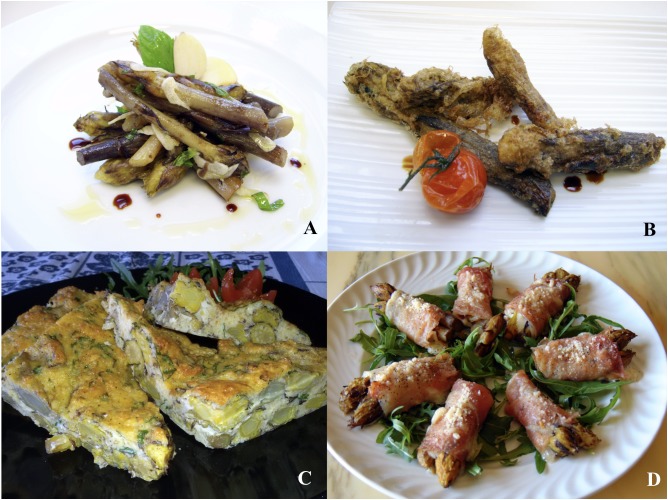
Globe artichoke ( L. subsp. [L.] Hayek), summer squash ( L.) and faba bean ( L.) are widely cultivated for their immature inflorescences, fruits and seeds, respectively. Nevertheless, in some areas of Puglia (Southern Italy), other organs of these species are traditionally used as vegetables, instead of being considered as by-products. Offshoots (so-called or ) of globe artichoke, produced during the vegetative growing cycle and removed by common cultural procedures, are used like to the cultivated cardoons ( L. var. DC). The stems, petioles, flowers and smaller leaves of summer squash are used as greens (so-called ), like other leafy vegetables such as chicory ( L.) and Swiss chard ( L.). Also the plant apex of faba bean, about 5-10 cm long, obtained from the green pruning, are used as greens (so-called ) like spinach leaves. Moreover, crenate broomrape ( Forssk.), a root parasite plant that produces devastating effects on many crops (mostly legumes), is used like asparagus ( L.) to prepare several traditional dishes. In this study ethnobotanical surveys and quality assessment of these unconventional vegetables were performed. For their content of fiber, offshoots of globe artichokes can be considered a useful food to bowel. Summer squash greens could be recommended as a vegetable to use especially in the case of hypoglycemic diets considering both content and composition of their carbohydrates. For their low content of nitrate, faba greens could be recommended as a substitute of nitrate-rich leafy vegetables. Crenate broomrape shows a high antioxidant activity and may be considered as a very nutritious agri-food product. Overall, the results of the present study indicate that offshoots of globe artichoke, summer squash greens, faba greens and crenate broomrape have good potential as novel foods, being nutritious and refined products. Their exploitation aiming to the obtainment of labeled and/or new potential ready-to-eat retail products could satisfy the demand for local functional foods.
洋蓟(L. subsp. [L.] Hayek)、西葫芦(L.)和蚕豆(L.)分别因其未成熟的花序、果实和种子而被广泛种植。然而,在普利亚大区(意大利南部)的一些地区,这些物种的其他器官传统上被用作蔬菜,而不是被视为副产品。洋蓟在营养生长周期中产生并通过常规栽培程序去除的侧枝(所谓的“spines”或“cardoon shoots”),其使用方式类似于栽培的刺菜蓟(L. var. DC)。西葫芦的茎、叶柄、花和较小的叶子被用作蔬菜(所谓的“verdure”),就像其他叶菜类蔬菜如菊苣(L.)和瑞士甜菜(L.)一样。同样,蚕豆约5 - 10厘米长的植株顶端,通过绿色修剪获得,也被用作蔬菜(所谓的“verdure”),就像菠菜叶一样。此外,锯齿菟丝子(Forssk.),一种对许多作物(主要是豆类)产生毁灭性影响的根寄生植物,被用作芦笋(L.)来制作几种传统菜肴。在本研究中,对这些非常规蔬菜进行了民族植物学调查和质量评估。就其纤维含量而言,洋蓟侧枝可被视为对肠道有益的食物。考虑到西葫芦蔬菜的碳水化合物含量和组成,在低血糖饮食的情况下,尤其可以推荐将其作为一种蔬菜食用。由于其硝酸盐含量低,蚕豆蔬菜可被推荐作为富含硝酸盐的叶菜类蔬菜的替代品。锯齿菟丝子具有很高的抗氧化活性,可被视为一种非常有营养的农业食品。总体而言,本研究结果表明,洋蓟侧枝、西葫芦蔬菜、蚕豆蔬菜和锯齿菟丝子作为新型食品具有良好的潜力,它们营养丰富且品质优良。旨在获得标签化和/或新的潜在即食零售产品的开发可以满足对当地功能性食品的需求。