Kesten Joanna May, Anderson Emma C, Lane Isabel, Hay Alastair D, Cabral Christie
The National Institute for Health Research Health Protection Research Unit in Evaluation of Interventions, School of Social and Community Medicine, University of Bristol, Bristol, UK.
The National Institute for Health Research Collaboration for Leadership in Applied Health Research and Care West (NIHR CLAHRC West) at University Hospitals Bristol NHS Foundation Trust, Bristol, UK.
BMJ Paediatr Open. 2017 Aug 11;1(1):e000036. doi: 10.1136/bmjpo-2017-000036. eCollection 2017.
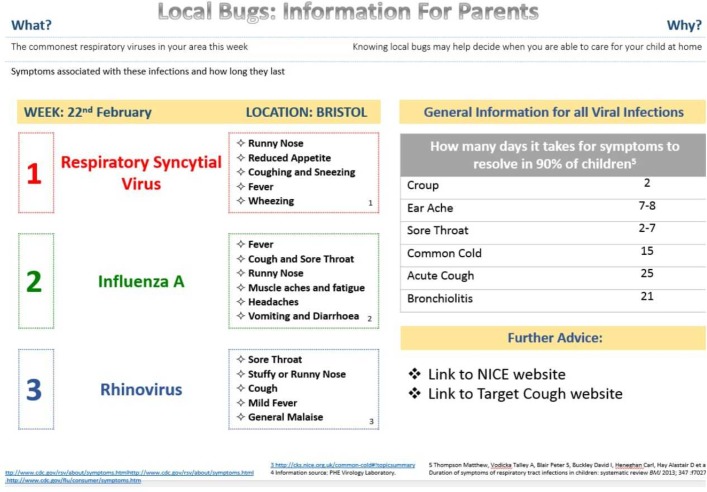
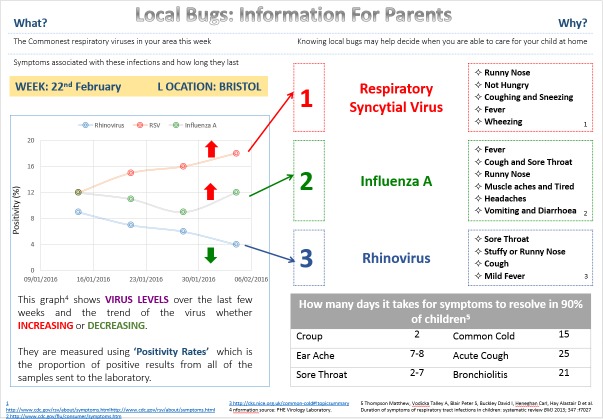
This study explored the potential value of real-time information regarding respiratory tract infections (RTIs) circulating in the community by eliciting parent views on illustrative surveillance information and its possible impact on primary care consultations.
Semistructured interviews were conducted with parents of children (>3 months-15 years). Participants were presented with example information on circulating viruses, symptoms and symptom duration and asked about its potential impact on perceptions of child illness and management practices. Interviews were analysed using the framework method.
Parents participating in a cohort study were selected purposefully using index of multiple deprivation and child age.
30 mothers of children (>3 months-15years).
Parents anticipated using the information to inform lay diagnoses particularly when child symptoms were severe and thought normal symptom duration awareness might extend the time prior to seeking medical advice, but it also may encourage consultations when symptoms exceed the given duration. The information was not expected to change consultation behaviour if parents felt their child needed a medical evaluation and they felt unable to manage the symptoms. Most parents felt that the information could provide reassurance that could reduce intention to consult, but some felt it could raise concerns, by heightening awareness of circulating viruses. Lastly, parents wanted advice about protecting children from circulating viruses and felt that general practitioners using the information to diagnose child RTIs with greater certainty was acceptable.
Diverse responses to the surveillance information were elicited, and there was some support for the intended outcomes. This study has important implications for the design of interventions to modify consulting behaviour. Future piloting to measure behaviour change in response to infection surveillance information are needed.
本研究通过征集家长对说明性监测信息及其对初级保健咨询可能影响的看法,探讨社区中呼吸道感染(RTIs)实时信息的潜在价值。
对3个月以上至15岁儿童的家长进行半结构化访谈。向参与者展示了关于流行病毒、症状和症状持续时间的示例信息,并询问其对儿童疾病认知和管理实践的潜在影响。采用框架法对访谈进行分析。
通过多重贫困指数和儿童年龄有目的地选择参与队列研究的家长。
30名3个月以上至15岁儿童的母亲。
家长们预计会利用这些信息进行初步诊断,尤其是在儿童症状严重时,并且认为了解正常症状持续时间可能会延长寻求医疗建议之前的时间,但当症状超过给定持续时间时也可能会促使他们去咨询。如果家长认为孩子需要医学评估且自己无法处理症状,预计这些信息不会改变咨询行为。大多数家长认为这些信息可以提供安心感,从而减少咨询的意愿,但也有一些家长认为这可能会引发担忧,因为会提高对流行病毒的认识。最后,家长希望得到关于保护孩子免受流行病毒感染的建议,并认为全科医生利用这些信息更准确地诊断儿童呼吸道感染是可以接受的。
对监测信息有多种不同的反应,并且对预期结果有一些支持。本研究对旨在改变咨询行为的干预措施设计具有重要意义。未来需要进行试点,以衡量对感染监测信息的行为变化。