Daw William James, Kingshott Ruth N, Elphick Heather E
Department of Respiratory Medicine, Sheffield Childen's Hospital, Sheffield, UK.
Academic Unit of Child Health, Sheffield Children's Hospital, Sheffield, UK.
BMJ Paediatr Open. 2017 Nov 16;1(1):e000173. doi: 10.1136/bmjpo-2017-000173. eCollection 2017.
To determine the inter-observer agreement of a respiratory rate (RR) count on a child when assessed by three independent observers.
The RR of 169 children (age range: 3 days to 15 years) was measured by three independent observers over a 3-month period. The first RR was taken by different healthcare professionals (HCPs) from within the hospital using their own preferred method of measurement. A further count of RR was then taken by two observers from the research team simultaneously within 30 min of the first measurement, using the WHO-recommended method of measurement.
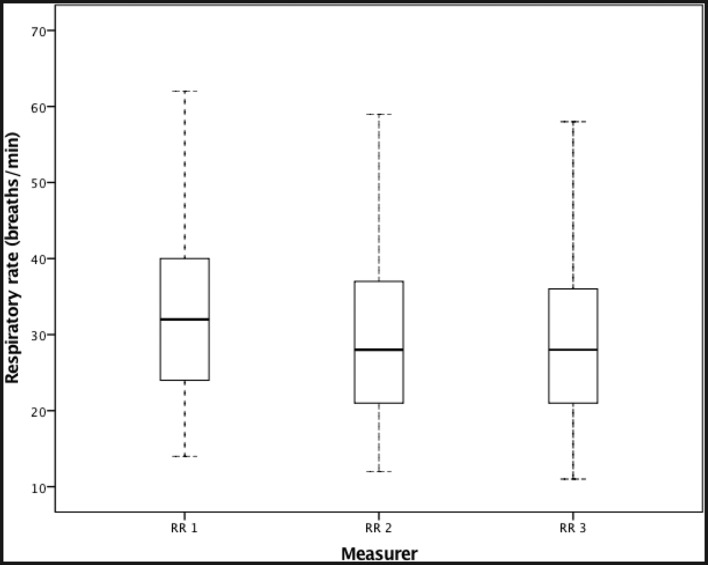
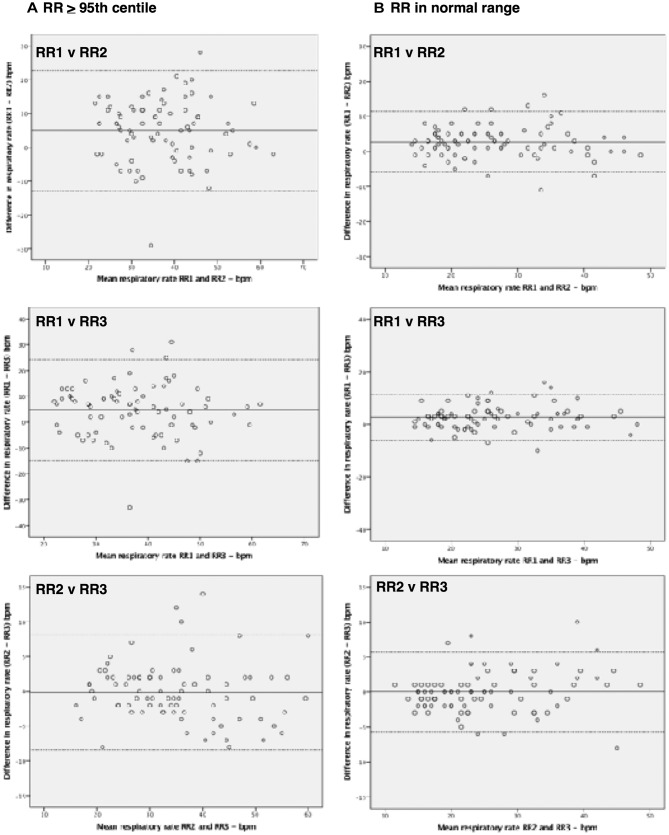
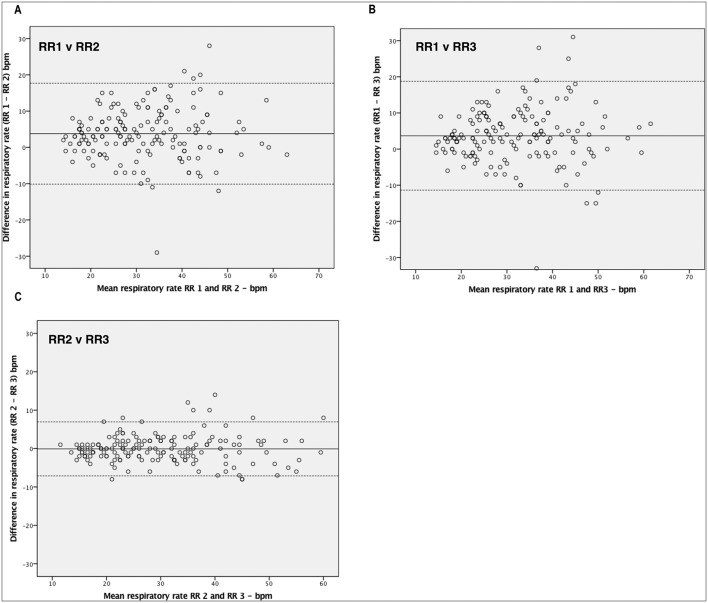
507 RR measurements were taken on 169 children. Median RR showed a 4 beats per minute (bpm) difference between the HCP (median RR 32 bpm) and the researchers (median RR 28 bpm). The 95% limits of agreement between the first measurement and second and third measurements were -10.2 to 17.7 bpm and -11.4 to 18.7 bpm, respectively. For simultaneous measurements, the 95% limits of agreement were -7.1 to 7.0 bpm. 81 children had a RR > 95th centile for their age and an even poorer level of agreement was seen in these children than in those whose RR was within normal range. In only 27 of these 81 children (33%) did all three observers agree on the presence of a raised RR.
Inter-observer agreement for the measurement of RR in children is poor. The effect that this variation has on the clinical assessment and subsequent management of a child may be significant. These findings highlight the need for a robust review of our current measurement methods and interpretation of an important vital sign.
确定三名独立观察者对儿童呼吸频率(RR)计数的观察者间一致性。
在3个月期间,由三名独立观察者对169名儿童(年龄范围:3天至15岁)的RR进行测量。首次RR由医院内不同的医护人员(HCP)使用他们自己偏爱的测量方法进行测量。然后,研究团队的两名观察者在首次测量的30分钟内,使用世界卫生组织推荐的测量方法同时再次测量RR。
对169名儿童进行了507次RR测量。HCP测量的RR中位数(中位数RR为32次/分钟)与研究人员测量的RR中位数(中位数RR为28次/分钟)之间相差4次/分钟。首次测量与第二次和第三次测量之间的95%一致性界限分别为-10.2至17.7次/分钟和-11.4至18.7次/分钟。对于同时测量,95%一致性界限为-7.1至7.0次/分钟。81名儿童的RR高于其年龄的第95百分位数,与RR在正常范围内的儿童相比,这些儿童的一致性水平更差。在这81名儿童中,只有27名(33%)的所有三名观察者都一致认为RR升高。
儿童RR测量的观察者间一致性较差。这种差异对儿童临床评估及后续管理的影响可能很大。这些发现凸显了对我们当前测量方法及一项重要生命体征解读进行严格审查的必要性。