Department of Psychology, Durham University, Durham DH1 3LE, United Kingdom.
School of Psychology, Cardiff University, Cardiff CF10 3AT, United Kingdom.
Hippocampus. 2018 Jul;28(7):484-496. doi: 10.1002/hipo.22847. Epub 2018 Apr 23.
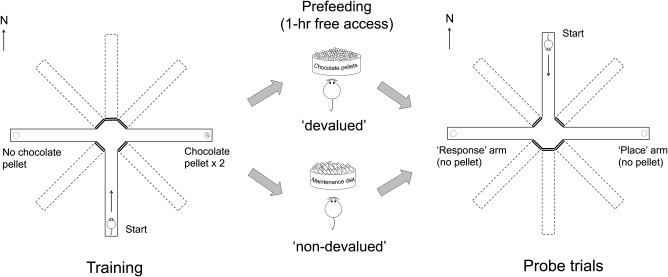
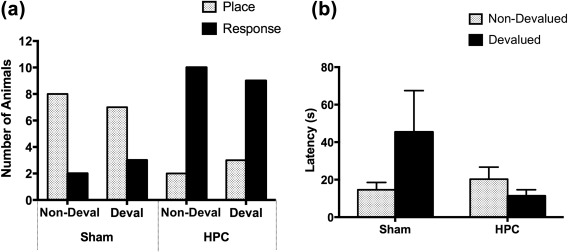
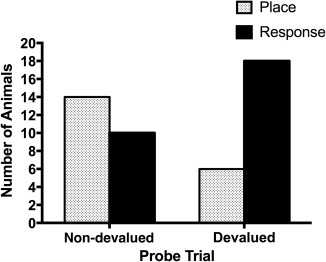
Previous studies have suggested that spatial navigation can be achieved with at least two distinct learning processes, involving either cognitive map-like representations of the local environment, referred to as the "place strategy", or simple stimulus-response (S-R) associations, the "response strategy". A similar distinction between cognitive/behavioral processes has been made in the context of non-spatial, instrumental conditioning, with the definition of two processes concerning the sensitivity of a given behavior to the expected value of its outcome as well as to the response-outcome contingency ("goal-directed action" and "S-R habit"). Here we investigated whether these two versions of dichotomist definitions of learned behavior, one spatial and the other non-spatial, correspond to each other in a formal way. Specifically, we assessed the goal-directed nature of two navigational strategies, using a combination of an outcome devaluation procedure and a spatial probe trial frequently used to dissociate the two navigational strategies. In Experiment 1, rats trained in a dual-solution T-maze task were subjected to an extinction probe trial from the opposite start arm, with or without prefeeding-induced devaluation of the expected outcome. We found that a non-significant preference for the place strategy in the non-devalued condition was completely reversed after devaluation, such that significantly more animals displayed the use of the response strategy. The result suggests that the place strategy is sensitive to the expected value of the outcome, while the response strategy is not. In Experiment 2, rats with hippocampal lesions showed significant reliance on the response strategy, regardless of whether the expected outcome was devalued or not. The result thus offers further evidence that the response strategy conforms to the definition of an outcome-insensitive, habitual form of instrumental behavior. These results together attest a formal correspondence between two types of dual-process accounts of animal learning and behavior.
先前的研究表明,空间导航至少可以通过两种不同的学习过程来实现,一种涉及到对局部环境的认知地图样表示,称为“位置策略”,另一种涉及到简单的刺激-反应(S-R)关联,称为“反应策略”。在非空间的工具性条件反射的背景下,也对认知/行为过程进行了类似的区分,定义了两种过程,一种涉及到给定行为对其结果的预期值的敏感性,另一种涉及到反应-结果的关联(“目标导向行动”和“S-R 习惯”)。在这里,我们研究了这两种学习行为的二分定义版本,一种是空间的,另一种是非空间的,是否以一种形式对应。具体来说,我们使用一种结果贬值程序和一种经常用于区分两种导航策略的空间探针试验,来评估两种导航策略的目标导向性质。在实验 1 中,在双解 T 迷宫任务中接受训练的大鼠接受了来自相反起始臂的消退探针试验,有或没有预喂食诱导的预期结果贬值。我们发现,在未贬值的情况下,对位置策略的非显著偏好完全被贬值所逆转,以至于更多的动物明显表现出使用反应策略。结果表明,位置策略对结果的预期值敏感,而反应策略则不敏感。在实验 2 中,海马损伤的大鼠表现出对反应策略的显著依赖,无论预期的结果是否贬值。结果因此提供了进一步的证据,表明反应策略符合对结果不敏感的、习惯形式的工具性行为的定义。这些结果共同证明了动物学习和行为的两种双过程解释类型之间的一种形式对应。