Wigal Sharon B, Childress Ann, Berry Sally A, Belden Heidi W, Chappell Phillip, Wajsbrot Dalia B, Nagraj Praneeta, Abbas Richat, Palumbo Donna
1 University of California Irvine , Irvine, California.
2 Center for Psychiatry and Behavioral Medicine, Inc. , Las Vegas, Nevada.
J Child Adolesc Psychopharmacol. 2018 Jun;28(5):314-321. doi: 10.1089/cap.2017.0138. Epub 2018 Mar 13.
To examine methylphenidate extended-release chewable tablets (MPH ERCT) dose patterns, attention-deficit/hyperactivity disorder (ADHD) symptom scores, and safety during the 6-week, open-label (OL) dose-optimization period of a phase 3, laboratory classroom study.
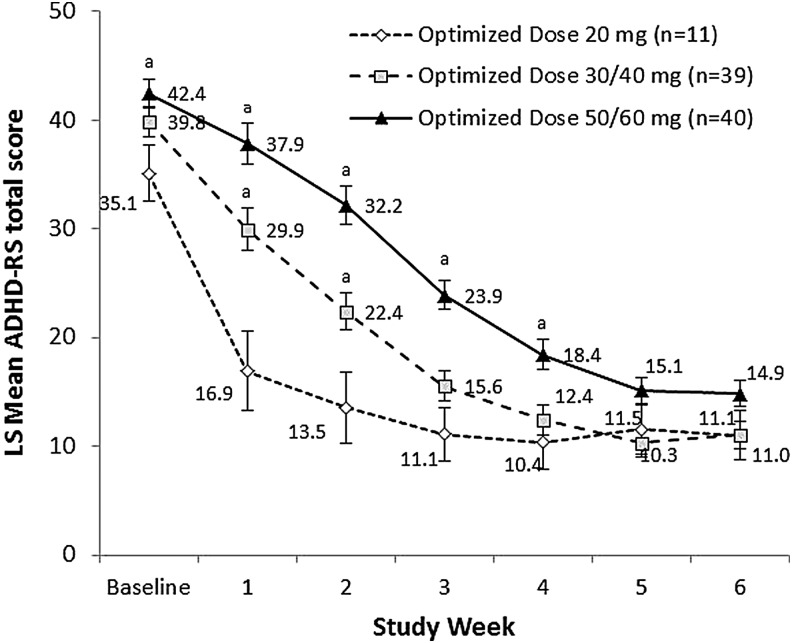
Boys and girls (6-12 years) diagnosed with ADHD were enrolled. MPH ERCT was initiated at 20 mg/day; participants were titrated in 10-20 mg/day increments weekly based on efficacy and tolerability (maximum dose, 60 mg/day). Dose-optimization period efficacy assessments included the ADHD Rating Scale (ADHD-RS-IV), analyzed by week in a post hoc analysis using a mixed-effects model for repeated measures with final optimized dose (20, 30/40, or 50/60 mg), visit, final optimized dose and visit interaction, and baseline score as terms. Adverse events (AEs) and concomitant medications were collected throughout the study.
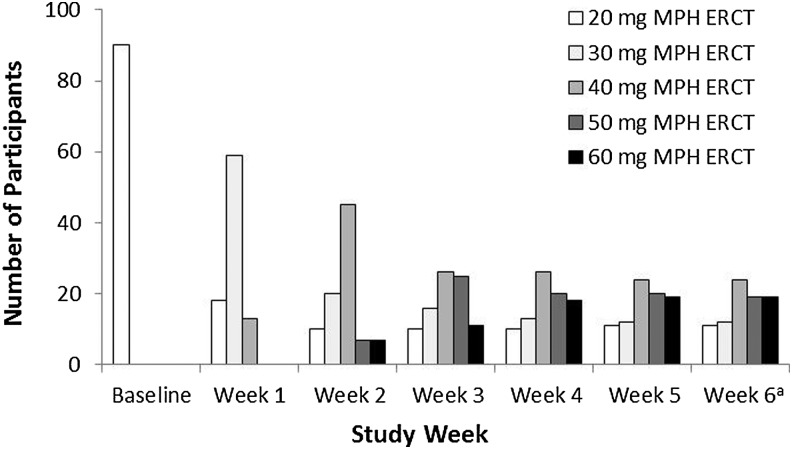
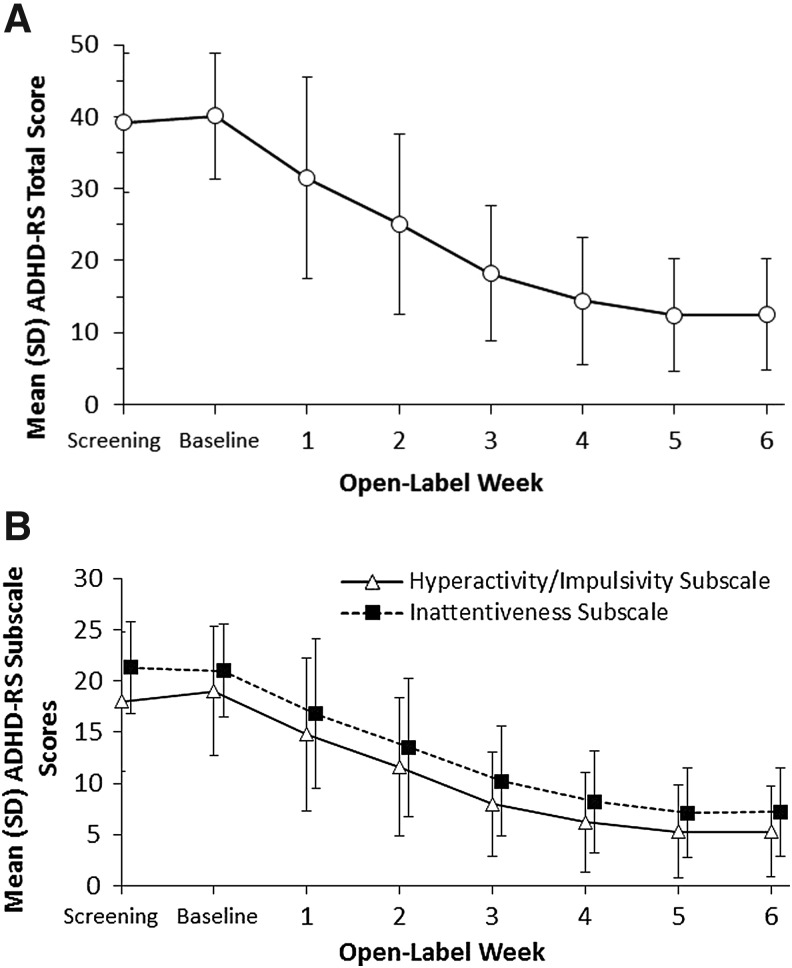
Mean MPH ERCT daily dose increased weekly from 29.4 mg/day after the first dose adjustment at week 1 (n = 90) to 42.8 mg/day after the final adjustment at week 5 (n = 86). Final optimized MPH ERCT dose ranged from 20 to 60 mg/day. Mean final optimized MPH ERCT dose ranged from 40.0 mg/day in 6-8 year-old participants to 44.8 mg/day for 11-12 year-old participants. There was a progressive decrease in mean (standard deviation) ADHD-RS-IV total score from 40.1 (8.72) at baseline to 12.4 (7.88) at OL week 5, with similar improvement patterns for hyperactivity/impulsivity and inattentiveness subscale scores. Participants optimized to MPH ERCT 50/60 mg/day had a significantly higher mean (standard error) ADHD-RS-IV score at baseline compared with participants optimized to MPH ERCT 20 mg/day (42.4 [1.34] vs. 35.1 [2.55]; p = 0.013). Treatment-emergent AEs were reported by 65/90 (72.2%) participants in the dose-optimization period.
Dose-optimization period results describing relationships between change in ADHD symptom scores and final optimized MPH ERCT dose will be valuable for clinicians optimizing MPH ERCT dose.
在一项3期实验室课堂研究的为期6周的开放标签(OL)剂量优化期内,研究哌甲酯缓释咀嚼片(MPH ERCT)的剂量模式、注意力缺陷多动障碍(ADHD)症状评分及安全性。
纳入诊断为ADHD的6至12岁男孩和女孩。MPH ERCT起始剂量为20mg/天;根据疗效和耐受性,参与者每周以10至20mg/天的增量进行滴定(最大剂量为60mg/天)。剂量优化期的疗效评估包括ADHD评定量表(ADHD-RS-IV),在事后分析中按周进行分析,使用重复测量的混合效应模型,以最终优化剂量(20、30/40或50/60mg)、访视、最终优化剂量与访视的交互作用以及基线评分作为变量。在整个研究过程中收集不良事件(AE)和伴随用药情况。
MPH ERCT的平均每日剂量从第1周首次剂量调整后的29.4mg/天(n = 90)每周增加,至第5周最终调整后的42.8mg/天(n = 86)。最终优化的MPH ERCT剂量范围为20至60mg/天。最终优化的MPH ERCT平均剂量在6至8岁参与者中为40.0mg/天,在11至12岁参与者中为44.8mg/天。ADHD-RS-IV总分的平均值(标准差)从基线时的40.1(8.72)逐渐降至OL第5周时的12.4(7.88),多动/冲动和注意力不集中子量表评分的改善模式相似。与优化至MPH ERCT 20mg/天的参与者相比,优化至MPH ERCT 50/60mg/天的参与者在基线时的ADHD-RS-IV平均评分显著更高(42.4 [1.34]对35.1 [2.55];p = 0.013)。在剂量优化期,65/90(72.2%)的参与者报告了治疗中出现的AE。
描述ADHD症状评分变化与最终优化的MPH ERCT剂量之间关系的剂量优化期结果,对临床医生优化MPH ERCT剂量具有重要价值。