Yan Lina, Gu Yun, Luan Ting, Miao Miao, Jiang Lisha, Liu Yu, Li Ping, Zeng Xin
The Affiliated Obstetrics and Gynecology Hospital of Nanjing Medical University, Nanjing Maternity and Child Health Care Hospital, Nanjing Department of Obstetrics and Gynecology, The Second Affiliated Hospital of Medical University of Anhui, Hefei, China.
Medicine (Baltimore). 2018 Apr;97(15):e0360. doi: 10.1097/MD.0000000000010360.
Female reproductive tumors are common with high morbidity and mortality worldwide; however, the association between gynecological tumors and serum vitamin D is controversial. The aim of this meta-analysis was to evaluate the relationship between insufficiency of serum vitamin D and the occurrence of benign and malignant gynecological tumors.
Studies from inception to June 2017 were searched in the electronic databases: National Library of Medicine (PubMed), Web of Science (Clerivate), and Cochrane Database of Systematic Reviews (Cochrane Library, CDSR) by 2 investigators independently. Odds ratios (ORs) with 95% confidence intervals (CIs) were calculated using a random-effects model. STATA 12.0 Software and Trial Sequential Analysis (TSA) software were applied for data analyses.
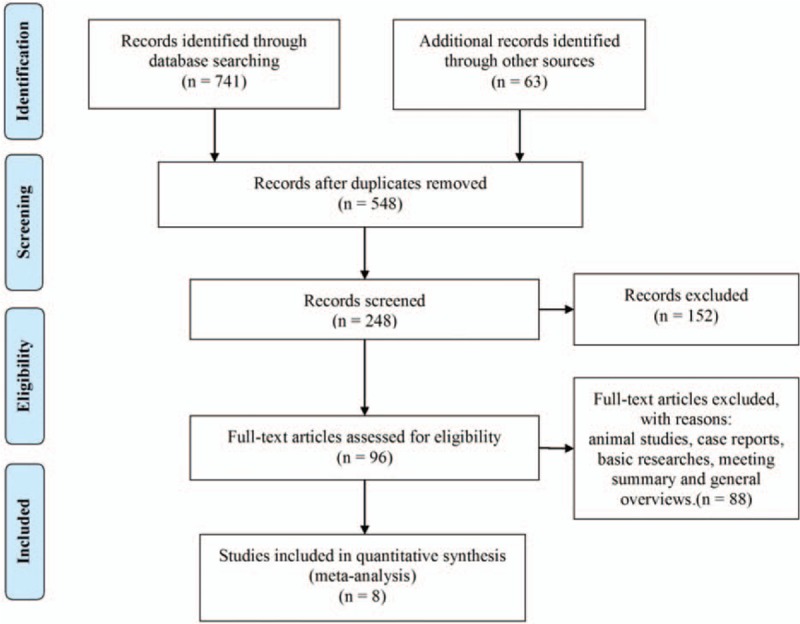
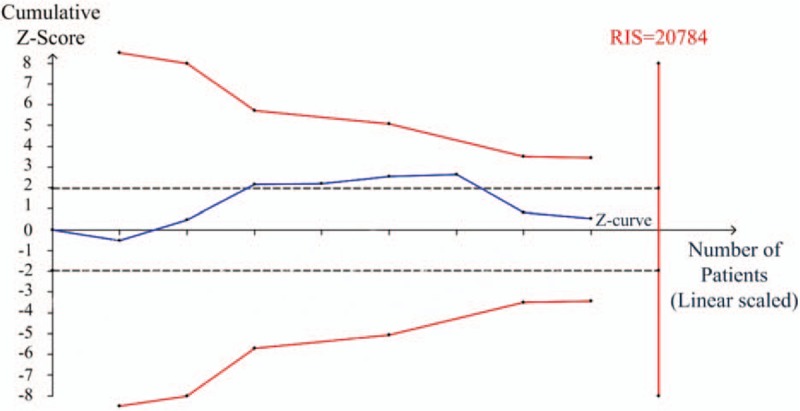
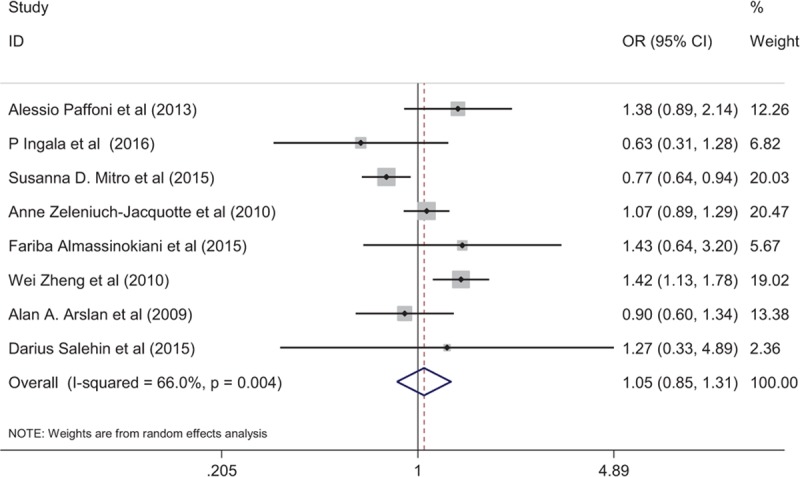
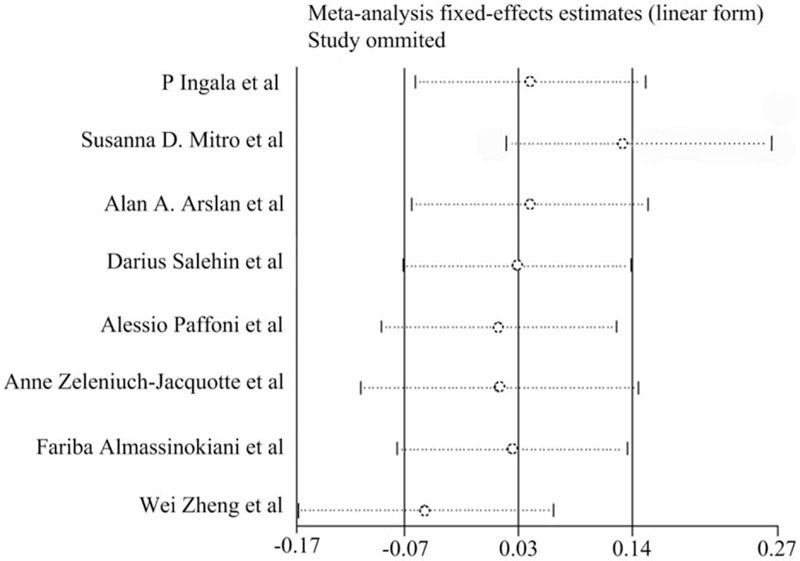
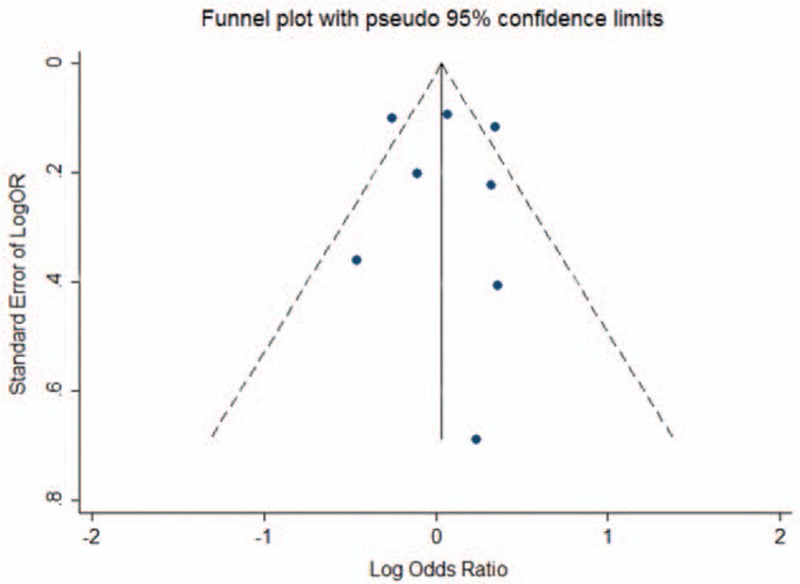
Overall, 8 studies (including 2391 patients and 5798 patients with and without female reproductive tumors, respectively) were eligible for the present meta-analysis. In the subsequent meta-analysis, the occurrence of vitamin D deficiency in the case and control groups were 52.36% and 48.70%, respectively; women with female reproductive benign and malignant tumors were 55.57% and 50.59%, respectively. Although, no conclusive association was found between vitamin D deficiency and female reproductive tumors (OR, 1.05; 95% CI, 0.85-1.31); vitamin D deficiency may be a risk factor of malignant female reproductive neoplasm, as shown by the pooled OR (95% CI):1.17 (1.02-1.33). Furthermore, based on the OR values, association of vitamin D insufficiency with disease type, study location, number of patients, and methods for detecting CLA was observed. Similar results in the sensitivity analysis were observed. TSA showed that the cumulative Z-curve crossed the traditional boundary line, rather than crossing the trial sequential monitoring boundary. However, the cumulative information failed to reach the required information size.
Currently, vitamin D deficiency appears to be a common issue in females, and there may be an urgent need to improve the level of vitamin D. Furthermore, vitamin D deficiency may be a non-negligible risk factor of malignant female reproductive neoplasm. Undoubtedly, more trials are required in the future according to TSA.
女性生殖系统肿瘤在全球范围内发病率和死亡率较高,是常见疾病;然而,妇科肿瘤与血清维生素D之间的关联仍存在争议。本荟萃分析旨在评估血清维生素D不足与良恶性妇科肿瘤发生之间的关系。
两名研究者独立在电子数据库中检索从建库至2017年6月的研究,这些数据库包括:美国国立医学图书馆(PubMed)、科学网(科睿唯安)以及考克兰系统评价数据库(考克兰图书馆,CDSR)。采用随机效应模型计算比值比(OR)及95%置信区间(CI)。运用STATA 12.0软件和试验序贯分析(TSA)软件进行数据分析。
总体而言,8项研究(分别包括2391例患有和5798例未患有女性生殖系统肿瘤的患者)符合本荟萃分析的纳入标准。在随后的荟萃分析中,病例组和对照组维生素D缺乏的发生率分别为52.36%和48.70%;患有女性生殖系统良性和恶性肿瘤的女性中维生素D缺乏的发生率分别为55.57%和50.59%。虽然未发现维生素D缺乏与女性生殖系统肿瘤之间存在确凿关联(OR = 1.05;95% CI:0.85 - 1.31);但汇总后的OR(95% CI)显示,维生素D缺乏可能是女性生殖系统恶性肿瘤的一个危险因素:1.17(1.02 - 1.33)。此外,基于OR值,观察到维生素D不足与疾病类型、研究地点、患者数量以及检测CLA的方法之间存在关联。敏感性分析中观察到类似结果。TSA显示累积Z曲线越过了传统边界线,但未越过试验序贯监测边界。然而,累积信息量未达到所需信息量。
目前,维生素D缺乏在女性中似乎是一个常见问题,可能迫切需要提高维生素D水平。此外,维生素D缺乏可能是女性生殖系统恶性肿瘤一个不可忽视的危险因素。无疑,未来根据TSA需要进行更多试验。