Veettil Sajesh K, Ching Siew Mooi, Lim Kean Ghee, Saokaew Surasak, Phisalprapa Pochamana, Chaiyakunapruk Nathorn
School of Pharmacy/School of Postgraduate Studies, International Medical University, Kuala Lumpur Department of Family Medicine, Faculty of Medicine and Health Sciences, Universiti Putra Malaysia, Serdang, Malaysia Malaysian Research Institute on Ageing, Universiti Putra Malaysia, Serdang, Malaysia Clinical School, Department of Surgery, International Medical University, Seremban, Negeri Sembilan, Malaysia Center of Health Outcomes Research and Therapeutic Safety (Cohorts), School of Pharmaceutical Sciences, University of Phayao, Thailand School of Pharmacy, Monash University Malaysia, Bandar Sunway, Selangor, Malaysia Center of Pharmaceutical Outcomes Research, Department of Pharmacy Practice, Faculty of Pharmaceutical Sciences, Naresuan University, Phitsanulok Unit of Excellence on Herbal Medicine, School of Pharmaceutical Sciences, University of Phayao Division of Ambulatory Medicine, Department of Medicine, Faculty of Medicine Siriraj Hospital, Mahidol University, Bangkok, Thailand School of Pharmacy, University of Wisconsin, Madison, USA Asian Centre for Evidence Synthesis in Population, Implementation and Clinical Outcomes (PICO), Health and Well-being Cluster, Global Asia in the 21st Century (GA21) Platform, Monash University Malaysia, Bandar Sunway, Selangor, Malaysia.
Medicine (Baltimore). 2017 Aug;96(32):e7661. doi: 10.1097/MD.0000000000007661.
Protective effects of calcium supplementation against colorectal adenomas have been documented in systematic reviews; however, the results have not been conclusive. Our objective was to update and systematically evaluate the evidence for calcium supplementation taking into consideration the risks of systematic and random error and to GRADE the evidence.
The study comprised a systematic review with meta-analysis and trial sequential analysis (TSA) of randomized controlled trials (RCTs). We searched for RCTs published up until September 2016. Retrieved trials were evaluated using risk of bias. Primary outcome measures were the incidences of any recurrent adenomas and of advanced adenomas. Meta-analytic estimates were calculated with the random-effects model and random errors were evaluated with trial sequential analyses (TSAs).
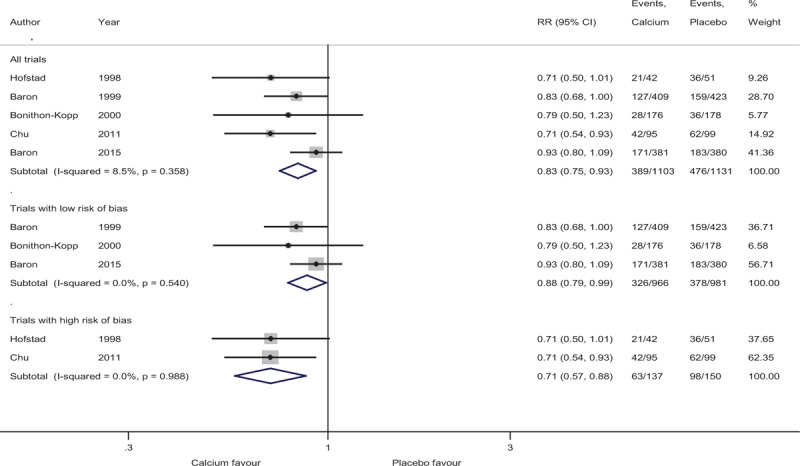
Five randomized trials (2234 patients with a history of adenomas) were included. Two of the 5 trials showed either unclear or high risks of bias in most criteria. Meta-analysis of good quality RCTs suggest a moderate protective effect of calcium supplementation on recurrence of adenomas (relative risk [RR], 0.88 [95% CI 0.79-0.99]); however, its effects on advanced adenomas did not show statistical significance (RR, 1.02 [95% CI 0.67-1.55]). Subgroup analyses demonstrated a greater protective effect on recurrence of adenomas with elemental calcium dose ≥1600 mg/day (RR, 0.74 [95% CI 0.56-0.97]) compared to ≤1200 mg/day (RR, 0.84 [95% CI 0.73-0.97]). No major serious adverse events were associated with the use of calcium, but there was an increase in the incidence of hypercalcemia (P = .0095). TSA indicated a lack of firm evidence for a beneficial effect. Concerns with directness and imprecision rated down the quality of the evidence to "low."
The available good quality RCTs suggests a possible beneficial effect of calcium supplementation on the recurrence of adenomas; however, TSA indicated that the accumulated evidence is still inconclusive. Using GRADE-methodology, we conclude that the quality of evidence is low. Large well-designed randomized trials with low risk of bias are needed.
系统评价已证实补钙对结直肠腺瘤具有保护作用;然而,结果尚无定论。我们的目的是更新并系统评估补钙证据,同时考虑系统误差和随机误差风险,并对证据进行分级。
本研究包括对随机对照试验(RCT)进行系统评价、荟萃分析和试验序贯分析(TSA)。我们检索了截至2016年9月发表的RCT。使用偏倚风险评估检索到的试验。主要结局指标为任何复发性腺瘤和高级别腺瘤的发生率。采用随机效应模型计算荟萃分析估计值,并通过试验序贯分析(TSA)评估随机误差。
纳入了5项随机试验(2234例有腺瘤病史的患者)。5项试验中的2项在大多数标准中显示出不明确或高偏倚风险。高质量RCT的荟萃分析表明,补钙对腺瘤复发有中度保护作用(相对风险[RR],0.88[95%CI 0.79 - 0.99]);然而,其对高级别腺瘤的影响未显示统计学意义(RR,1.02[95%CI 0.67 - 1.55])。亚组分析表明,与元素钙剂量≤1200mg/天(RR,0.84[95%CI 0.73 - 0.97])相比,元素钙剂量≥1600mg/天对腺瘤复发的保护作用更大(RR,0.74[95%CI 0.56 - 0.97])。使用钙未发现重大严重不良事件,但高钙血症发生率有所增加(P = 0.0095)。TSA表明缺乏有益效果的确凿证据。对证据的直接性和不精确性的担忧将证据质量评定为“低”。
现有的高质量RCT表明补钙对腺瘤复发可能有有益作用;然而,TSA表明积累的证据仍无定论。使用GRADE方法,我们得出证据质量低的结论。需要进行大量设计良好、偏倚风险低的随机试验。