Aslanidou Dimitra, Karapanagiotis Ioannis, Lampakis Dimitrios
Department of Management and Conservation of Ecclesiastical Cultural Heritage Objects, University Ecclesiastical Academy of Thessaloniki, 54250 Thessaloniki, Greece.
Materials (Basel). 2018 Apr 10;11(4):585. doi: 10.3390/ma11040585.
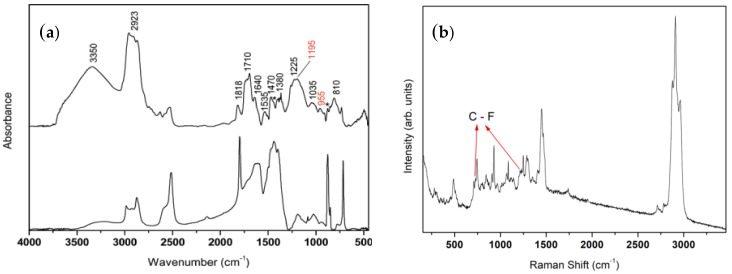
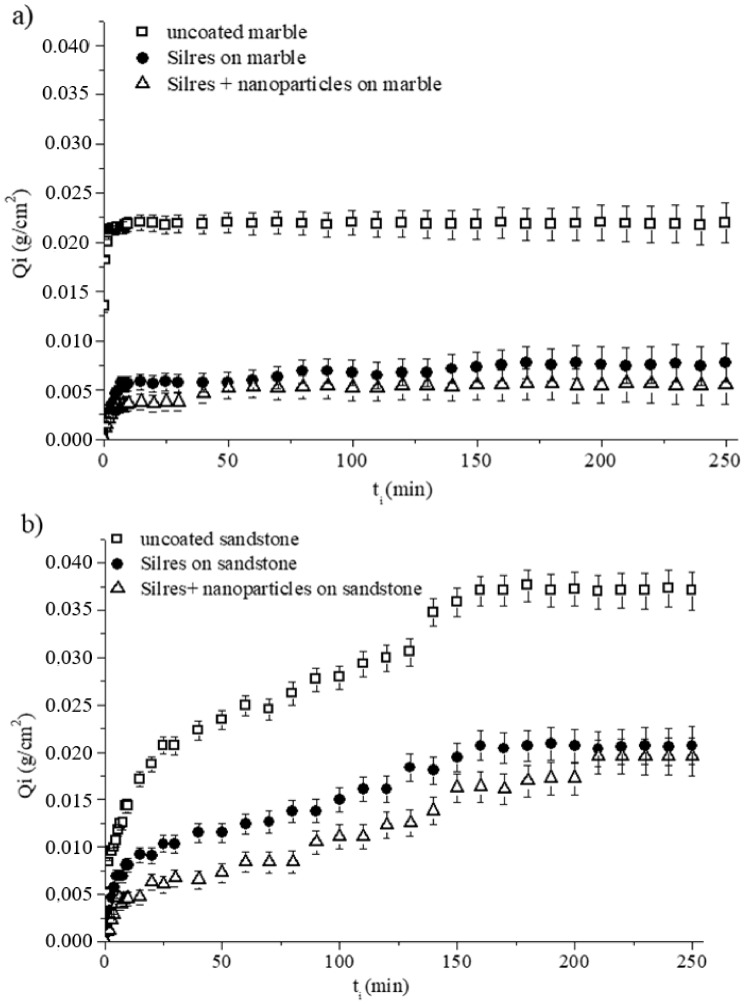
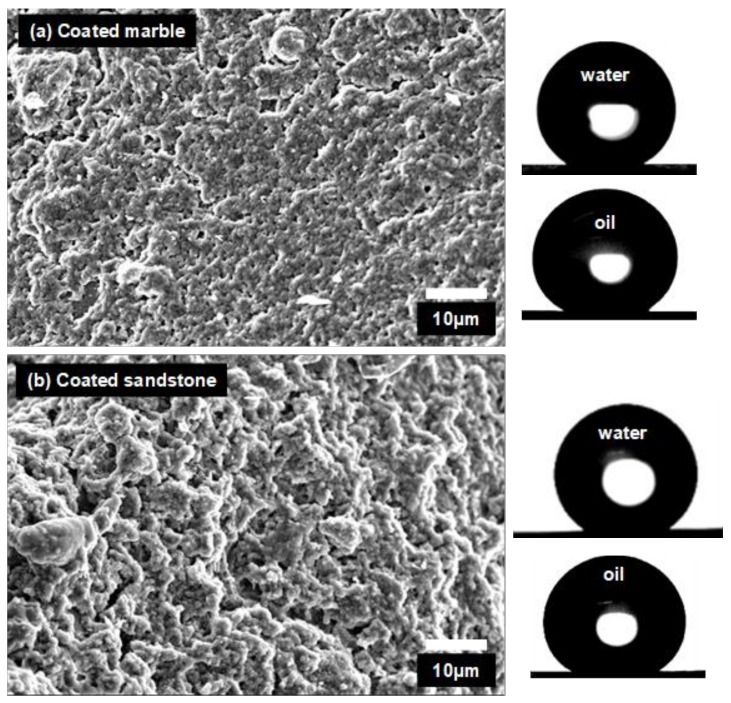
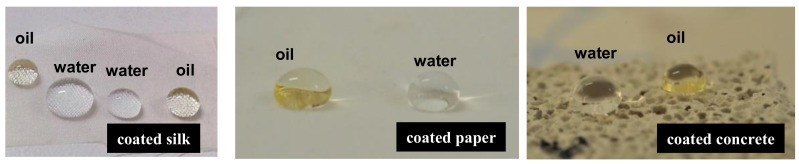
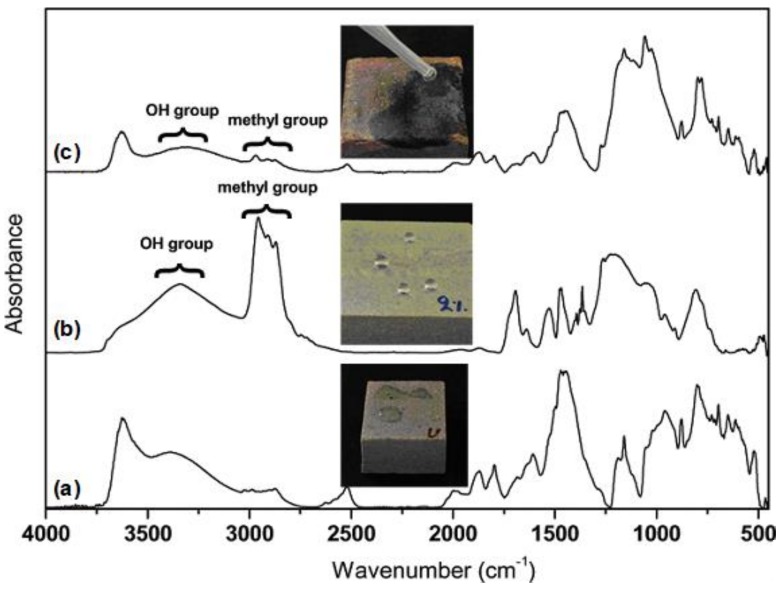
Silica nanoparticles were dispersed in an aqueous emulsion of alkoxy silanes and organic fluoropolymer. The dispersion was sprayed onto white marble and sandstone. The deposited composite coatings exhibited (i) superhydrophobicity and superoleophobicity, as evidenced by the high (>150°) static contact angles of water and oil drops as well as (ii) water and oil repellency according to the low (<7°) corresponding tilt contact angles. Apart from marble and sandstone, the coatings with extreme wetting properties were deposited onto concrete, silk, and paper, thus demonstrating the versatility of the method. The siloxane/fluoropolymer product was characterized using Fourier Transform Infrared Spectroscopy (FT-IR), Raman spectroscopy and Scanning Electron Microscopy equipped with an Energy Dispersive X-ray Spectrometer (SEM-EDX). Moreover, SEM and FT-IR were used to reveal the surface structures of the composite coatings and their transition from superhydrophobicity to superhydrophilicity which occurred after severe thermal treatment. The composite coatings slightly reduced the breathability of marble and sandstone and had practically no optical effect on the colour of the two stones. Moreover, the coatings offered good protection against water penetration by capillarity.
二氧化硅纳米颗粒分散于烷氧基硅烷和有机含氟聚合物的水乳液中。将该分散液喷涂到白色大理石和砂岩上。沉积的复合涂层表现出:(i)超疏水性和超疏油性,水和油滴的高静态接触角(>150°)证明了这一点;以及(ii)根据相应的低倾斜接触角(<7°)表现出拒水和拒油性能。除了大理石和砂岩外,具有极端润湿性的涂层还沉积到了混凝土、丝绸和纸张上,从而证明了该方法的通用性。使用傅里叶变换红外光谱(FT-IR)、拉曼光谱和配备能量色散X射线光谱仪的扫描电子显微镜(SEM-EDX)对硅氧烷/含氟聚合物产品进行了表征。此外,利用扫描电子显微镜和傅里叶变换红外光谱揭示了复合涂层的表面结构以及在经过严重热处理后从超疏水性到超亲水性的转变。复合涂层略微降低了大理石和砂岩的透气性,并且对这两种石材的颜色几乎没有光学影响。此外,涂层对毛细作用导致的水渗透提供了良好的防护。