Department of Psychiatry and Psychotherapy, University of Leipzig, Semmelweisstrasse 10, 04103, Leipzig, Germany.
Depression Research Centre, German Depression Foundation, Leipzig, Germany.
BMC Neurosci. 2018 Apr 11;19(1):18. doi: 10.1186/s12868-018-0419-y.
Autonomic nervous system (ANS) activity has been shown to vary with the state of brain arousal. In a previous study, this association of ANS activity with distinct states of brain arousal was demonstrated using 15-min EEG data, but without directly controlling for possible time-on-task effects. In the current study we examine ANS-activity in fine-graded EEG-vigilance stages (indicating states of brain arousal) during two conditions of a 2-h oddball task while controlling for time-on-task. In addition, we analyze the effect of time-on-task on ANS-activity while holding the level of brain arousal constant.
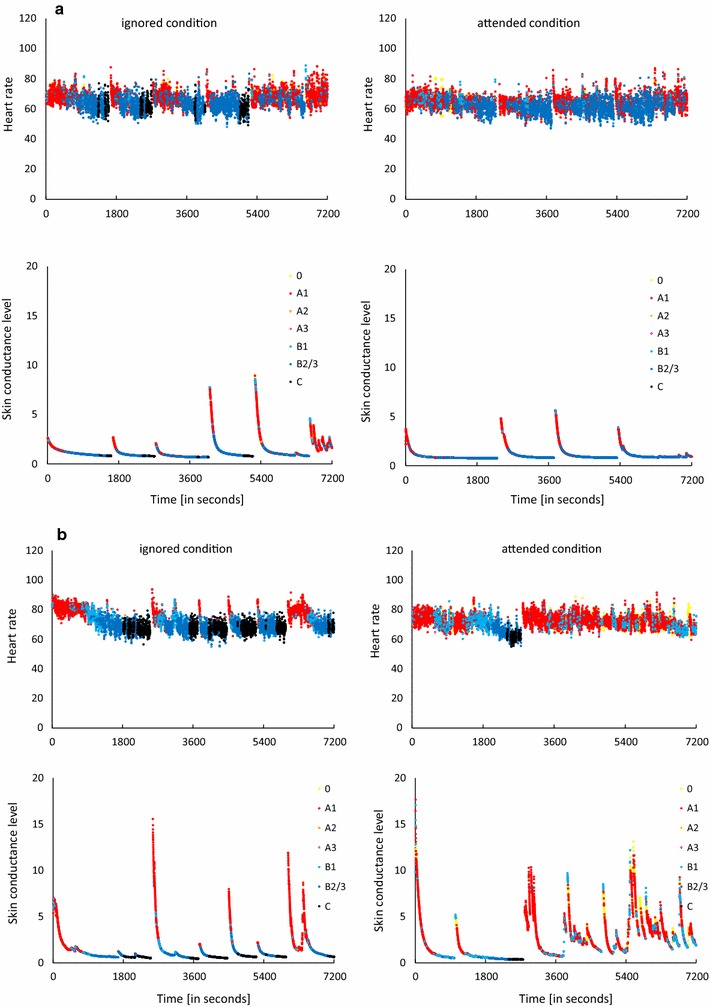
Heart rate and skin conductance level of healthy participants were recorded during a 2-h EEG with eyes closed under simultaneous presentation of stimuli in an ignored (N = 39) and attended (N = 39) oddball condition. EEG-vigilance stages were classified using the Vigilance Algorithm Leipzig (VIGALL 2.1). The time-on-task effect was tested by dividing the EEG into four 30-min consecutive time blocks. ANS-activity was compared between EEG-vigilance stages across the entire 2 h and within each time block.
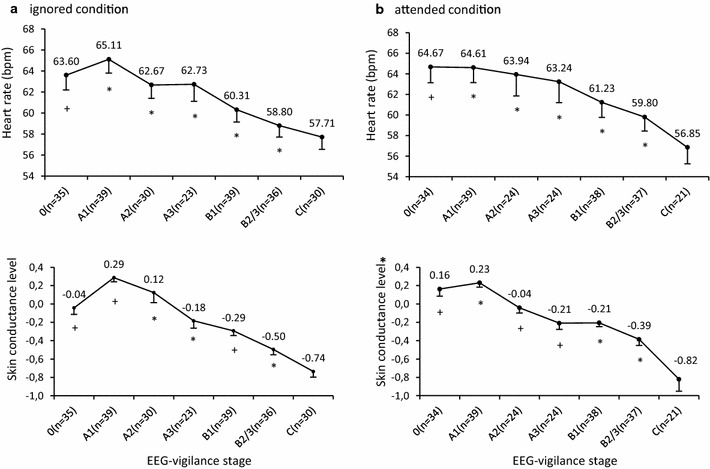
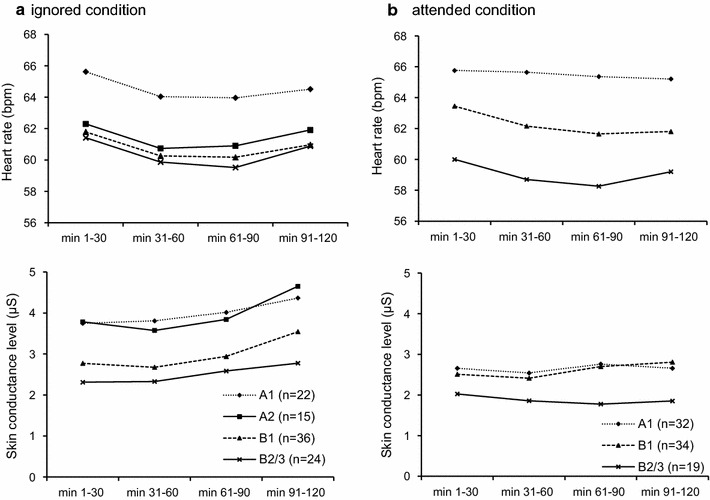
We found a coherent decline of ANS-activity with declining brain arousal states, over the 2-h recording and in most cases within each 30-min block in both conditions. Furthermore, we found a significant time-on-task effect on heart rate, even when arousal was kept constant. It was most pronounced between the first and all subsequent blocks and could have been a consequence of postural change at the beginning of the experiment.
Our findings contribute to the validation of VIGALL 2.1 using ANS parameters in 2-h EEG recording under oddball conditions.
自主神经系统 (ANS) 的活动已被证明随大脑觉醒状态的变化而变化。在之前的研究中,使用 15 分钟的 EEG 数据证明了 ANS 活动与大脑觉醒状态的不同状态之间的这种关联,但没有直接控制可能的任务时间效应。在当前的研究中,我们在 2 小时的Oddball 任务的两种条件下,检查在精细分级的 EEG 警觉阶段(表示大脑觉醒状态)期间的 ANS 活动,同时控制任务时间。此外,我们在保持大脑觉醒水平不变的情况下,分析任务时间对 ANS 活动的影响。
在闭眼的 2 小时 EEG 期间,同时呈现忽略(N=39)和注意(N=39)Oddball 条件下的刺激,记录健康参与者的心率和皮肤电导水平。使用莱比锡警觉算法(VIGALL 2.1)对 EEG 警觉阶段进行分类。通过将 EEG 分为四个连续的 30 分钟时间块来测试任务时间效应。在整个 2 小时和每个 30 分钟块内比较 EEG 警觉阶段之间的 ANS 活动。
我们发现,随着大脑觉醒状态的下降,ANS 活动在 2 小时的记录中以及在大多数情况下,在两种条件下的每个 30 分钟块内都呈现出一致的下降趋势。此外,我们发现心率存在显著的任务时间效应,即使在保持觉醒状态不变的情况下也是如此。它在第一个和所有后续块之间最为明显,可能是实验开始时姿势变化的结果。
我们的研究结果为在 Oddball 条件下使用 2 小时 EEG 记录中的 ANS 参数验证 VIGALL 2.1 提供了贡献。