Department of Psychiatry and Psychotherapy, University of Leipzig Medical Center, Semmelweisstrasse 10, 04103, Leipzig, Germany.
Depression Research Center, German Depression Foundation, Leipzig, Germany.
Eur Arch Psychiatry Clin Neurosci. 2021 Apr;271(3):527-536. doi: 10.1007/s00406-020-01216-w. Epub 2020 Dec 4.
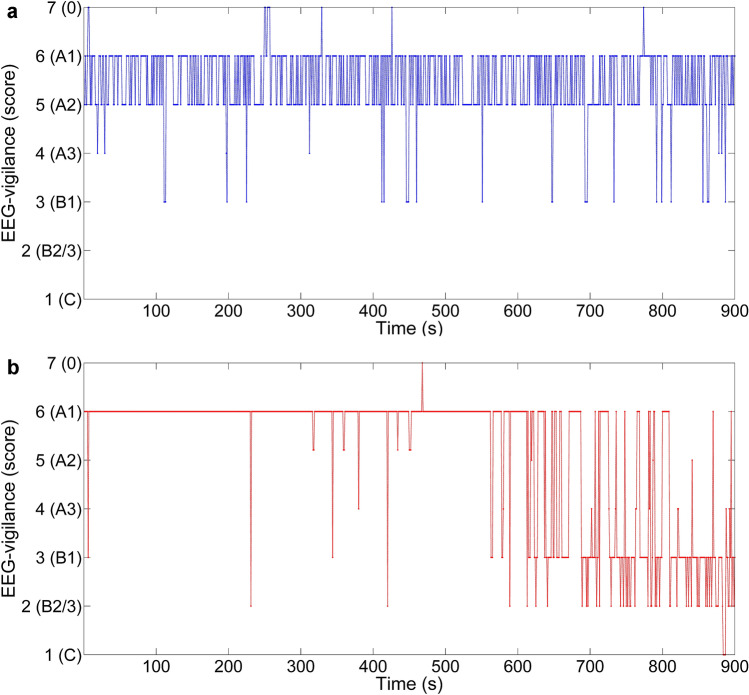
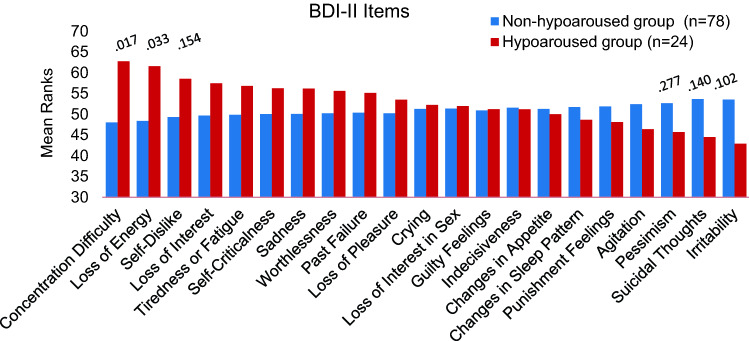
Fatigue is considered a key symptom of major depressive disorder (MDD), yet the term lacks specificity. It can denote a state of increased sleepiness and lack of drive (i.e., downregulated arousal) as well as a state of high inner tension and inhibition of drive with long sleep onset latencies (i.e., upregulated arousal), the latter typically found in depression. It has been proposed to differentiate fatigue along the dimension of brain arousal. We investigated whether such stratification within a group of MDD patients would reveal a subgroup with distinct clinical features. Using an automatic classification of EEG vigilance stages, an arousal stability score was calculated for 15-min resting EEGs of 102 MDD patients with fatigue. 23.5% of the patients showed signs of hypoarousal with EEG patterns indicating drowsiness or sleep; this hypoaroused subgroup was compared with remaining patients (non-hypoaroused subgroup) concerning self-rated measures of depressive symptoms, sleepiness, and sleep. The hypoaroused subgroup scored higher on the Beck Depression Inventory items "loss of energy" (Z = - 2.13, p = 0.033; ɳ = 0.044, 90% CI 0.003-0.128) and "concentration difficulty" (Z = - 2.40, p = 0.017; ɳ = 0.056, 90% CI 0.009-0.139), and reported higher trait and state sleepiness (p < 0.05) as compared to the non-hypoaroused group. The non-hypoaroused subgroup, in contrast, reported more frequently the presence of suicidal ideation (Chi = 3.81, p = 0.051; ɳ = 0.037, 90% CI 0.0008-0.126). In this study, we found some evidence that stratifying fatigued MDD patients by arousal may lead to subgroups that are pathophysiologically and clinically more homogeneous. Brain arousal may be a worth while target in clinical research for better understanding the mechanisms underlying suicidal tendencies and to improve treatment response.
疲劳被认为是重度抑郁症(MDD)的一个关键症状,但这个术语缺乏特异性。它可以表示一种嗜睡和缺乏动力的状态(即唤醒水平降低),也可以表示一种高度的内在紧张和动力抑制状态,伴有较长的睡眠潜伏期(即唤醒水平升高),后者通常在抑郁症中发现。有人提出沿着大脑唤醒维度来区分疲劳。我们研究了在一组 MDD 患者中进行这种分层是否会揭示出具有不同临床特征的亚组。使用 EEG 警觉阶段的自动分类,我们为 102 名有疲劳症状的 MDD 患者的 15 分钟静息 EEG 计算了唤醒稳定性评分。23.5%的患者出现了脑唤醒不足的迹象,EEG 模式显示困倦或睡眠;与其余患者(非脑唤醒不足亚组)相比,该亚组的抑郁症状、嗜睡和睡眠的自我评估测量值更高。脑唤醒不足亚组的贝克抑郁量表项目“精力丧失”得分更高(Z=-2.13,p=0.033;ɳ=0.044,90%CI 0.003-0.128)和“注意力集中困难”(Z=-2.40,p=0.017;ɳ=0.056,90%CI 0.009-0.139),并且报告了更高的特质和状态嗜睡(p<0.05),与非脑唤醒不足亚组相比。相反,非脑唤醒不足亚组更频繁地报告存在自杀意念(卡方=3.81,p=0.051;ɳ=0.037,90%CI 0.0008-0.126)。在这项研究中,我们发现了一些证据,表明通过唤醒对疲劳的 MDD 患者进行分层可能会导致亚组在病理生理学和临床方面更加同质。大脑唤醒可能是临床研究中一个有价值的目标,有助于更好地理解自杀倾向的机制,并改善治疗反应。