Department of Psychiatry, Kaohsiung Veterans General Hospital, Kaohsiung, Taiwan.
Center for Geriatric and Gerontology, Kaohsiung Veterans General Hospital, Kaohsiung, Taiwan.
Sci Rep. 2018 Apr 11;8(1):5804. doi: 10.1038/s41598-018-24248-8.
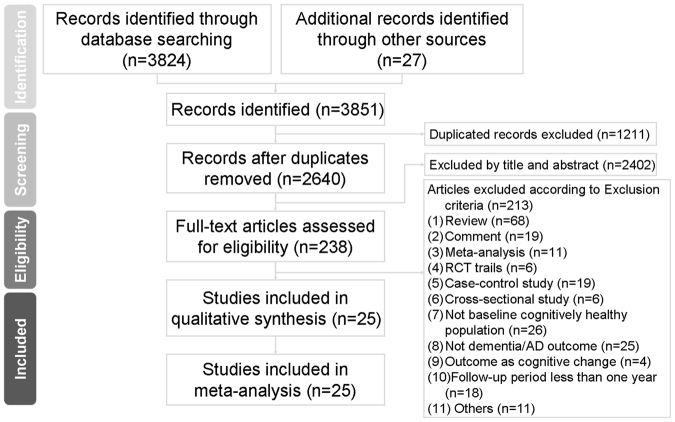
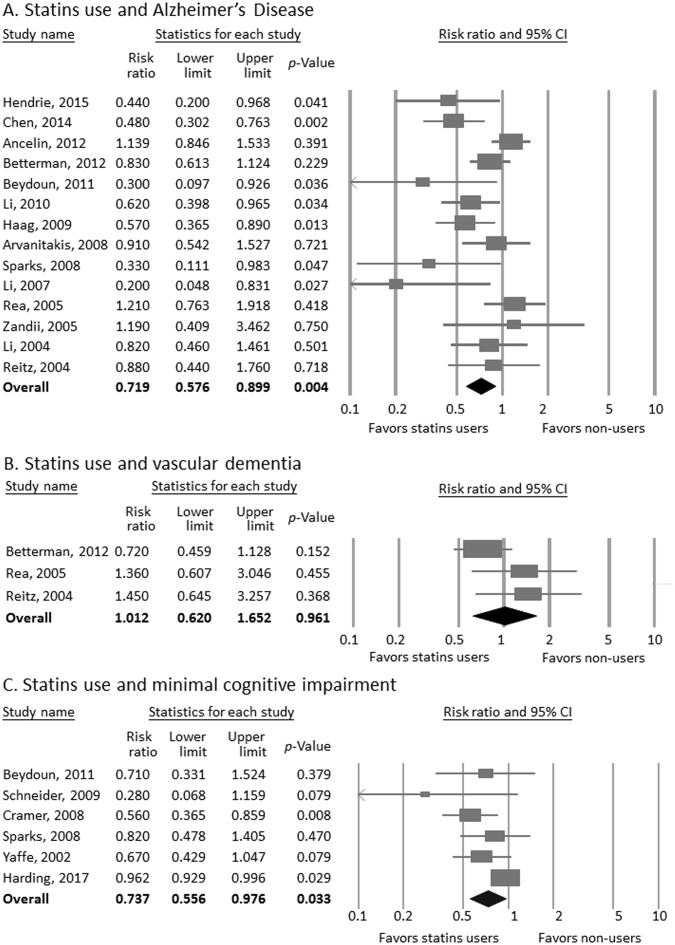
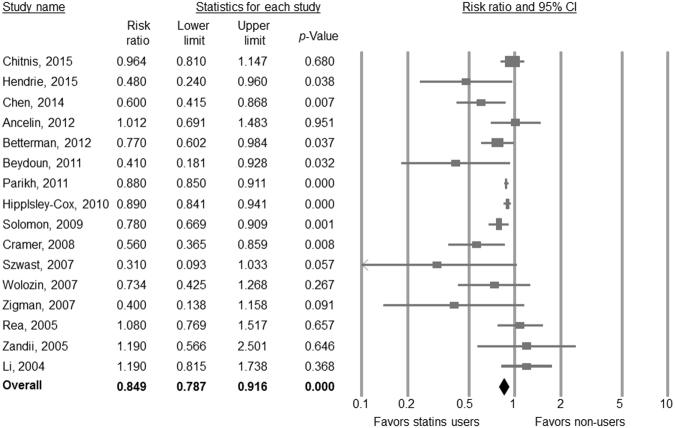
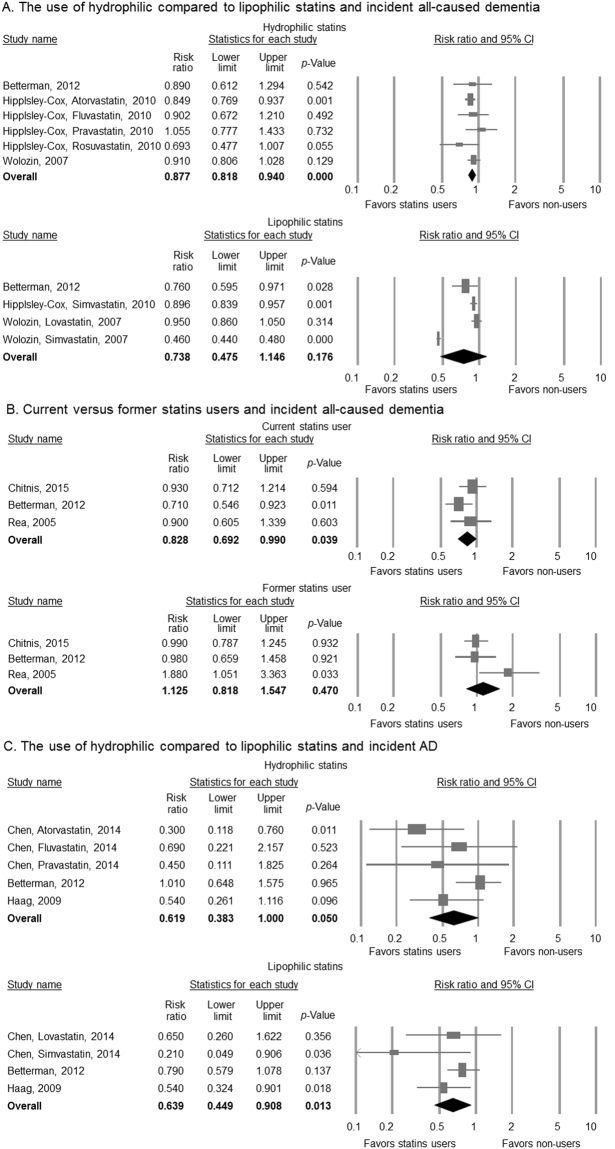
We conducted a systematic review and meta-analysis to investigate whether the use of statins could be associated with the risk of all-caused dementia, Alzheimer's disease (AD), vascular dementia (VaD), and mild cognitive impairment (MCI). Major electronic databases were searched until December 27, 2017 for studies investigating use of statins and incident cognitive decline in adults. Random-effects meta-analyses calculating relative risks (RRs) were conducted to synthesize effect sizes of individual studies. Twenty-five studies met eligibility criteria. Use of statins was significantly associated with a reduced risk of all-caused dementia (k = 16 studies, adjusted RR (aRR) = 0.849, 95% CI = 0.787-0.916, p = 0.000), AD (k = 14, aRR = 0.719, 95% CI = 0.576-0.899, p = 0.004), and MCI (k = 6, aRR = 0.737, 95% CI = 0.556-0.976, p = 0.033), but no meaningful effects on incident VaD (k = 3, aRR = 1.012, 95% CI = 0.620-1.652, p = 0.961). Subgroup analysis suggested that hydrophilic statins were associated with reduced risk of all-caused dementia (aRR = 0.877; CI = 0.818-0.940; p = 0.000) and possibly lower AD risk (aRR = 0.619; CI = 0.383-1.000; p = 0.050). Lipophilic statins were associated with reduced risk of AD (aRR = 0.639; CI = 0.449-0.908; p = 0.013) but not all-caused dementia (aRR = 0.738; CI = 0.475-1.146; p = 0.176). In conclusion, our meta-analysis suggests that the use of statins may reduce the risk of all-type dementia, AD, and MCI, but not of incident VaD.
我们进行了一项系统评价和荟萃分析,以调查他汀类药物的使用是否与全因痴呆、阿尔茨海默病(AD)、血管性痴呆(VaD)和轻度认知障碍(MCI)的风险相关。主要电子数据库检索至 2017 年 12 月 27 日,以调查他汀类药物使用与成人认知能力下降相关的研究。采用随机效应荟萃分析计算个体研究的相对风险(RR)来综合效应大小。25 项研究符合入选标准。他汀类药物的使用与全因痴呆(k=16 项研究,调整 RR(aRR)=0.849,95%CI=0.787-0.916,p=0.000)、AD(k=14 项,aRR=0.719,95%CI=0.576-0.899,p=0.004)和 MCI(k=6 项,aRR=0.737,95%CI=0.556-0.976,p=0.033)的风险降低显著相关,但对 VaD(k=3 项,aRR=1.012,95%CI=0.620-1.652,p=0.961)的发生无明显影响。亚组分析表明,亲水性他汀类药物与全因痴呆(aRR=0.877;CI=0.818-0.940;p=0.000)和可能较低的 AD 风险(aRR=0.619;CI=0.383-1.000;p=0.050)相关。亲脂性他汀类药物与 AD(aRR=0.639;CI=0.449-0.908;p=0.013)而非全因痴呆(aRR=0.738;CI=0.475-1.146;p=0.176)风险降低相关。总之,我们的荟萃分析表明,他汀类药物的使用可能降低全类型痴呆、AD 和 MCI 的风险,但不能降低 VaD 的风险。