Homeyer Sabine, Hoffmann Wolfgang, Hingst Peter, Oppermann Roman F, Dreier-Wolfgramm Adina
1Institute for Community Medicine, Department Epidemiology of Health Care and Community Health, University Medicine Greifswald, Ellernholzstr. 1-2, 17487 Greifswald, Germany.
2Nursing Board, University Medicine Greifswald, Fleischmannstraße 8, 17475 Greifswald, Germany.
BMC Nurs. 2018 Apr 10;17:13. doi: 10.1186/s12912-018-0279-x. eCollection 2018.
To ensure high quality patient care an effective interprofessional collaboration between healthcare professionals is required. Interprofessional education (IPE) has a positive impact on team work in daily health care practice. Nevertheless, there are various challenges for sustainable implementation of IPE. To identify enablers and barriers of IPE for medical and nursing students as well as to specify impacts of IPE for both professions, the 'Cooperative academical regional evidence-based Nursing Study in Mecklenburg-Western Pomerania' (Care-N Study M-V) was conducted. The aim is to explore, how IPE has to be designed and implemented in medical and nursing training programs to optimize students' impact for IPC.
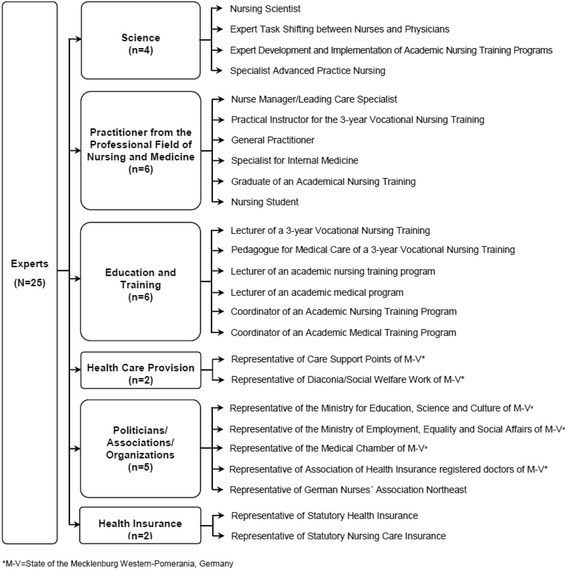
A qualitative study was conducted using the Delphi method and included 25 experts. Experts were selected by following inclusion criteria: (a) ability to answer every research question, one question particularly competent, (b) interdisciplinarity, (c) sustainability and (d) status. They were purposely sampled. Recruitment was based on existing collaborations and a web based search.
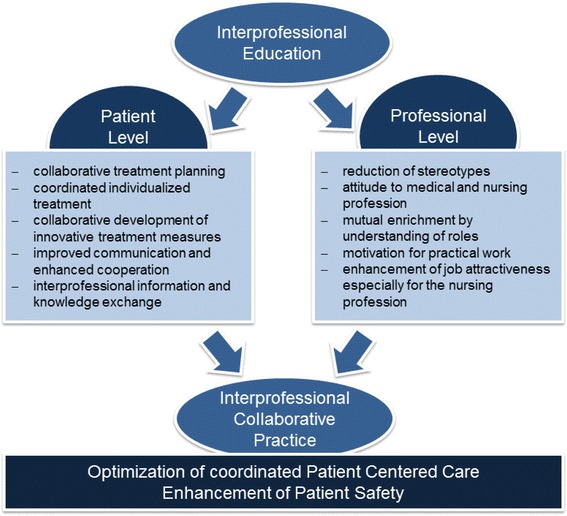
The experts find more enablers than barriers for IPE between medical and nursing students. Four primary arguments for IPE were mentioned: (1) development and promotion of interprofessional thinking and acting, (2) acquirement of shared knowledge, (3) promotion of beneficial information and knowledge exchange, and (4) promotion of mutual understanding. Major barriers of IPE are the coordination and harmonization of the curricula of the two professions. With respect to the effects of IPE for IPC, experts mentioned possible improvements on (a) patient level and (b) professional level. Experts expect an improved patient-centered care based on better mutual understanding and coordinated cooperation in interprofessional health care teams. To sustainably implement IPE for medical and nursing students, IPE needs endorsement by both, medical and nursing faculties.
In conclusion, IPE promotes interprofessional cooperation between the medical and the nursing profession. Skills in interprofessional communication and roles understanding will be primary preconditions to improve collaborative patient-centered care. The impact of IPE for patients and caregivers as well as for both professions now needs to be more specifically analysed in prospective intervention studies.
为确保高质量的患者护理,医疗保健专业人员之间需要有效的跨专业协作。跨专业教育(IPE)对日常医疗保健实践中的团队合作有积极影响。然而,IPE的可持续实施面临各种挑战。为了确定IPE对医学和护理专业学生的促进因素和障碍,并明确IPE对这两个专业的影响,开展了“梅克伦堡-前波美拉尼亚州合作学术区域循证护理研究”(Care-N研究M-V)。目的是探索如何在医学和护理培训项目中设计和实施IPE,以优化学生对跨专业协作(IPC)的影响。
采用德尔菲法进行了一项定性研究,包括25名专家。专家根据以下纳入标准进行选择:(a)能够回答每个研究问题,对一个问题特别精通,(b)跨学科性,(c)可持续性,以及(d)地位。他们是有目的地抽样。招募基于现有的合作关系和网络搜索。
专家们发现医学和护理专业学生之间IPE的促进因素多于障碍。提到了IPE的四个主要论据:(1)跨专业思维和行动的发展与促进,(2)共享知识的获取,(3)有益信息和知识交流的促进,以及(4)相互理解的促进。IPE的主要障碍是两个专业课程的协调与统一。关于IPE对IPC的影响,专家们提到了在(a)患者层面和(b)专业层面可能的改进。专家们期望基于跨专业医疗团队中更好的相互理解和协调合作,实现以患者为中心的护理得到改善。为了可持续地在医学和护理专业学生中实施IPE,IPE需要医学和护理学院双方的认可。
总之,IPE促进了医学和护理专业之间的跨专业合作。跨专业沟通和角色理解技能将是改善以患者为中心的协作护理的主要前提条件。现在需要在前瞻性干预研究中更具体地分析IPE对患者和护理人员以及对这两个专业的影响。