Ahmed Doaa Sadek, Hassan Rania Hassan, Ali Doaa Ali Soliman, Alkalash Safa Hamdy, Almowafy Abeer A, Ismail Samar Samy
Community and Occupational Medicine Department, Faculty of Medicine for Girls, Al-Azhar University, Cairo, Egypt.
Technical Institute of Nursing, Faculty of Medicine for Girls, Al-Azhar University, Cairo, Egypt.
BMC Med Educ. 2025 May 5;25(1):651. doi: 10.1186/s12909-025-07150-6.
Effective healthcare relies on strong collaboration between nurses and physicians. Interprofessional education [IPE] plays a vital role in fostering positive attitudes of medical and nursing students toward this collaboration. This study aims to explore the perceptions of nurse-physician collaboration among medical and nursing students at Al-Azhar University in Egypt, along with its related factors.
This cross-sectional study included 364 female medical and nursing students. Data were collected using a self-administered questionnaire comprising socio-demographic and academic information, along with the validated Jefferson Scale of Attitudes toward Physician-Nurse Collaboration (JSAPNC), which assesses attitudes toward nurse-physician collaboration.
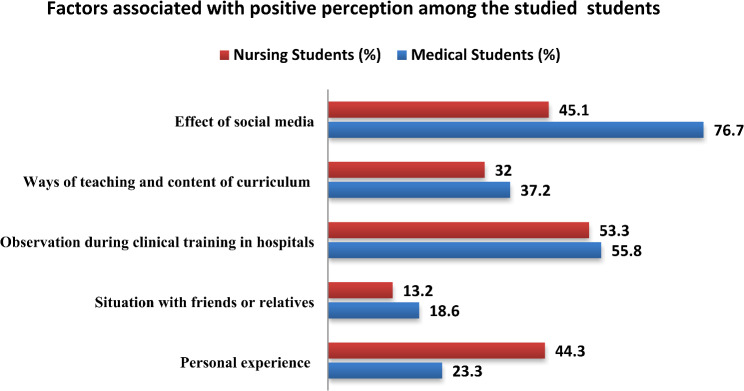
Among the participants, there were 153 medical students (including 25 house officers) and 211 nursing students (including 20 interns). Nursing students demonstrated higher scores across all subdomains of the JSAPNC, with a significantly higher total median score (47.9 vs. 44.8, p < 0.05). Nursing students with a positive perception had significantly lower parental education levels and family income compared to medical students (p-value < 0.05). Additionally, 55.7% of nursing students had a history of clinical training, compared to only 9.3% of medical students (p-value < 0.001). The determinants of positive perception among students differed, with 53.3% of nursing students citing clinical observations in hospitals, while 76.7% of medical students identified social media as the primary factor. Moreover, medical students exhibited a more positive overall attitude towards nurse-physician collaboration than house officers, with a total score median of 44 vs. 42 (p value = 0.05). However, no significant differences were observed between nursing students and interns across all JSAPNC domains.
Nursing students had a more positive attitude toward nurse-physician collaboration than medical students; their perceptions were shaped by clinical training, while social media impacted medical students. Enhancing structured teamwork in training and addressing social media roles can improve collaboration and patient care.
有效的医疗保健依赖于护士与医生之间的紧密协作。跨专业教育[IPE]在培养医学和护理专业学生对这种协作的积极态度方面发挥着至关重要的作用。本研究旨在探讨埃及爱资哈尔大学医学和护理专业学生对医护协作的看法及其相关因素。
这项横断面研究纳入了364名医学和护理专业的女学生。使用一份自我管理问卷收集数据,问卷包括社会人口统计学和学术信息,以及经过验证的杰斐逊医生 - 护士协作态度量表(JSAPNC),该量表用于评估对医护协作的态度。
在参与者中,有153名医学专业学生(包括25名住院医师)和211名护理专业学生(包括20名实习生)。护理专业学生在JSAPNC的所有子领域得分更高,总中位数得分显著更高(47.9对44.8,p < 0.05)。与医学专业学生相比,对医护协作持积极看法的护理专业学生的父母教育水平和家庭收入显著更低(p值< 0.05)。此外,55.7%的护理专业学生有临床培训经历,而医学专业学生只有9.3%有临床培训经历(p值< 0.001)。学生对医护协作持积极看法的决定因素有所不同,53.3%的护理专业学生将医院临床观察列为原因,而76.7%的医学专业学生认为社交媒体是主要因素。此外,医学专业学生对医护协作的总体态度比住院医师更积极,总得分中位数为44对42(p值 = 0.05)。然而,在所有JSAPNC领域中,护理专业学生和实习生之间未观察到显著差异。
护理专业学生对医护协作的态度比医学专业学生更积极;他们的看法受临床培训影响,而社交媒体对医学专业学生有影响。加强培训中的结构化团队合作并明确社交媒体的作用可以改善协作和患者护理。