Wahab Fazal, Atika Bibi, Ullah Farhad, Shahab Muhammad, Behr Rüdiger
Platform Degenerative Diseases, German Primate Center, Leibniz Institute for Primate Research, Göttingen, Germany.
Department of Developmental Biology, Faculty of Biology, University of Göttingen, Göttingen, Germany.
Front Endocrinol (Lausanne). 2018 Mar 28;9:123. doi: 10.3389/fendo.2018.00123. eCollection 2018.
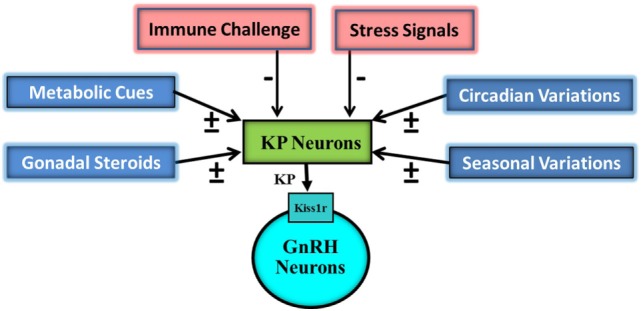
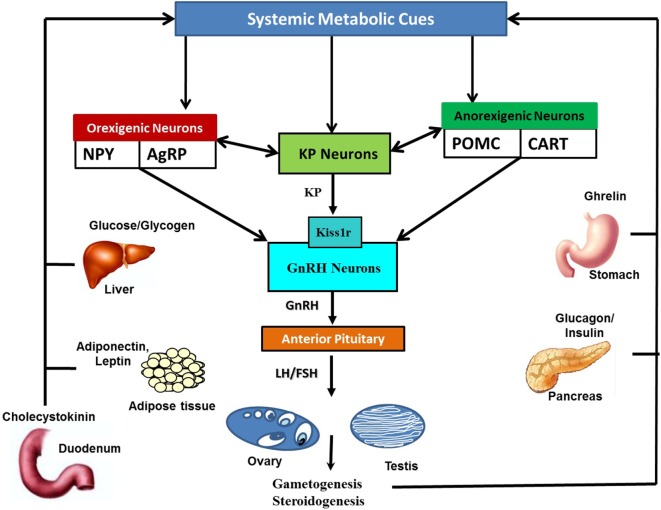
A large body of data has established the hypothalamic kisspeptin (KP) and its receptor, KISS1R, as major players in the activation of the neuroendocrine reproductive axis at the time of puberty and maintenance of reproductive capacity in the adult. Due to its strategic location, this ligand-receptor pair acts as an integrator of cues from gonadal steroids as well as of circadian and seasonal variation-related information on the reproductive axis. Besides these cues, the activity of the hypothalamic KP signaling is very sensitive to the current metabolic status of the body. In conditions of energy imbalance, either positive or negative, a number of alterations in the hypothalamic KP signaling pathway have been documented in different mammalian models including nonhuman primates and human. Deficiency of metabolic fuels during fasting causes a marked reduction of gene transcript levels in the hypothalamus and, hence, decreases the output of KP-containing neurons. Food intake or exogenous supply of metabolic cues, such as leptin, reverses metabolic insufficiency-related changes in the hypothalamic KP signaling. Likewise, alterations in Kiss1 expression have also been reported in other situations of energy imbalance like diabetes and obesity. Information related to the body's current metabolic status reaches to KP neurons both directly as well as indirectly a complex network of other neurons. In this review article, we have provided an updated summary of the available literature on the regulation of the hypothalamic KP-Kiss1r signaling by metabolic cues. In particular, the potential mechanisms of metabolic impact on the hypothalamic KP-Kiss1r signaling, in light of available evidence, are discussed.
大量数据已证实,下丘脑的 kisspeptin(KP)及其受体 KISS1R 是青春期激活神经内分泌生殖轴以及维持成年期生殖能力的主要参与者。由于其关键位置,这一配体 - 受体对可整合来自性腺类固醇的信号以及生殖轴上与昼夜节律和季节变化相关的信息。除了这些信号外,下丘脑 KP 信号传导的活性对身体当前的代谢状态非常敏感。在能量失衡(无论是正向还是负向)的情况下,包括非人灵长类动物和人类在内的不同哺乳动物模型中,下丘脑 KP 信号通路都出现了一些变化。禁食期间代谢燃料的缺乏会导致下丘脑基因转录水平显著降低,从而减少含 KP 神经元的输出。食物摄入或外源性提供代谢信号(如瘦素)可逆转下丘脑 KP 信号传导中与代谢不足相关的变化。同样,在糖尿病和肥胖等其他能量失衡情况下,也有关于 Kiss1 表达变化的报道。与身体当前代谢状态相关的信息通过其他神经元组成的复杂网络直接或间接地传递给 KP 神经元。在这篇综述文章中,我们提供了关于代谢信号调节下丘脑 KP - Kiss1r 信号传导的现有文献的最新总结。特别是,根据现有证据讨论了代谢对下丘脑 KP - Kiss1r 信号传导产生影响的潜在机制。