Panisch Sigrid, Johansson Tim, Flamm Maria, Winkler Henrike, Weitgasser Raimund, Sönnichsen Andreas C
1Department of Mathematics, University of Salzburg, Hellbrunner Str. 34, 5020 Salzburg, Austria.
2Institute of General Practice, Family Medicine and Preventive Medicine, Paracelsus Medical University, Salzburg, Strubergasse 21, 5020 Salzburg, Austria.
Diabetol Metab Syndr. 2018 Apr 10;10:28. doi: 10.1186/s13098-018-0330-9. eCollection 2018.
Type 2 diabetes is a chronic disease associated with poorer health outcomes and decreased health related quality of life (HRQoL). The aim of this analysis was to explore the impact of a disease management programme (DMP) in type 2 diabetes on HRQoL. A multilevel model was used to explain the variation in EQ-VAS.
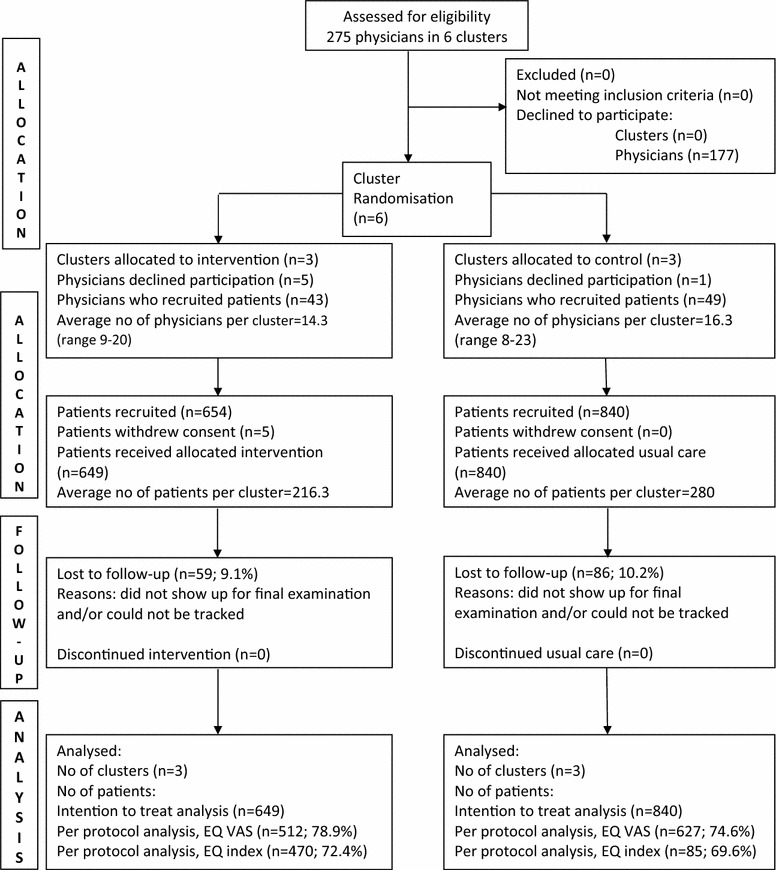
A cluster-randomized controlled trial-analysis of the secondary endpoint HRQoL. Our study population were general practitioners and patients in the province of Salzburg. The DMP "Therapie-Aktiv" was implemented in the intervention group, and controls received usual care. Outcome measure was a change in EQ-VAS after 12 months. For comparison of rates, we used Fisher's Exact test; for continuous variables the independent T test or Welch test were used. In the multilevel modeling, we examined various models, continuously adding variables to explain the variation in the dependent variable, starting with an empty model, including only the random intercept. We analysed random effects parameters in order to disentangle variation of the final EQ-VAS.
The EQ-VAS significantly increased within the intervention group (mean difference 2.19, p = 0.005). There was no significant difference in EQ-VAS between groups (mean difference 1.00, p = 0.339). In the intervention group the improvement was more distinct in women (2.46, p = 0.036) compared to men (1.92, p = 0.063). In multilevel modeling, sex, age, family and work circumstances, any macrovascular diabetic complication, duration of diabetes, baseline body mass index and baseline EQ-VAS significantly influence final EQ-VAS, while DMP does not. The final model explains 28.9% (EQ-VAS) of the total variance. Most of the unexplained variance was found on patient-level (95%) and less on GP-level (5%).
DMP "Therapie-Aktiv" has no significant impact on final EQ-VAS. The impact of DMPs in type 2 diabetes on HRQoL is still unclear and future programmes should focus on patient specific needs and predictors in order to improve HRQoL. Current Controlled trials Ltd., ISRCTN27414162.
2型糖尿病是一种与较差的健康结局及健康相关生活质量(HRQoL)下降相关的慢性疾病。本分析旨在探讨2型糖尿病疾病管理项目(DMP)对HRQoL的影响。采用多水平模型来解释欧洲五维度健康量表视觉模拟量表(EQ-VAS)的变异情况。
对次要终点HRQoL进行整群随机对照试验分析。我们的研究人群为萨尔茨堡州的全科医生和患者。干预组实施“Therapie-Aktiv”疾病管理项目,对照组接受常规护理。结局指标为12个月后EQ-VAS的变化。对于率的比较,我们采用Fisher精确检验;对于连续变量,采用独立样本t检验或韦尔奇检验。在多水平建模中,我们检验了各种模型,从仅包含随机截距的空模型开始,不断添加变量以解释因变量的变异情况。我们分析了随机效应参数,以剖析最终EQ-VAS的变异情况。
干预组的EQ-VAS显著增加(平均差值为2.19,p = 0.005)。两组之间的EQ-VAS无显著差异(平均差值为1.00,p = 0.339)。在干预组中,女性的改善(2.46,p = 0.036)比男性(1.92,p = 0.063)更明显。在多水平建模中,性别、年龄、家庭和工作情况、任何糖尿病大血管并发症、糖尿病病程、基线体重指数和基线EQ-VAS对最终EQ-VAS有显著影响,而疾病管理项目无此影响。最终模型解释了总变异的28.9%(EQ-VAS)。大部分未解释的变异存在于患者层面(95%),而在全科医生层面较少(5%)。
“Therapie-Aktiv”疾病管理项目对最终EQ-VAS无显著影响。2型糖尿病疾病管理项目对HRQoL的影响仍不明确,未来的项目应关注患者的特定需求和预测因素,以改善HRQoL。Current Controlled trials Ltd., ISRCTN27414162。