Tian Jingru, Luo Yien, Wu Haijing, Long Hai, Zhao Ming, Lu Qianjin
Department of Dermatology, Hunan Key Laboratory of Medical Epigenomics, The Second Xiangya Hospital, Central South University, Changsha, China.
Xiangya School of Medicine, Central South University, Changsha, China.
Lupus Sci Med. 2018 Mar 9;5(1):e000253. doi: 10.1136/lupus-2017-000253. eCollection 2018.
The comparative safety of immunosuppressive drugs, biologicals and glucocorticoids (GC) for patients with SLE remains controversial. We aimed to investigate the specific side effects of the available SLE drugs in this population of patients.
Electronic databases were systematically searched through September 2017 for randomised trials in patients with SLE. The primary outcomes were all-cause mortality and withdrawal related to adverse events (AEs). We performed a random-effects network meta-analysis to obtain estimates for primary and secondary outcomes and presented these estimates as ORs with 95% CIs.
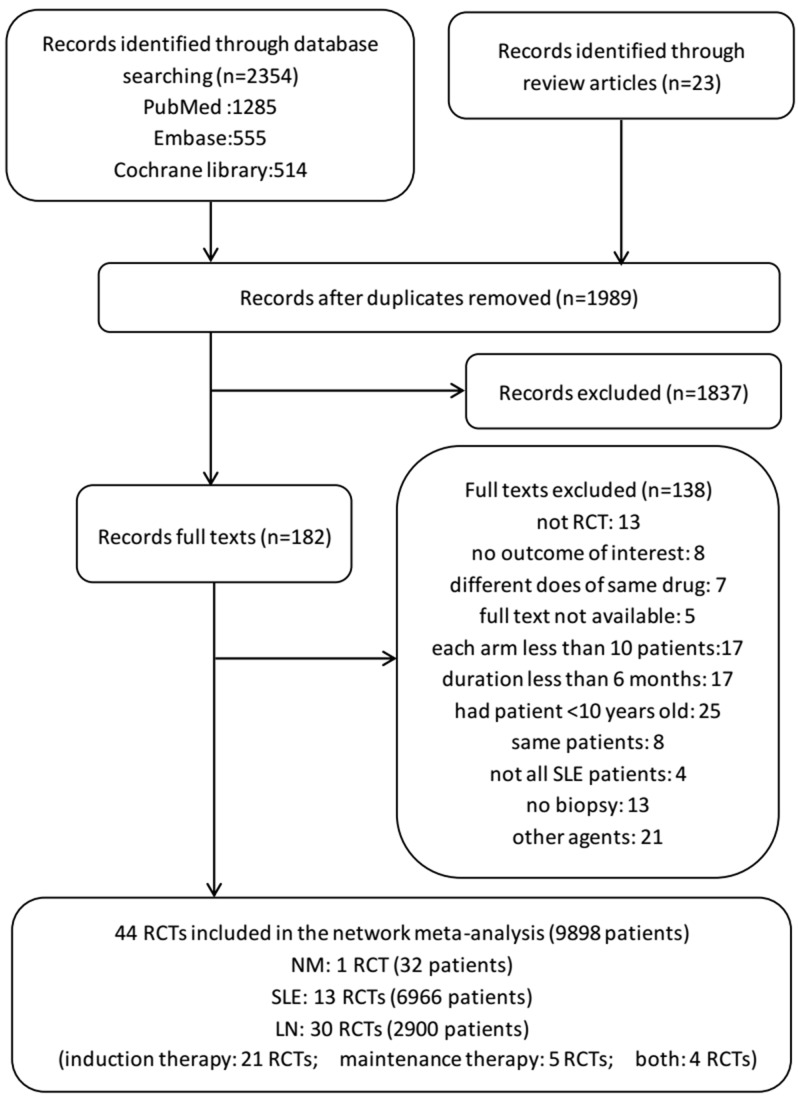
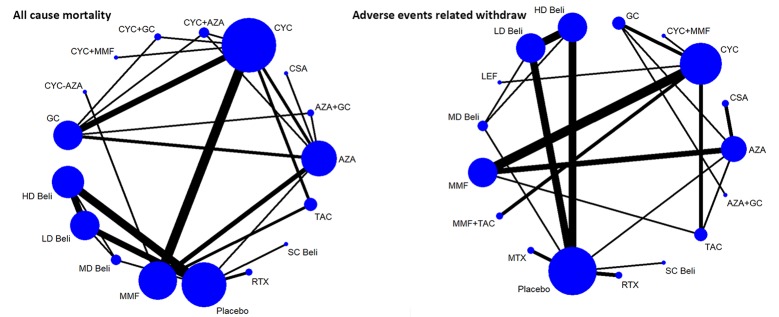
Forty-four studies comprising 9898 participants were included in the network meta-analysis. No drug regimen was considered to be safer for reducing all-cause mortality. However, compared with cyclophosphamide, azathioprine (OR 3.04, 95% CI (1.44 to 6.42)) and cyclosporine (OR 3.28, 95% CI (1.04 to 10.35)) were significantly less safety in AE-related withdrawals, and GC was ranked lowest and led to higher withdrawal rates. Tacrolimus (TAC) was ranked high and showed a benefit in many outcomes. Biologicals and chloroquine also showed good safety in all of the available outcomes, while the beneficial effects of other immunosuppressive drugs were not substantial in different types of serious adverse events.
TAC is the safest strategy for patients with SLE. Biologicals and chloroquine are also fairly safe for patients with SLE. The use of other immunosuppressive drugs and GC needs to be balanced against the potential harms of different types of AEs, and the practical safety of drug combinations still requires further trials to evaluate.
免疫抑制药物、生物制剂和糖皮质激素(GC)对系统性红斑狼疮(SLE)患者的比较安全性仍存在争议。我们旨在调查现有SLE药物在该患者群体中的特定副作用。
系统检索电子数据库至2017年9月,查找SLE患者的随机试验。主要结局为全因死亡率和与不良事件(AE)相关的撤药情况。我们进行了随机效应网络荟萃分析,以获得主要和次要结局的估计值,并将这些估计值表示为具有95%置信区间(CI)的比值比(OR)。
网络荟萃分析纳入了44项研究,共9898名参与者。没有一种药物方案被认为在降低全因死亡率方面更安全。然而,与环磷酰胺相比,硫唑嘌呤(OR 3.04,95%CI(1.44至6.42))和环孢素(OR 3.28,95%CI(1.04至10.35))在与AE相关的撤药方面安全性显著较低,GC排名最低且撤药率较高。他克莫司(TAC)排名较高,在许多结局中显示出益处。生物制剂和氯喹在所有可用结局中也显示出良好的安全性,而其他免疫抑制药物在不同类型的严重不良事件中的有益作用并不显著。
TAC是SLE患者最安全的治疗策略。生物制剂和氯喹对SLE患者也相当安全。其他免疫抑制药物和GC的使用需要在不同类型AE的潜在危害之间进行权衡,药物组合的实际安全性仍需要进一步试验来评估。