Department of Neurology, University of Maryland School of Medicine, Baltimore, MD, 21201, USA.
Department of Anatomy and Neurobiology, University of Maryland School of Medicine, Baltimore, MD, USA.
J Neurovirol. 2018 Apr;24(2):246-253. doi: 10.1007/s13365-018-0623-7. Epub 2018 Apr 11.
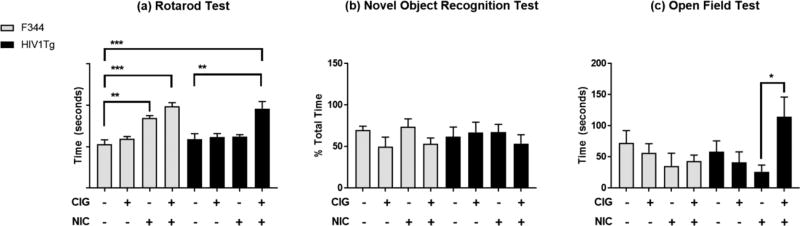
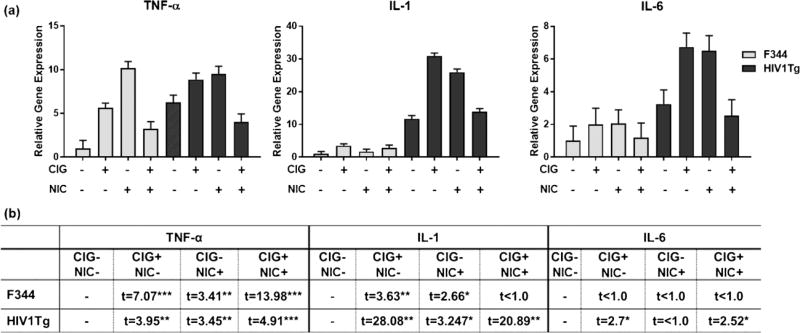
Cognitive impairment in HIV-1 infection is associated with the induction of chronic proinflammatory responses in the brains of infected individuals. The risk of HIV-related cognitive impairment is increased by cigarette smoking, which induces brain inflammation in rodent models. To better understand the role of smoking and the associated immune response on behavioral and motor function in HIV infection, wild-type F344 and HIV-1 transgenic (HIV1Tg) rats were exposed to either smoke from nicotine-containing (regular) cigarettes, smoke from nicotine-free cigarettes, or to nicotine alone. The animals were then tested using the rotarod test (RRT), the novel object recognition test (NORT), and the open field test (OFT). Subsequently, brain frontal cortex from the rats was analyzed for levels of TNF-α, IL-1, and IL-6. On the RRT, impairment was noted for F344 rats exposed to either nicotine-free cigarette smoke or nicotine alone and for F344 and HIV1Tg rats exposed to regular cigarette smoke. Effects from the exposures on the OFT were seen only for HIV1Tg rats, for which function was worse following exposure to regular cigarette smoke as compared to exposure to nicotine alone. Expression levels for all three cytokines were overall higher for HIV1Tg than for F344 rats. For HIV1Tg rats, TNF-α, IL-1, and IL-6 gene expression levels for all exposure groups were higher than for control rats. All F344 rat exposure groups also showed significantly increased TNF-α expression levels. However, for F344 rats, IL-1 expression levels were higher only for rats exposed to nicotine-free and nicotine-containing CS, and no increase in IL-6 gene expression was noted with any of the exposures as compared to controls. These studies, therefore, demonstrate that F344 and HIV1Tg rats show differential behavioral and immune effects from these exposures. These effects may potentially reflect differences in the responsiveness of the various brain regions in the two animal species as well as the result of direct toxicity mediated by the proinflammatory cytokines that are produced by HIV proteins and by other factors that are present in regular cigarette smoke.
HIV-1 感染导致的认知障碍与受感染个体大脑中慢性促炎反应的诱导有关。吸烟会增加 HIV 相关认知障碍的风险,在啮齿动物模型中,吸烟会引起大脑炎症。为了更好地了解吸烟和相关免疫反应对 HIV 感染行为和运动功能的影响,野生型 F344 和 HIV-1 转基因(HIV1Tg)大鼠分别暴露于含尼古丁(常规)香烟、无尼古丁香烟或尼古丁烟雾中。然后,使用转棒测试(RRT)、新物体识别测试(NORT)和旷场测试(OFT)对动物进行测试。随后,分析大鼠大脑额叶皮质中的 TNF-α、IL-1 和 IL-6 水平。在 RRT 上,暴露于无尼古丁香烟烟雾或尼古丁单独的 F344 大鼠以及暴露于常规香烟烟雾的 F344 和 HIV1Tg 大鼠均出现了损伤。仅 HIV1Tg 大鼠在 OFT 上出现了来自暴露的影响,与单独暴露于尼古丁相比,暴露于常规香烟烟雾后,其功能更差。与 F344 大鼠相比,所有三种细胞因子的表达水平在 HIV1Tg 大鼠中总体更高。对于 HIV1Tg 大鼠,所有暴露组的 TNF-α、IL-1 和 IL-6 基因表达水平均高于对照大鼠。所有 F344 大鼠暴露组的 TNF-α 表达水平也显著升高。然而,对于 F344 大鼠,仅暴露于无尼古丁和含尼古丁 CS 的大鼠的 IL-1 表达水平升高,与对照组相比,任何暴露组的 IL-6 基因表达均未增加。因此,这些研究表明,F344 和 HIV1Tg 大鼠对这些暴露表现出不同的行为和免疫效应。这些效应可能反映了两种动物物种中不同大脑区域的反应性差异,以及 HIV 蛋白产生的促炎细胞因子以及常规香烟烟雾中存在的其他因素引起的直接毒性的结果。