Liang Zhifang, Tian Fengchun, Yang Simon X, Zhang Ci, Sun Hao, Liu Tao
College of Communication and Information Engineering, Chongqing University of Posts and Telecommunications, Chongwen Road 2nd, Nan'an District, Chongqing 400065, China.
College of Communication Engineering, Chongqing University, 174 ShaZheng Street, ShaPingBa District, Chongqing 400044, China.
Sensors (Basel). 2018 Apr 12;18(4):1179. doi: 10.3390/s18041179.
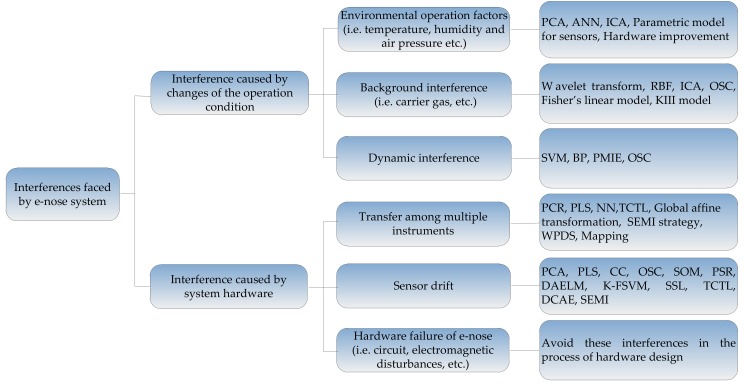
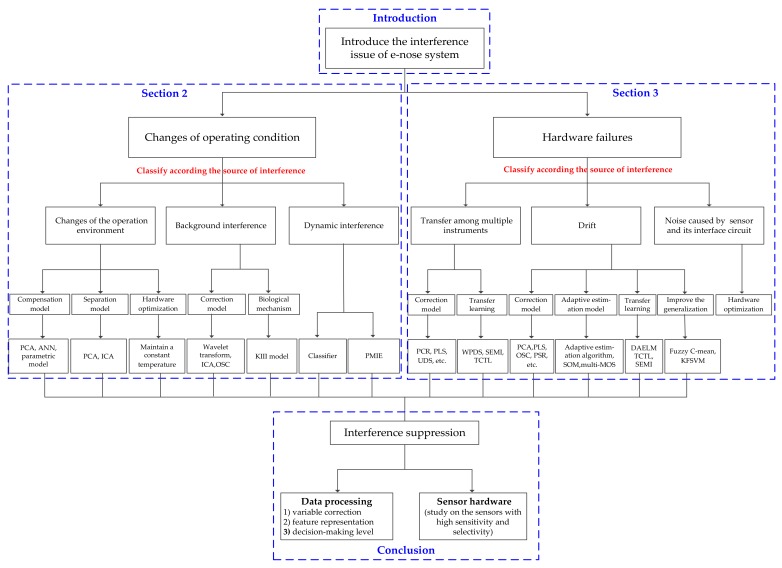
Electronic noses (e-nose) are composed of an appropriate pattern recognition system and a gas sensor array with a certain degree of specificity and broad spectrum characteristics. The gas sensors have their own shortcomings of being highly sensitive to interferences which has an impact on the detection of target gases. When there are interferences, the performance of the e-nose will deteriorate. Therefore, it is urgent to study interference suppression techniques for e-noses. This paper summarizes the sources of interferences and reviews the advances made in recent years in interference suppression for e-noses. According to the factors which cause interference, interferences can be classified into two types: interference caused by changes of operating conditions and interference caused by hardware failures. The existing suppression methods were summarized and analyzed from these two aspects. Since the interferences of e-noses are uncertain and unstable, it can be found that some nonlinear methods have good effects for interference suppression, such as methods based on transfer learning, adaptive methods, etc.
电子鼻由一个合适的模式识别系统和一个具有一定特异性和广谱特性的气体传感器阵列组成。气体传感器自身存在对干扰高度敏感的缺点,这会影响目标气体的检测。当存在干扰时,电子鼻的性能会变差。因此,研究电子鼻的干扰抑制技术迫在眉睫。本文总结了干扰源,并综述了近年来电子鼻干扰抑制方面取得的进展。根据引起干扰的因素,干扰可分为两类:由操作条件变化引起的干扰和由硬件故障引起的干扰。从这两个方面对现有的抑制方法进行了总结和分析。由于电子鼻的干扰具有不确定性和不稳定性,可以发现一些非线性方法对干扰抑制有很好的效果,如基于迁移学习的方法、自适应方法等。