Sun Yuxiao, Wang Jianan, Heine Lizette, Huang Wangshan, Wang Jing, Hu Nantu, Hu Xiaohua, Fang Xiaohui, Huang Supeng, Laureys Steven, Di Haibo
International Vegetative State and Consciousness Science Institute, Hangzhou Normal University, Hangzhou, China.
GIGA, GIGA-Consciousness, Coma Science Group, University & Neurology Department, Hospital of Liege, Liege, Belgium.
BMC Neurol. 2018 Apr 12;18(1):38. doi: 10.1186/s12883-018-1040-5.
Behavioral assessment has been acted as the gold standard for the diagnosis of disorders of consciousness (DOC) patients. The item "Functional Object Use" in the motor function sub-scale in the Coma Recovery Scale-Revised (CRS-R) is a key item in differentiating between minimally conscious state (MCS) and emergence from MCS (EMCS). However, previous studies suggested that certain specific stimuli, especially something self-relevant can affect DOC patients' scores of behavioral assessment scale. So, we attempted to find out if personalized objects can improve the diagnosis of EMCS in the assessment of Functional Object Use by comparing the use of patients' favorite objects and other common objects in MCS patients.
Twenty-one post-comatose patients diagnosed as MCS were prospectively included. The item "Functional Object Use" was assessed by using personalized objects (e.g., cigarette, paper) and non-personalized objects, which were presented in a random order. The rest assessments were performed following the standard protocol of the CRS-R. The differences between functional uses of the two types of objects were analyzed by the McNemar test.
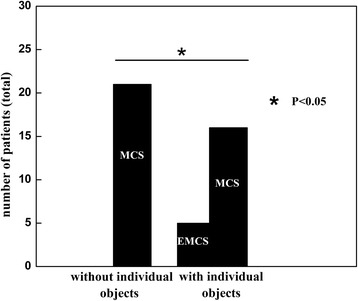
The incidence of Functional Object Use was significantly higher using personalized objects than non-personalized objects in the CRS-R. Five out of the 21 MCS studied patients, who were assessed with non-personalized objects, were re-diagnosed as EMCS with personalized objects (χ = 5, df = 1, p < 0.05).
Personalized objects employed here seem to be more effective to elicit patients' responses as compared to non-personalized objects during the assessment of Functional Object Use in DOC patients.
Clinical Trials.gov: NCT02988206 ; Date of registration: 2016/12/12.
行为评估一直是意识障碍(DOC)患者诊断的金标准。昏迷恢复量表修订版(CRS-R)运动功能子量表中的“功能性物品使用”项目是区分最低意识状态(MCS)和从MCS中苏醒(EMCS)的关键项目。然而,先前的研究表明,某些特定刺激,尤其是与自身相关的事物,会影响DOC患者行为评估量表的得分。因此,我们试图通过比较MCS患者使用其喜爱物品和其他普通物品时功能性物品使用的情况,来探究个性化物品在评估功能性物品使用时能否改善EMCS的诊断。
前瞻性纳入21例诊断为MCS的昏迷后患者。使用个性化物品(如香烟、纸张)和非个性化物品对“功能性物品使用”项目进行评估,并随机呈现。其余评估按照CRS-R的标准方案进行。采用McNemar检验分析两种物品功能性使用的差异。
在CRS-R中,使用个性化物品时功能性物品使用的发生率显著高于非个性化物品。在21例接受研究的MCS患者中,使用非个性化物品评估时被诊断为EMCS的5例患者在使用个性化物品评估时被重新诊断为EMCS(χ² = 5,自由度 = 1,p < 0.05)。
在DOC患者功能性物品使用评估中,与非个性化物品相比这里使用的个性化物品似乎更能有效激发患者的反应。
ClinicalTrials.gov:NCT02988206;注册日期:2016/12/12。