Bochenska Katarzyna, Milad Magdy P, DeLancey John Ol, Lewicky-Gaupp Christina
Division of Female Pelvic Medicine and Reconstructive Surgery, Department of Obstetrics and Gynecology, Northwestern University Feinberg School of Medicine, Chicago, IL, United States.
Division of Minimally Invasive Gynecology, Department of Obstetrics and Gynecology, Northwestern University Feinberg School of Medicine, Chicago, IL, United States.
JMIR Med Educ. 2018 Apr 12;4(1):e9. doi: 10.2196/mededu.9068.
Many senior medical students lack simple surgical and procedural skills such as knot tying.
The aim of this study was to determine whether viewing a Web-based expert knot-tying training video, in addition to the standard third-year medical student curriculum, will result in more proficient surgical knot tying.
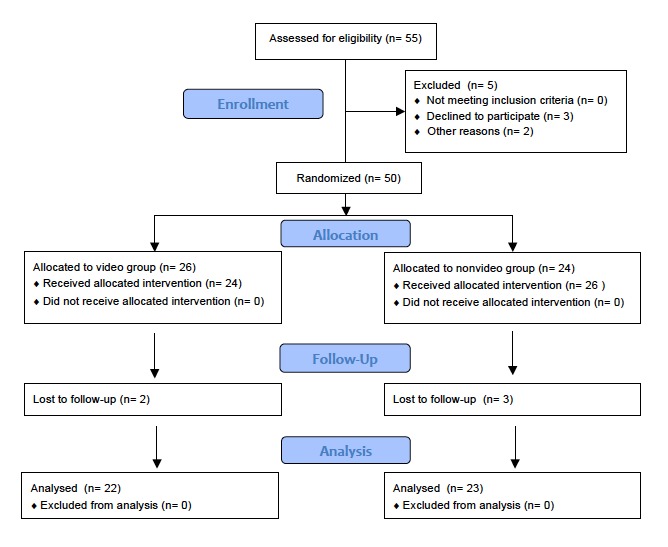
At the start of their obstetrics and gynecology clerkship, 45 students were videotaped tying surgical knots for 2 minutes using a board model. Two blinded female pelvic medicine and reconstructive surgery physicians evaluated proficiency with a standard checklist (score range 0-16) and anchored scoring scale (range 0-20); higher numbers represent better skill. Students were then randomized to either (1) expert video (n=26) or (2) nonvideo (n=24) groups. The video group was provided unlimited access to an expert knot-tying instructional video. At the completion of the clerkship, students were again videotaped and evaluated.
At initial evaluation, preclerkship cumulative scores (range 0-36) on the standard checklist and anchored scale were not significantly different between the nonvideo and video groups (mean 20.3, SD 7.1 vs mean 20.2, SD 9.2, P=.90, respectively). Postclerkship scores improved in both the nonvideo and video groups (mean 28.4, SD 5.4, P<.001 and mean 28.7, SD 6.5, P=.004, respectively). Increased knot board practice was significantly correlated with higher postclerkship scores on the knot-tying task, but only in the video group (r=.47, P<.05).
The addition of a Web-based expert instructional video to a standard curriculum, coupled with knot board practice, appears to have a positive impact on medical student knot-tying proficiency.
许多高年级医学生缺乏诸如打结之类的简单外科手术和操作技能。
本研究的目的是确定在标准的三年级医学生课程之外,观看基于网络的专家打结训练视频是否会使外科打结更熟练。
在妇产科实习开始时,45名学生使用板模型进行2分钟的外科打结录像。两名不知情的女性盆底医学和重建外科医生使用标准检查表(评分范围0 - 16)和锚定评分量表(范围0 - 20)评估熟练程度;分数越高表示技能越好。然后将学生随机分为两组:(1)专家视频组(n = 26)或(2)非视频组(n = 24)。视频组可无限次观看专家打结教学视频。在实习结束时,再次对学生进行录像和评估。
在初始评估时,非视频组和视频组在标准检查表和锚定量表上的实习前累积分数(范围0 - 36)无显著差异(分别为均值20.3,标准差7.1与均值20.2,标准差9.2,P = 0.90)。实习后两组分数均有所提高(分别为均值28.4,标准差5.4,P < 0.001和均值28.7,标准差6.5,P = 0.004)。打结板练习次数增加与打结任务的实习后分数较高显著相关,但仅在视频组中如此(r = 0.47,P < 0.05)。
在标准课程中增加基于网络的专家教学视频,并结合打结板练习,似乎对外科打结熟练程度有积极影响。