Faculty of Medicine and Health, The University of Sydney, Sydney, NSW, Australia.
Faculty of Medicine and Health, The University of Sydney, Sydney, NSW, Australia.
J Surg Educ. 2022 Nov-Dec;79(6):1536-1545. doi: 10.1016/j.jsurg.2022.07.016. Epub 2022 Aug 4.
Online education has been increasingly utilized over the past decades. The COVID-19 pandemic accelerated the transition of conventional face-to-face curricula to online platforms, with limited evidence for its teaching efficacy. This systematic review aims to assess the effectiveness of online video-based education compared with standard conventional education in teaching basic surgical skills to surgical trainees and students undergoing medical training.
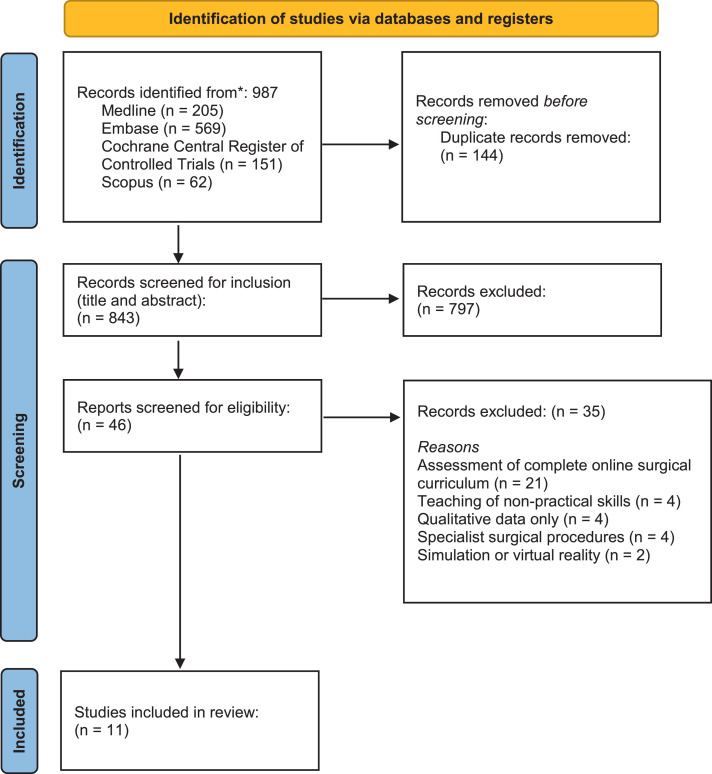
We performed a literature search in Embase, Medline, Cochrane CENTRAL and Scopus from inception until February 2022. Studies included were randomised controlled trials (RCTs) and observational studies. We included randomised controlled trials only for meta-analysis. The primary outcome was surgical skill proficiency. The secondary outcomes were participant perception, confidence and satisfaction. Two authors independently assessed the search results for eligibility, extracted the data and assessed the risk of bias using the Cochrane Risk of Bias tool 2. Where appropriate, we performed random effects meta-analyses of the pooled study data to calculate a standardized mean difference.
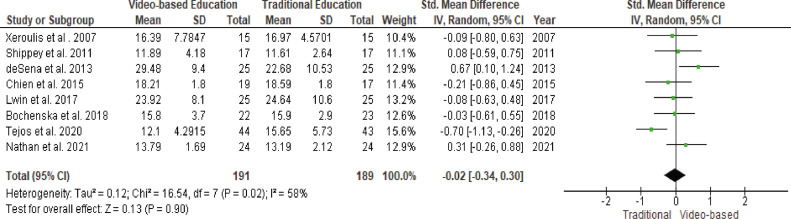
A total of 11 studies met the inclusion criteria totaling 715 participants; 603 were included in qualitative analysis and 380 in meta-analysis. All included studies were assessed as having a low risk of bias. The majority of studies found no significant difference between conventional and video-based education in teaching basic surgical skills, three studies found video-based education was superior and one study found conventional education was superior. There was no statistically significant difference in skill proficiency between the two groups (standardized mean difference of -0.02 (95% CI: -0.34, 0.30); p=0.90). Video-based education results in an equivalent improvement in confidence and satisfaction rates. Additional benefits of video-based education include convenience, accessibility and efficiency.
Basic surgical skills can be taught as effectively through online video-based education as conventional teaching methods. Online education should be utilized as an adjunct to medical curricula beyond the COVID-19 era.
过去几十年来,在线教育得到了越来越多的应用。新冠疫情加速了传统面对面课程向在线平台的转变,但关于其教学效果的证据有限。本系统评价旨在评估在线视频教育与传统标准教育相比,在向接受医学培训的外科实习医生和学生教授基本外科技能方面的效果。
我们在 Embase、Medline、Cochrane CENTRAL 和 Scopus 数据库中进行了文献检索,检索时间从建库至 2022 年 2 月。研究包括随机对照试验(RCT)和观察性研究。我们仅对 RCT 进行 meta 分析。主要结局是手术技能熟练程度。次要结局是参与者的感知、信心和满意度。两位作者独立评估检索结果的纳入资格,提取数据,并使用 Cochrane 偏倚风险工具 2 评估偏倚风险。在适当的情况下,我们对汇总研究数据进行随机效应 meta 分析,以计算标准化均数差。
共有 11 项研究符合纳入标准,共计 715 名参与者;603 项研究纳入定性分析,380 项研究纳入 meta 分析。所有纳入的研究均被评估为低偏倚风险。大多数研究发现,在教授基本外科技能方面,传统教育与视频教育之间没有显著差异,3 项研究发现视频教育更优越,1 项研究发现传统教育更优越。两组在技能熟练程度方面无统计学差异(标准化均数差为-0.02(95%CI:-0.34,0.30);p=0.90)。视频教育在提高信心和满意度方面的效果相当。视频教育的额外优势包括便利性、可及性和效率。
基本外科技能可以通过在线视频教育与传统教学方法一样有效地教授。在线教育应作为新冠疫情后医学课程的辅助手段加以利用。