Department Nephrology, Centre Hospitalier Lyon Sud, F-69495 Pierre-Benite, France.
CarMeN Lab, INSA-Lyon, INSERM U1060, INRA, University Lyon 1, F-69621 Villeurbanne, France.
Toxins (Basel). 2018 Apr 13;10(4):155. doi: 10.3390/toxins10040155.
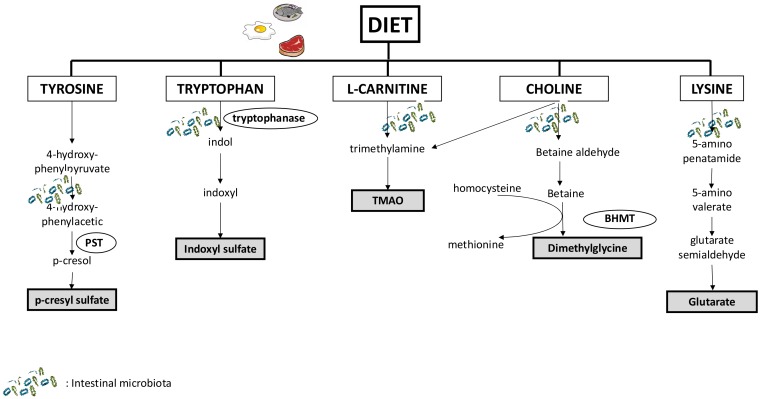
Uremic retention solutes (URS) are associated with cardiovascular complications and poor survival in chronic kidney disease. The better understanding of the origin of a certain number of these toxins enabled the development of new strategies to reduce their production. URS can be classified according to their origins (i.e., host, microbial, or exogenous). The discovery of the fundamental role that the intestinal microbiota plays in the production of many URS has reinstated nutrition at the heart of therapeutics to prevent the accumulation of URS and their deleterious effects. The intestinal microbiota is personalized and is strongly influenced by dietary habits, such as the quantity and the quality of dietary protein and fibers. Herein, this review out lines the role of intestinal microbiota on URS production and the recent discoveries on the effect of diet composition on the microbial balance in the host with a focus on the effect on URS production.
尿毒症潴留溶质(URS)与慢性肾脏病的心血管并发症和不良预后相关。对某些毒素来源的更好理解,使得开发减少其产生的新策略成为可能。URS 可根据其来源(即宿主、微生物或外源性)进行分类。肠道微生物群在产生许多 URS 方面的基本作用的发现,使营养重新成为治疗的核心,以防止 URS 的积累及其有害影响。肠道微生物群是个性化的,并且受到饮食习惯的强烈影响,例如膳食蛋白质和纤维的数量和质量。本文概述了肠道微生物群在 URS 产生中的作用,以及最近关于饮食成分对宿主中微生物平衡的影响的发现,重点是对 URS 产生的影响。