Oregon Research Institute, USA.
Oregon Research Institute, USA.
Behav Res Ther. 2018 Jun;105:52-62. doi: 10.1016/j.brat.2018.03.005. Epub 2018 Mar 17.
Because no study has tested for interactions between risk factors in the prediction of future onset of each eating disorder, this exploratory study addressed this lacuna to generate hypotheses to be tested in future confirmatory studies.
Data from three prevention trials that targeted young women at high risk for eating disorders due to body dissatisfaction (N = 1271; M age 18.5, SD 4.2) and collected diagnostic interview data over 3-year follow-up were combined to permit sufficient power to predict onset of anorexia nervosa (AN), bulimia nervosa (BN), binge eating disorder (BED), and purging disorder (PD) using classification tree analyses, an analytic technique uniquely suited to detecting interactions.
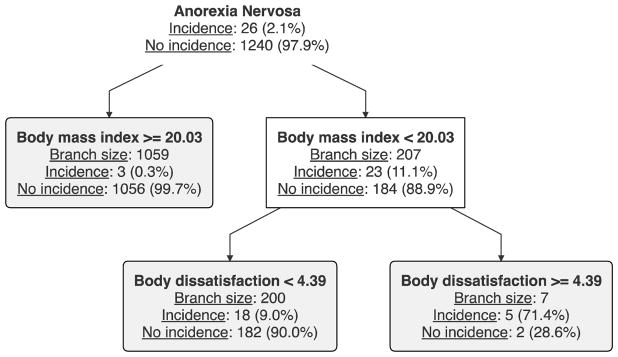
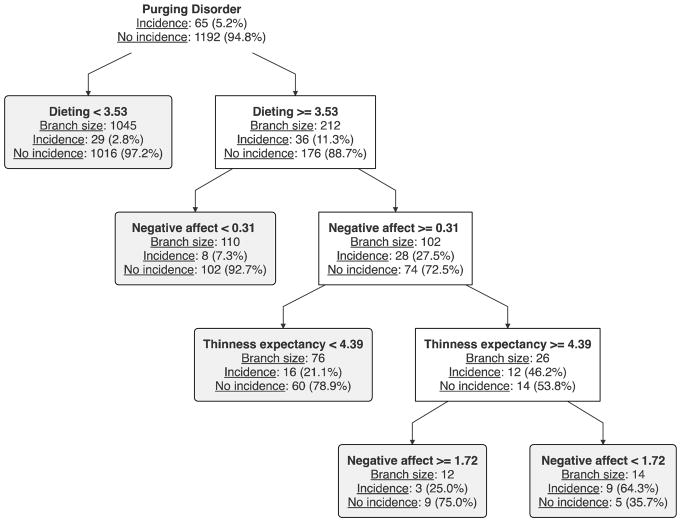
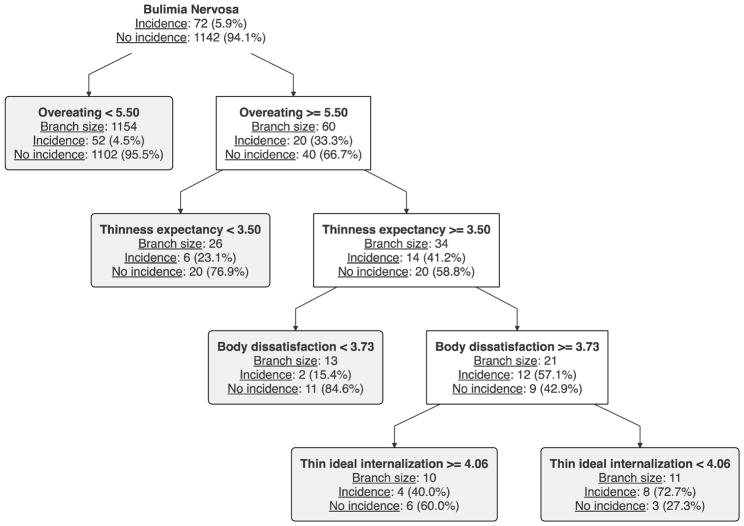
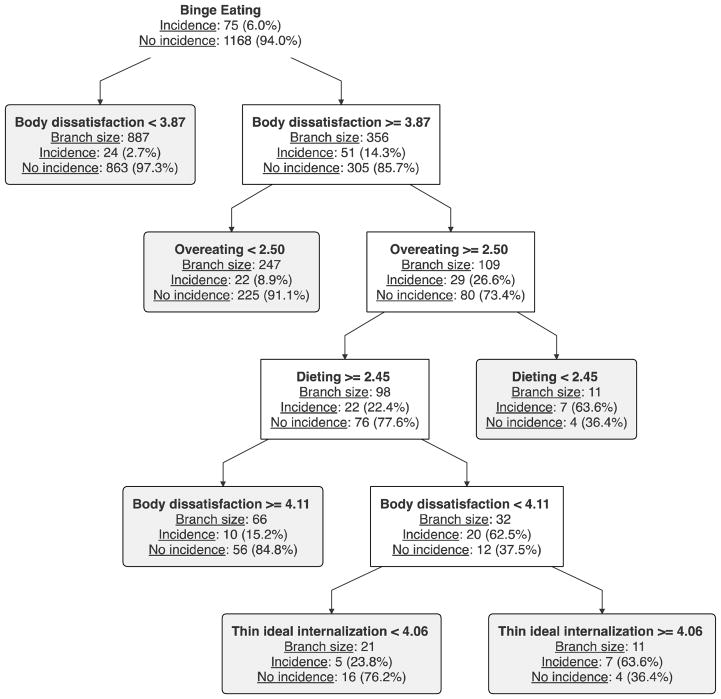
Low BMI was the most potent predictor of AN onset, and body dissatisfaction amplified this relation. Overeating was the most potent predictor of BN onset, and positive expectancies for thinness and body dissatisfaction amplified this relation. Body dissatisfaction was the most potent predictor of BED onset, and overeating, low dieting, and thin-ideal internalization amplified this relation. Dieting was the most potent predictor of PD onset, and negative affect and positive expectancies for thinness amplified this relation.
Results provided evidence of amplifying interactions between risk factors suggestive of cumulative risk processes that were distinct for each disorder; future confirmatory studies should test the interactive hypotheses generated by these analyses. If hypotheses are confirmed, results may allow interventionists to target ultra high-risk subpopulations with more intensive prevention programs that are uniquely tailored for each eating disorder, potentially improving the yield of prevention efforts.
由于尚无研究检验预测每种进食障碍未来发病的风险因素之间的相互作用,因此本探索性研究旨在弥补这一空白,并提出可在未来验证性研究中检验的假设。
本研究整合了三项针对因不满体型而处于进食障碍高风险的年轻女性(N=1271;平均年龄 18.5,标准差 4.2)的预防试验的数据,这些试验通过 3 年随访收集了诊断访谈数据,以便有足够的能力使用分类树分析预测神经性厌食症(AN)、神经性贪食症(BN)、暴食障碍(BED)和清除障碍(PD)的发病,分类树分析是一种特别适合检测相互作用的分析技术。
低 BMI 是预测 AN 发病的最有力预测因子,而不满体型则放大了这种关系。暴饮暴食是预测 BN 发病的最有力预测因子,而对变瘦的积极期望和不满体型则放大了这种关系。不满体型是预测 BED 发病的最有力预测因子,而暴饮暴食、低节食和瘦体型内化则放大了这种关系。节食是预测 PD 发病的最有力预测因子,而消极情绪和对变瘦的积极期望则放大了这种关系。
结果为风险因素之间存在放大的相互作用提供了证据,这表明每种障碍都存在累积风险过程;未来的验证性研究应检验这些分析提出的交互假设。如果假设得到证实,结果可能使干预者能够针对每个进食障碍为具有超高风险的亚人群提供更密集的预防计划,从而可能提高预防效果。