International Centre for Eye Health, London School of Hygiene & Tropical Medicine, London, UK.
The Carter Center, Addis Ababa, Ethiopia.
Lancet Glob Health. 2018 May;6(5):e579-e592. doi: 10.1016/S2214-109X(18)30111-6.
Trachomatous trichiasis is treated surgically to prevent sight loss. Unfavourable surgical outcomes remain a major challenge. We investigated the hypothesis that doxycycline might reduce the risk of postoperative trichiasis following surgery in patients with trachomatous trichiasis through anti-matrix metalloproteinase and anti-inflammatory activity.
In this randomised, double-blind, placebo-controlled trial, adults (aged >18 years) with upper lid trachomatous trichiasis in association with tarsal conjunctive scarring were recruited through community-based screening and surgical outreach campaigns in Ethiopia. Individuals who had previously had eyelid surgery were excluded. Participants were randomly assigned (1:1), with random block sizes of four or six, to receive oral doxycycline (100 mg once a day) or placebo for 28 days immediately after trichiasis surgery. Randomisation was stratified by surgeon. Patients, investigators, surgeons, and all other study team members were masked to study group allocation and treatment. Participants were examined at 10 days, and 1, 6, and 12 months after surgery. The primary outcome was the cumulative proportion of individuals who developed postoperative trichiasis by 12 months. Primary analyses were done in all participants who attended at least one of the four follow-up assessments. Safety analyses were done in all participants who attended either the 10 day or 1 month follow-up assessments. This trial is registered with the Pan African Clinical Trials Registry, number PACTR201512001370307.
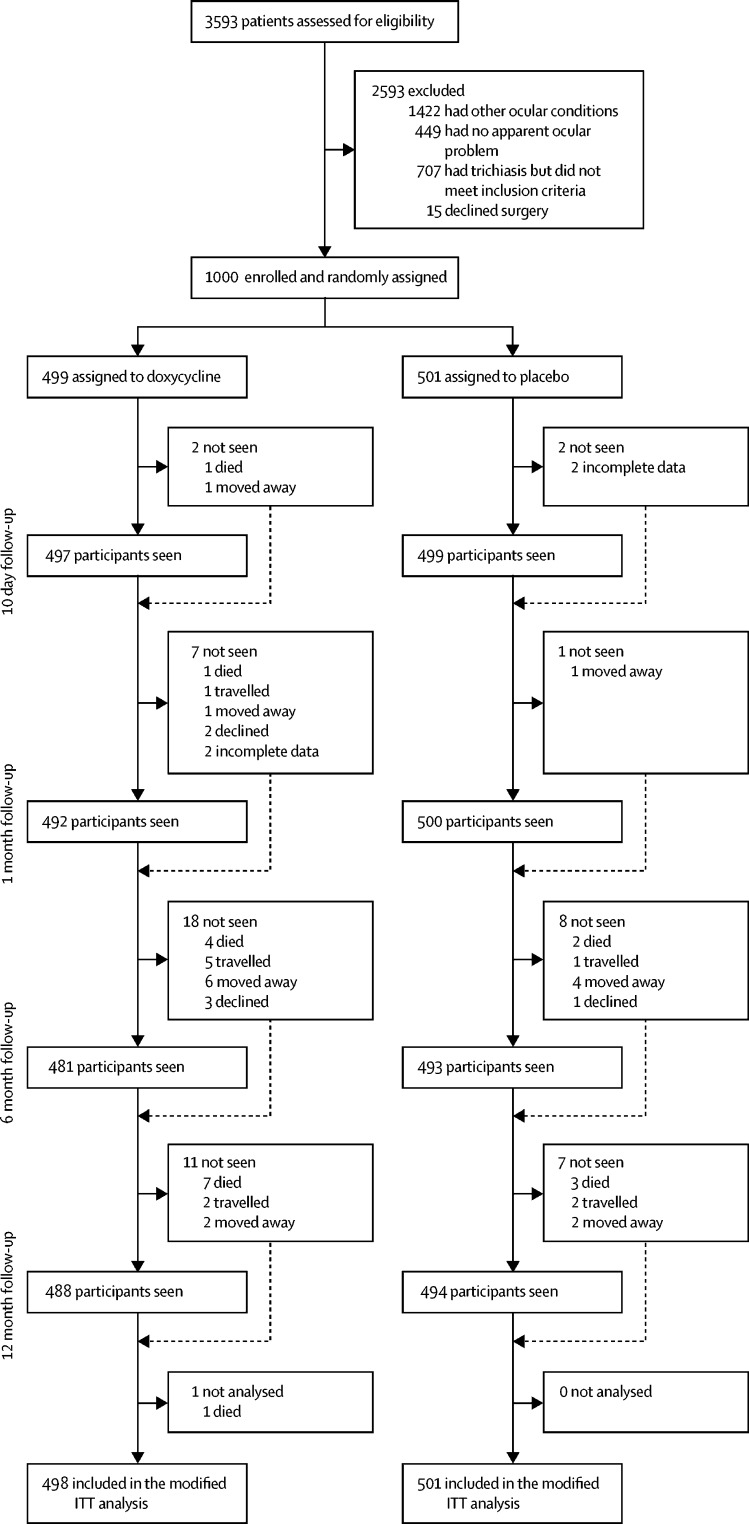
Between Dec 21, 2015, and April 6, 2016, 1000 patients with trichiasis were enrolled and randomly assigned to treatment (499 patients to doxycycline, 501 patients to placebo). All but one participant attended at least one follow-up assessment. Thus, 999 participants were assessed for the primary outcome: 498 in the doxycycline group and 501 in the placebo group. By month 12, 58 (12%) of 498 patients in the doxycycline group and 62 (12%) of 501 patients in the placebo group had developed postoperative trichiasis (adjusted odds ratio 0·91, 95% CI 0·61 to 1·34, p=0·63), with a risk difference of -0·5% (-4·5% to 3·5%). Significantly more patients in the doxycycline group had an adverse event than in the placebo group (18 [4%] of 498 vs six [1%] of 501; odds ratio 3·09, 95% CI 1·21-7·84; p=0·02). The most frequent adverse events in the doxycycline group were gastritis symptoms (n=9), constipation (n=4), and diarrhoea (n=4).
Doxycycline did not reduce the risk of postoperative trichiasis and is therefore not indicated for the improvement of outcomes following trachomatous trichiasis surgery. Surgical programmes should continue to make efforts to strengthen surgical training and supervision to improve outcomes.
The Wellcome Trust.
沙眼性倒睫通过手术治疗以防止视力丧失。但术后不良结局仍是一个主要挑战。我们通过抗基质金属蛋白酶和抗炎活性,研究了强力霉素可能降低沙眼性倒睫患者手术后发生倒睫风险的假设。
这是一项随机、双盲、安慰剂对照试验,纳入了埃塞俄比亚社区筛查和外展手术中患有上睑沙眼性倒睫和睑板结膜瘢痕的成年患者(年龄>18 岁)。先前接受过眼睑手术的患者被排除在外。参与者被随机分配(1:1),采用 4 或 6 个随机块大小,接受 100mg 强力霉素(每天一次)或安慰剂治疗,在沙眼性倒睫手术后立即使用 28 天。随机化按外科医生分层。患者、研究者、外科医生和所有其他研究团队成员均对研究组分配和治疗方案设盲。参与者在手术后 10 天、1 个月、6 个月和 12 个月接受检查。主要结局是在 12 个月时发生术后倒睫的个体累积比例。主要分析纳入了至少参加过四次随访评估中的一次的所有参与者。安全性分析纳入了至少参加过 10 天或 1 个月随访评估的所有参与者。该试验在泛非临床试验注册中心(Pancrican Clinical Trials Registry)注册,编号为 PACTR201512001370307。
2015 年 12 月 21 日至 2016 年 4 月 6 日,纳入了 1000 名患有倒睫的患者,并随机分配至治疗组(499 名患者接受强力霉素,501 名患者接受安慰剂)。除 1 人外,所有患者均参加了至少一次随访评估。因此,对 999 名参与者进行了主要结局评估:强力霉素组 498 名,安慰剂组 501 名。在 12 个月时,强力霉素组中 58(12%)名患者和安慰剂组中 62(12%)名患者发生了术后倒睫(调整后的优势比 0.91,95%CI 0.61 至 1.34,p=0.63),风险差异为-0.5%(-4.5%至 3.5%)。强力霉素组发生不良事件的患者明显多于安慰剂组(498 名患者中有 18 名[4%]vs 501 名患者中有 6 名[1%];比值比 3.09,95%CI 1.21-7.84;p=0.02)。强力霉素组最常见的不良事件是胃炎症状(n=9)、便秘(n=4)和腹泻(n=4)。
强力霉素并未降低术后倒睫的风险,因此不推荐用于改善沙眼性倒睫手术后的结局。手术项目应继续努力加强手术培训和监督,以改善结局。
惠康基金会。