Ward Alexander H, Norton Thomas T, Huisingh Carrie E, Gawne Timothy J
Department of Optometry and Vision Science, University of Alabama at Birmingham, Birmingham, AL 35294, United States.
Department of Ophthalmology, University of Alabama at Birmingham, Birmingham, AL 35294, United States.
Vision Res. 2018 May;146-147:9-17. doi: 10.1016/j.visres.2018.03.006. Epub 2018 Apr 26.
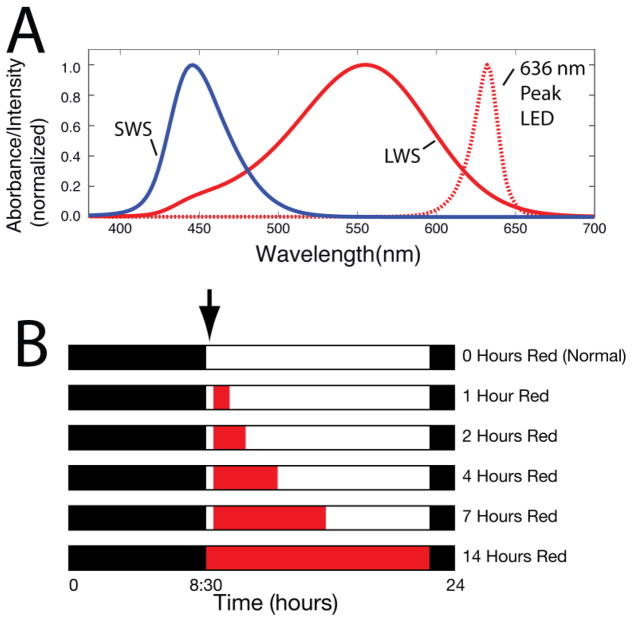
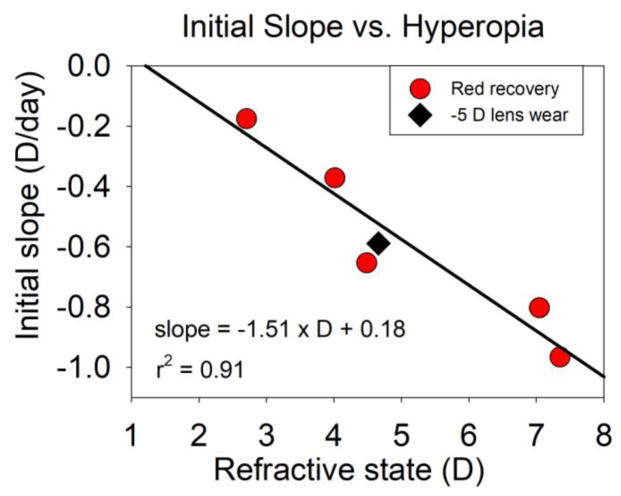
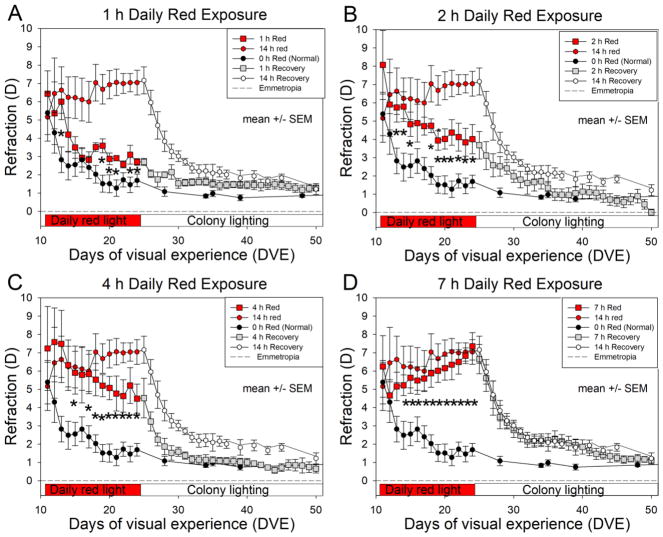
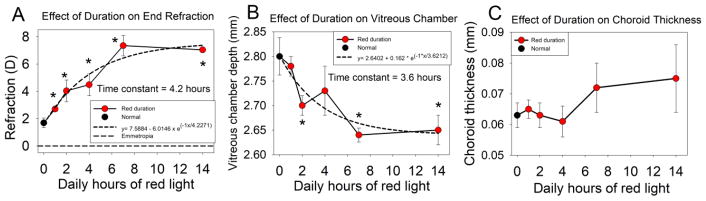
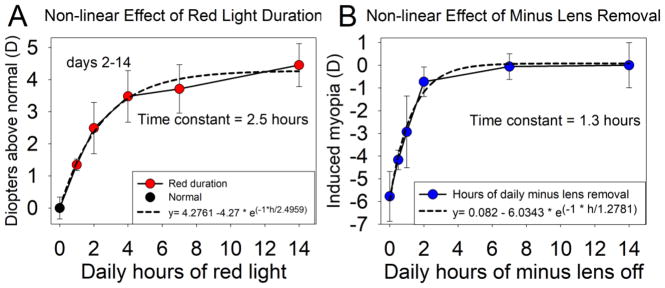
During postnatal refractive development, an emmetropization mechanism uses refractive error to modulate the growth rate of the eye. Hyperopia (image focused behind the retina) produces what has been described as "GO" signaling that increases growth. Myopia (image focused in front of the retina) produces "STOP" signaling that slows growth. The interaction between GO and STOP conditions is non-linear; brief daily exposure to STOP counteracts long periods of GO. In young tree shrews, long-wavelength (red) light, presented 14 h per day, also appears to produce STOP signals. We asked if red light also shows temporal non-linearity; does brief exposure slow the normal decrease in hyperopia in infant animals? At 11 days after eye opening (DVE), infant tree shrews (n = 5/group) began 13 days of daily treatment (red LEDs, 624 ± 10 or 636 ± 10 nm half peak intensity bandwidth) at durations of 0 h (normal animals, n = 7) or 1, 2, 4, or 7 h. Following each daily red period, colony lighting resumed. A 14 h red group had no colony lights. Refractive state was measured daily; ocular component dimensions at the end of the 13-day red-light period. Even 1 h of red light exposure produced some hyperopia. The average hyperopic shift from normal rose exponentially with duration (time constant 2.5 h). Vitreous chamber depth decreased non-linearly with duration (time constant, 3.3 h). After red treatment was discontinued, refractions in colony lighting recovered toward normal; the initial rate was linearly related to the amount of hyperopia. The red light may produce STOP signaling similar to myopic refractive error.
在出生后的屈光发育过程中,正视化机制利用屈光不正来调节眼睛的生长速度。远视(图像聚焦在视网膜后方)产生所谓的“启动”信号,可增加眼球生长。近视(图像聚焦在视网膜前方)产生“停止”信号,可减缓眼球生长。“启动”和“停止”状态之间的相互作用是非线性的;每天短暂暴露于“停止”状态可抵消长时间的“启动”状态。在幼年树鼩中,每天照射14小时的长波长(红色)光似乎也会产生“停止”信号。我们想知道红光是否也表现出时间上的非线性;短暂暴露是否会减缓幼年动物远视的正常降低?在睁眼后11天(DVE),幼年树鼩(每组n = 5)开始进行为期13天的每日治疗(红色发光二极管,半峰强度带宽为624±10或636±10 nm),持续时间为0小时(正常动物,n = 7)或1、2、4或7小时。每天的红光照射结束后,恢复群体照明。14小时红光组没有群体照明。每天测量屈光状态;在13天红光照射期结束时测量眼部各组成部分的尺寸。即使暴露1小时红光也会产生一些远视。与正常情况相比,平均远视偏移量随持续时间呈指数增加(时间常数为2.5小时)。玻璃体腔深度随持续时间呈非线性下降(时间常数为3.3小时)。停止红光治疗后,群体照明下的屈光状态恢复至正常;初始恢复速率与远视量呈线性相关。红光可能产生与近视性屈光不正类似的“停止”信号。