School of Healthcare Sciences, Cardiff University, Cardiff, UK.
Marie Curie Palliative Care Research Centre, Division of Population Medicine, School of Medicine, Cardiff University, Cardiff, UK.
BMC Palliat Care. 2018 Apr 16;17(1):60. doi: 10.1186/s12904-018-0314-4.
Symptom management is an essential aspect of palliative and end-of-life care, but evidence suggests that patients' symptoms may not always be relieved, causing significant harm to patients and magnifying their relatives' distress. A growing body of evidence focuses on symptom management at the end-of-life, but research funding for palliative care remains disproportionately low. It is therefore crucial that research funding is targeted at areas of importance to patients and relatives. The Palliative and end-of-life care Priority Setting Partnership (PeolcPSP) undertook a UK-wide free-text survey to establish research priorities within palliative and end-of-life care and disseminated its results in 2015. Much of the data were related more broadly to personal perceptions and experiences rather than specific research questions. The aim of this article is to report on a supplementary analysis exploring the experiences and questions of PeolcPSP survey respondents regarding symptoms, hydration and nutrition.
The PeolcPSP data (n = 1403) were coded by a team of qualitative researchers in a supplementary analysis. There were 190 responses that related to symptoms, nutrition and hydration. The data were analysed thematically using Braun and Clarke's approach.
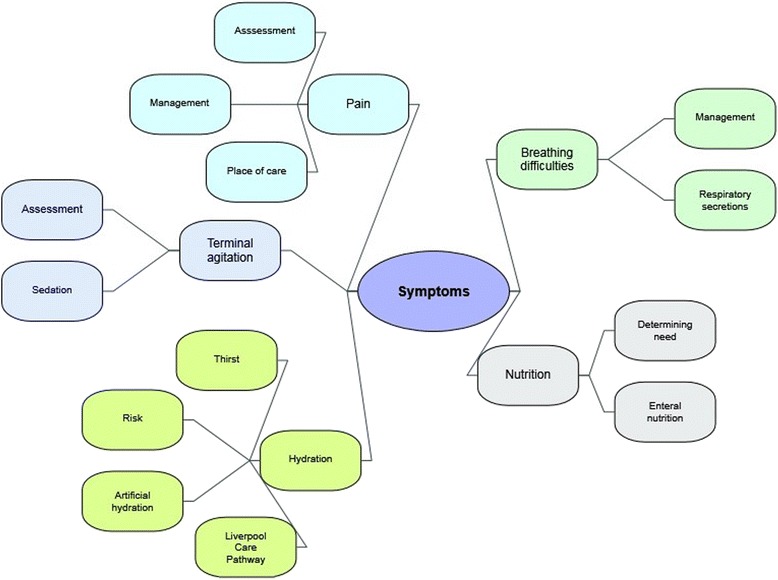
Five themes were identified: pain, breathlessness, agitation, nutrition and hydration. The majority of responses related to symptoms that were sub-optimally managed, in particular pain. Nutrition and hydration were of significant concern, particularly for carers. Overall, respondents consistently asked about the most effective, evidence-based methods for managing symptoms and suggested areas where further research is necessary.
This study highlights the perceptions and experiences of patients, families and professionals within palliative care, highlighting the need for improved care, communication and further research to establish which treatments are most effective within a palliative care population. This is essential to reduce harm and distress for patients and families.
症状管理是姑息治疗和临终关怀的重要方面,但有证据表明,患者的症状并不总是能得到缓解,这给患者带来了严重的伤害,并加剧了患者家属的痛苦。越来越多的证据集中在临终前的症状管理上,但姑息治疗的研究资金仍然不成比例地不足。因此,至关重要的是,研究资金应针对对患者和家属重要的领域。姑息治疗和临终关怀重点设定伙伴关系(PeolcPSP)在英国范围内进行了一项免费的文本调查,以确定姑息治疗和临终关怀领域的研究重点,并于 2015 年公布了调查结果。大部分数据更广泛地涉及个人的看法和经验,而不是具体的研究问题。本文的目的是报告一项补充分析,该分析探讨了 PeolcPSP 调查受访者在症状、水合作用和营养方面的经验和问题。
PeolcPSP 数据(n=1403)由一组定性研究人员在一项补充分析中进行编码。有 190 个与症状、营养和水合作用相关的回复。数据使用 Braun 和 Clarke 的方法进行主题分析。
确定了五个主题:疼痛、呼吸困难、躁动、营养和水合作用。大多数回复与管理不佳的症状有关,特别是疼痛。营养和水合作用是人们关注的焦点,特别是对护理人员而言。总体而言,受访者一直询问最有效、基于证据的症状管理方法,并建议需要进一步研究的领域。
这项研究突出了姑息治疗中患者、家庭和专业人员的看法和经验,强调需要改善护理、沟通和进一步研究,以确定在姑息治疗人群中哪些治疗方法最有效。这对于减轻患者和家庭的伤害和痛苦至关重要。