Tilouche Nejla, Hassen Mohamed Fekih, Ali Habiba Ben Sik, Jaoued Oussamma, Gharbi Rim, El Atrous S Souheil
Intensive Care Unit, University Hospital Taher Sfar Mahdia 5100, Tunisia.
University of Monastir, Research Laboratory, LR 12SP15.
Indian J Crit Care Med. 2018 Mar;22(3):144-149. doi: 10.4103/ijccm.IJCCM_244_17.
The incidence and risk factors for delirium vary among studies.
We aimed to determine the incidence, risk factors, and impact on outcome of delirium in a medical Intensive Care Unit (ICU) in Tunisia using a prospective observational study.
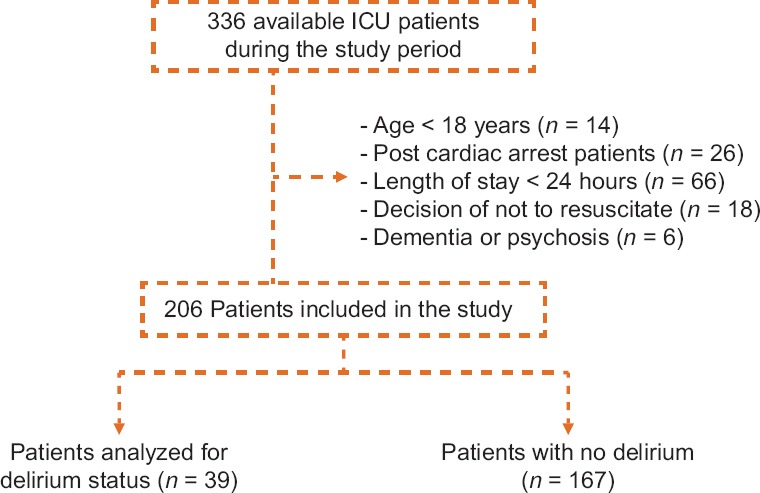
All consecutive patients admitted to the ICU between May 2012 and April 2013 were included if they were aged more than 18 years and had an ICU stay of more than 24 h. Patients who had a cardiac arrest or have a history of dementia or psychosis were excluded. Patients eligible for the study were evaluated by the medical staff to detect delirium using the CAM-ICU.
A total of 206 patients were included, 167 did not present delirium and 39 (19%) were analyzed for delirium. Delirious patients had a significantly longer duration of mechanical ventilation (10 days[6-20] vs. 2 days[0-7]) respectively and length of stay in ICU (21.5 days [10.5-32.5] vs. 8 days [5-13]), with no impact on mortality. Delirium was associated with high incidence of unintentional removal of catheters (39% vs. 9%; < 0.0001), endotracheal tubes (18% vs. 1%; < 0.0001), and urinary catheters (28% vs. 2%, < 0.0001). In multivariable risk regression analysis, age (odds ratio [OR] = 4.1, 95% confidence interval [CI]: 1.39-12.21; = 0.01), hypertension (OR = 3.3, 95% CI: 1.31-8.13; = 0.011), COPD (OR = 3.5, 95% CI: 1.47-8.59; = 0.005), steroids (OR = 2.8, 95% CI: 1.05-7.28; = 0.038), and sedation (OR = 5.4, 95% CI: 2.08-13.9; < 0.0001) were independent risk factors for delirium. We did not find a relationship between delirium and mortality.
Delirium is frequent in the ICU and is associated with poor outcome. Several risk factors for delirium are linked to intensive care environment.
不同研究中谵妄的发病率及危险因素各不相同。
我们旨在通过一项前瞻性观察性研究,确定突尼斯一家内科重症监护病房(ICU)中谵妄的发病率、危险因素及其对预后的影响。
纳入2012年5月至2013年4月期间连续入住ICU且年龄超过18岁、ICU住院时间超过24小时的所有患者。排除曾发生心脏骤停或有痴呆或精神病病史的患者。符合研究条件的患者由医护人员使用CAM-ICU评估以检测谵妄。
共纳入206例患者,167例未出现谵妄,39例(19%)被分析是否存在谵妄。谵妄患者的机械通气时间(分别为10天[6 - 20]对2天[0 - 7])和ICU住院时间(21.5天[10.5 - 32.5]对8天[5 - 13])显著更长,对死亡率无影响。谵妄与意外拔除导管(39%对9%;<0.0001)、气管内导管(18%对1%;<0.0001)和导尿管(28%对2%,<0.0001)的高发生率相关。在多变量风险回归分析中,年龄(优势比[OR]=4.1,95%置信区间[CI]:1.39 - 12.21;P = 0.01)、高血压(OR = 3.3,95% CI:1.31 - 8.13;P = 0.011)、慢性阻塞性肺疾病(COPD)(OR = 3.5,95% CI:1.47 - 8.59;P = 0.005)、类固醇(OR = 2.8,95% CI:1.05 - 7.28;P = 0.038)和镇静(OR = 5.4,95% CI:2.08 - 13.9;P < 0.00