Division of Hepatobiliary and Pancreatic Surgery, Department of Surgery, First Affiliated Hospital, School of Medicine, Zhejiang University, Key Laboratory of Combined Multi‑Organ Transplantation, Ministry of Public Health Key Laboratory of Organ Transplantation, Collaborative Innovation Center for Diagnosis Treatment of Infectious Diseases, Hangzhou, Zhejiang 310003, P.R. China.
Mol Med Rep. 2018 Jun;17(6):8153-8160. doi: 10.3892/mmr.2018.8871. Epub 2018 Apr 12.
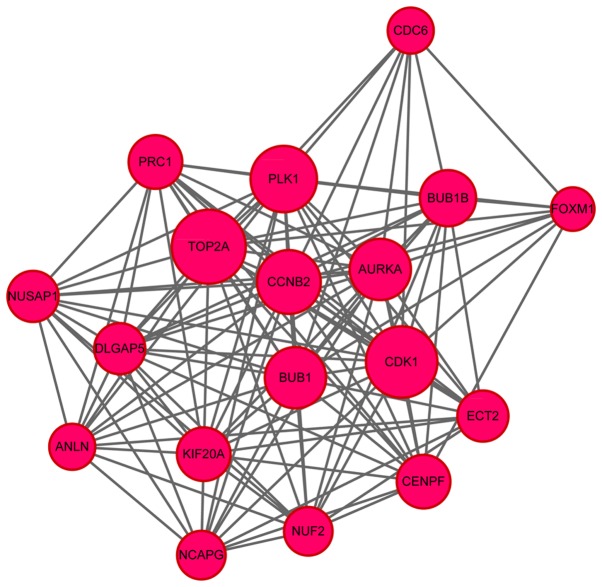
The purpose of the present study was to investigate the underlying molecular mechanism of hepatocellular carcinoma (HCC) using bioinformatics approaches. The microarray dataset GSE64041 was downloaded from the Gene Expression Omnibus database, which included 60 tumor liver samples and 60 matched control samples. Differentially expressed genes (DEGs) between HCC and control groups were identified. Then functional enrichment analyses, protein‑protein interaction (PPI) network, sub‑network and integrated transcription factor (TF)‑microRNA (miRNA)‑target network analyses were performed for these DEGs. A total of 378 DEGs were obtained, including 101 upregulated and 277 downregulated DEGs. In addition, functional enrichment analysis for DEGs in the sub‑network revealed 'cell division' and 'cell cycle' as key Gene Ontology (GO) terms and pathways. Topoisomerase (DNA) IIα (TOP2A) and integrin subunit α2 (ITGA2) were hub nodes in the PPI network. TOP2A, cyclin dependent kinase 1 (CDK1) and polo like kinase 1 (PLK1) were revealed to be hub nodes in the sub‑network. Finally, 4 TFs including forkhead box M1 (FOXM1), E2F transcription factor 4 (E2F4), SIN3 transcription regulator family member A (SIN3A) and transcription factor 7 like 1 (TCF7L1) were obtained through integrated network analysis. TOP2A, ITGA2, PLK1 and CDK1 may be key genes involved in HCC development. 'Cell division' and 'cell cycle' were indicated to act as key GO terms and Kyoto Encyclopedia of Genes and Genomes pathways in HCC. In addition, FOXM1, TCF7L1, E2F4 and SIN3A were revealed to be key TFs associated with HCC.
本研究旨在通过生物信息学方法探讨肝细胞癌(HCC)的潜在分子机制。从基因表达综合数据库中下载了 GSE64041 微阵列数据集,该数据集包含 60 个肿瘤肝样本和 60 个匹配的对照样本。鉴定 HCC 与对照组之间的差异表达基因(DEGs)。然后对这些 DEGs 进行功能富集分析、蛋白质-蛋白质相互作用(PPI)网络、子网络和综合转录因子(TF)-微小 RNA(miRNA)-靶基因网络分析。共获得 378 个 DEGs,包括 101 个上调和 277 个下调 DEGs。此外,子网络中 DEGs 的功能富集分析显示,“细胞分裂”和“细胞周期”是关键的基因本体论(GO)术语和途径。拓扑异构酶(DNA)IIα(TOP2A)和整合素亚基α2(ITGA2)是 PPI 网络中的枢纽节点。TOP2A、细胞周期蛋白依赖性激酶 1(CDK1)和 Polo 样激酶 1(PLK1)被揭示为子网络中的枢纽节点。最后,通过综合网络分析获得了 4 个 TF,包括叉头框 M1(FOXM1)、E2F 转录因子 4(E2F4)、SIN3 转录调节剂家族成员 A(SIN3A)和转录因子 7 样 1(TCF7L1)。TOP2A、ITGA2、PLK1 和 CDK1 可能是参与 HCC 发生发展的关键基因。“细胞分裂”和“细胞周期”被认为是 HCC 的关键 GO 术语和京都基因与基因组百科全书途径。此外,FOXM1、TCF7L1、E2F4 和 SIN3A 被揭示为与 HCC 相关的关键 TF。