Department of Psychology, University of Victoria.
Centre for Dementia Prevention, University of Edinburgh.
Psychol Aging. 2018 Mar;33(2):195-218. doi: 10.1037/pag0000236.
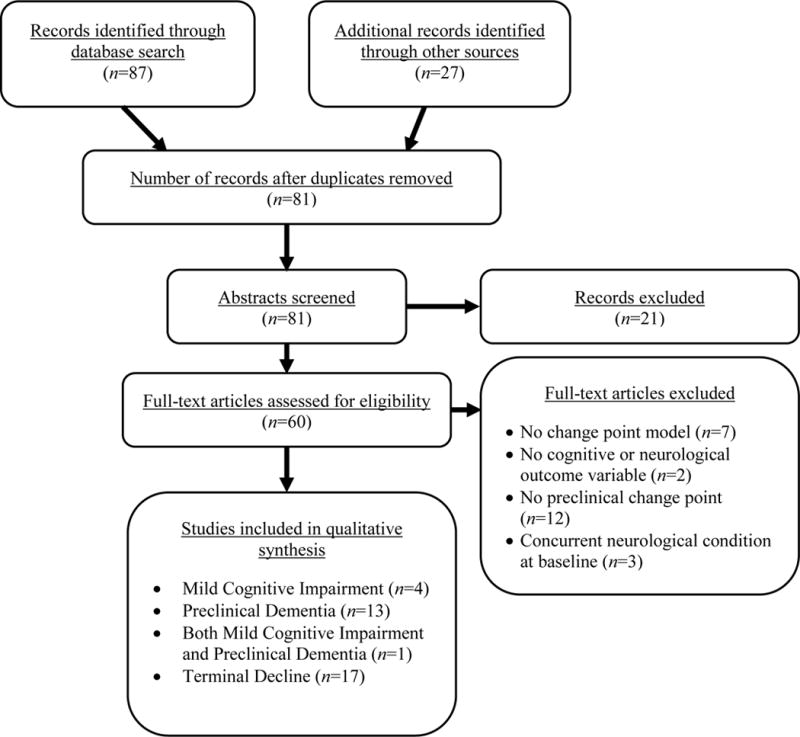
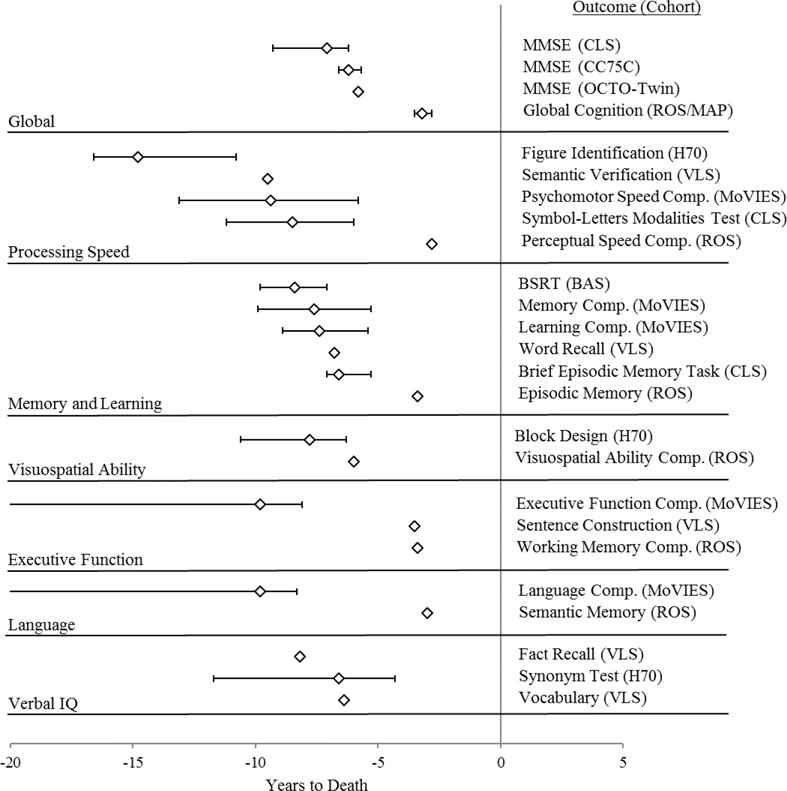
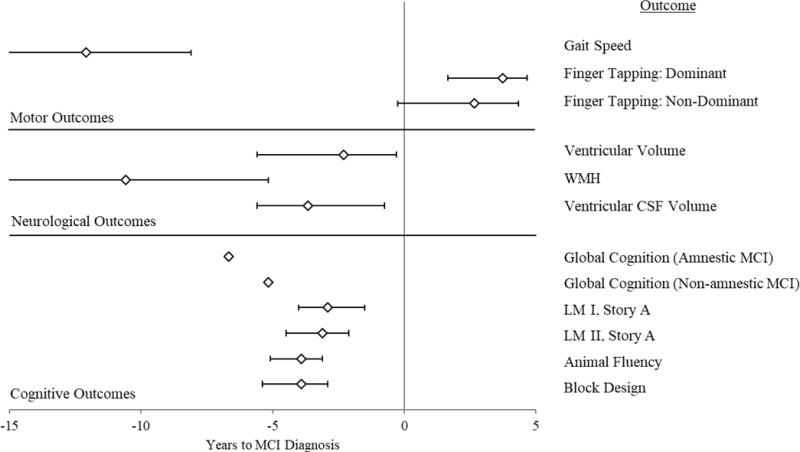
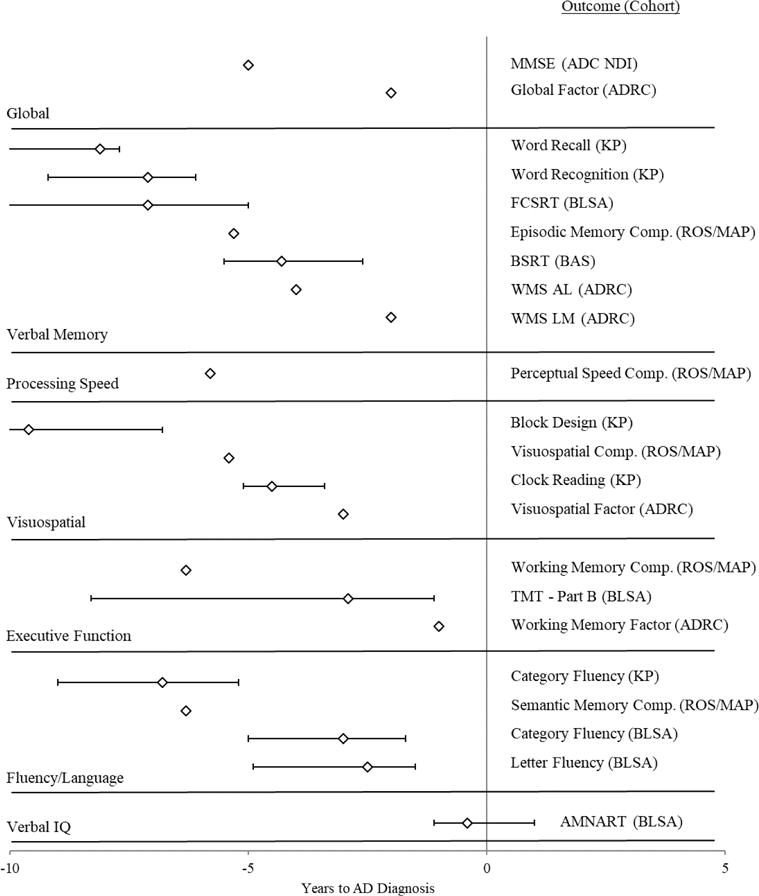
Older adults who ultimately develop dementia experience accelerated cognitive decline long before diagnosis. A similar acceleration in cognitive decline occurs in the years before death as well. To evaluate preclinical and terminal cognitive decline, past researchers have incorporated change points in their analyses of longitudinal data, identifying point estimates of how many years prior to diagnosis or death that decline begins to accelerate. The current systematic review aimed to summarize the published literature on preclinical and terminal change points in relation to mild cognitive impairment (MCI), dementia, and death, identifying the order in which cognitive and neurological outcomes decline and factors that modify the onset and rate of decline. A systematic search protocol yielded 35 studies, describing 16 longitudinal cohorts, modeling change points for cognitive and neurological outcomes preceding MCI, dementia, or death. Change points for cognitive abilities ranged from 3-7 years prior to MCI diagnosis, 1-11 years prior to dementia diagnosis, and 3-15 years before death. No sequence of decline was observed preceding MCI or death, but the following sequence was tentatively accepted for Alzheimer's disease: verbal memory, visuospatial ability, executive functions and fluency, and last, verbal IQ. Some of the modifiers of the onset and rate of decline examined by previous researchers included gender, education, genetics, neuropathology, and personality. Change point analyses evidence accelerated decline preceding MCI, dementia, and death, but moderators of the onset and rate of decline remain ambiguous due to between-study modeling differences, and coordinated analyses may improve comparability across future studies. (PsycINFO Database Record
最终发展为痴呆症的老年人在被诊断之前,认知能力会加速下降。在死亡前的几年里,也会出现类似的认知能力下降加速现象。为了评估临床前和终末期的认知能力下降,过去的研究人员在对纵向数据的分析中纳入了转折点,确定了在诊断或死亡前多少年开始加速下降的点估计值。本系统评价旨在总结关于轻度认知障碍(MCI)、痴呆和死亡的临床前和终末期转折点的文献,确定认知和神经结果下降的顺序以及改变下降起始和速度的因素。系统搜索方案产生了 35 项研究,描述了 16 个纵向队列,对 MCI 前、痴呆前或死亡前的认知和神经结果进行了转折点建模。认知能力的转折点范围从 MCI 诊断前 3-7 年,痴呆诊断前 1-11 年,死亡前 3-15 年。在 MCI 或死亡前没有观察到下降的顺序,但阿尔茨海默病的以下顺序被暂时接受:语言记忆、视空间能力、执行功能和流畅性,最后是语言智商。之前的研究人员研究了一些影响下降起始和速度的因素,包括性别、教育、遗传、神经病理学和个性。转折点分析表明,MCI、痴呆和死亡前认知能力下降加速,但由于研究间建模差异,下降起始和速度的调节因素仍不明确,协调分析可能会提高未来研究的可比性。