Sorbonne Université, CNRS, Laboratoire de Biologie du Développement de Villefranche-sur-mer (LBDV), 06230 Paris, France.
Departamento de Zoologia - Instituto Biociências, Universidade de São Paulo, São Paulo, Brazil.
Mol Biol Evol. 2018 Jul 1;35(7):1728-1743. doi: 10.1093/molbev/msy068.
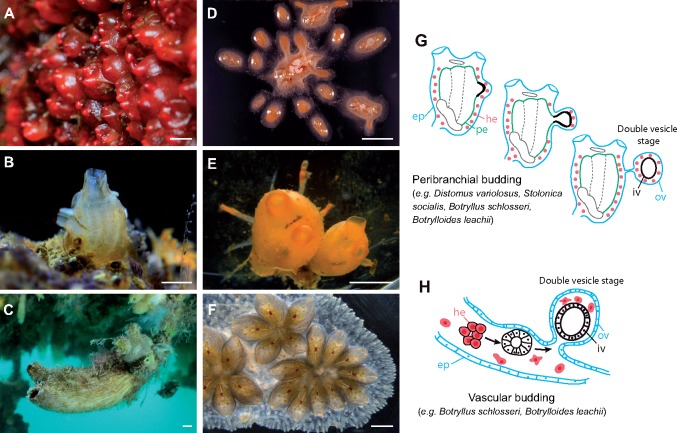
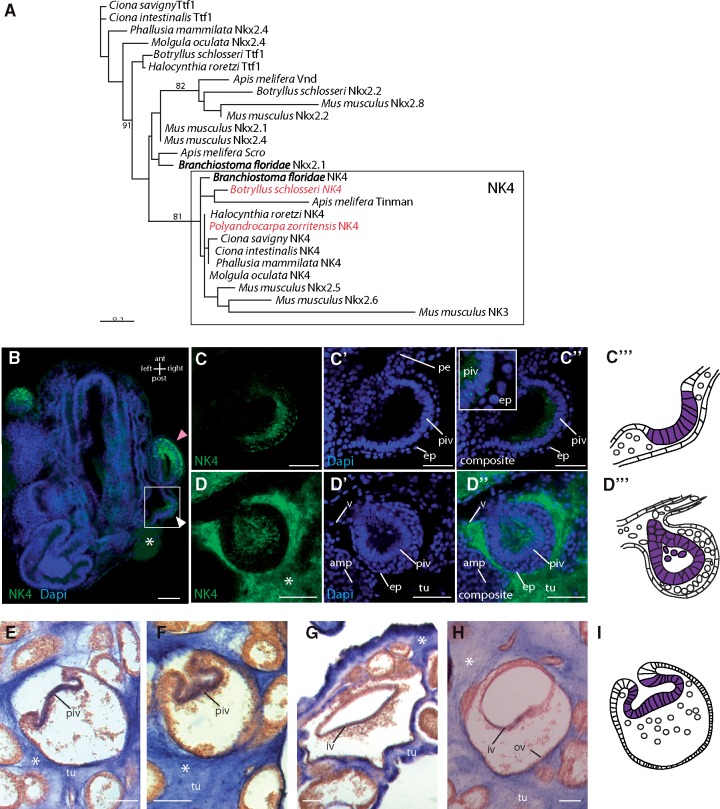
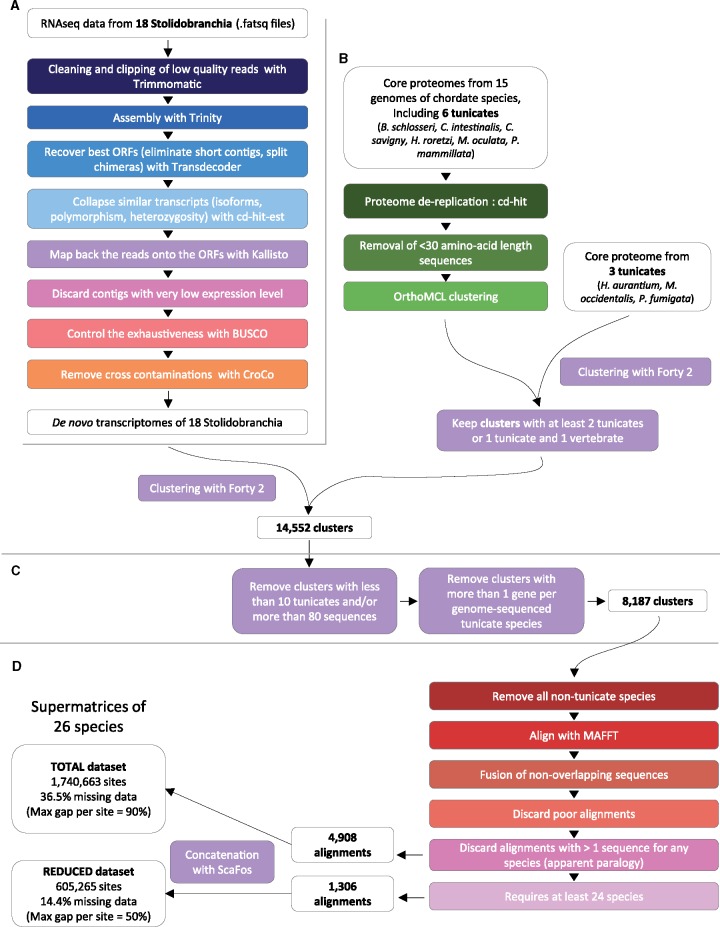
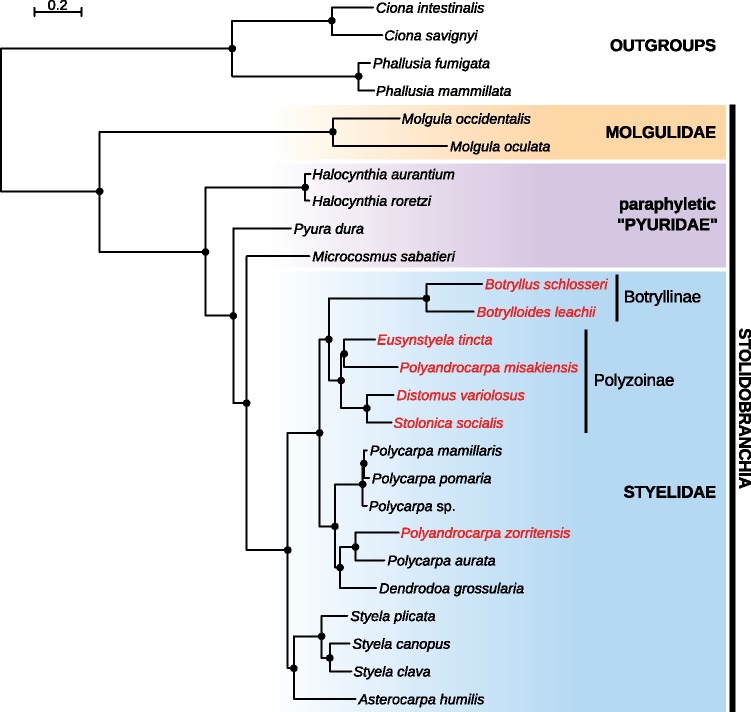
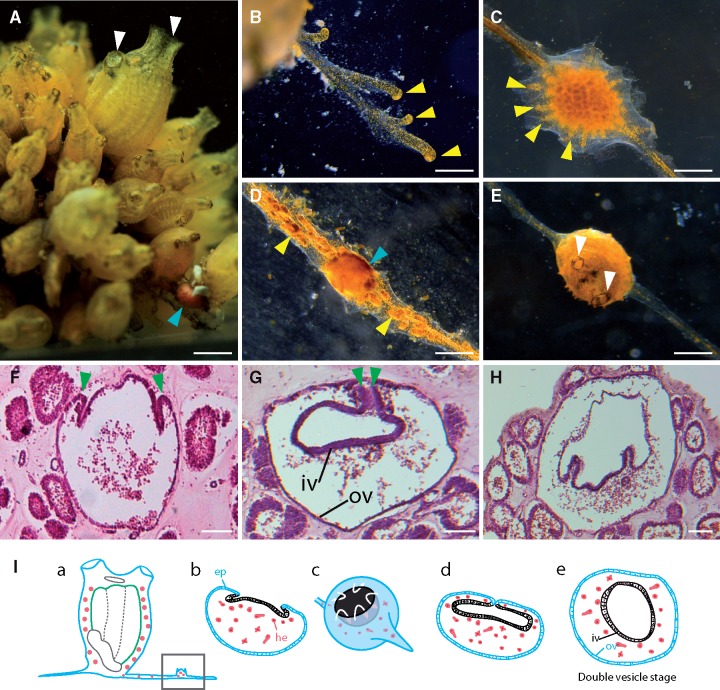
Asexual propagation and whole body regeneration are forms of nonembryonic development (NED) widespread across animal phyla and central in life history and evolutionary diversification of metazoans. Whereas it is challenging to reconstruct the gains or losses of NED at large phylogenetic scale, comparative studies could benefit from being conducted at more restricted taxonomic scale, in groups for which phylogenetic relationships are well established. The ascidian family of Styelidae encompasses strictly sexually reproducing solitary forms as well as colonial species that combine sexual reproduction with different forms of NED. To date, the phylogenetic relationships between colonial and solitary styelids remain controversial and so is the pattern of NED evolution. In this study, we built an original pipeline to combine eight genomes with 18 de novo assembled transcriptomes and constructed data sets of unambiguously orthologous genes. Using a phylogenomic super-matrix of 4,908 genes from these 26 tunicates we provided a robust phylogeny of this family of chordates, which supports two convergent acquisitions of NED. This result prompted us to further describe the budding process in the species Polyandrocarpa zorritensis, leading to the discovery of a novel mechanism of asexual development. Whereas the pipeline and the data sets produced can be used for further phylogenetic reconstructions in tunicates, the phylogeny provided here sets an evolutionary framework for future experimental studies on the emergence and disappearance of complex characters such as asexual propagation and whole body regeneration.
无性繁殖和全身再生是无胚胎发育(NED)的形式,广泛存在于动物门中,是后生动物生活史和进化多样化的核心。虽然在大的系统发育尺度上重建 NED 的获得或丧失具有挑战性,但在分类学上更受限制的群体中进行比较研究可能会受益,这些群体的系统发育关系已经得到很好的建立。Styelidae 海鞘科包括严格有性繁殖的独居形式以及与不同形式的 NED 相结合的群居物种。迄今为止,群居和独居Styelidae 之间的系统发育关系仍然存在争议,NED 进化的模式也是如此。在这项研究中,我们构建了一个原始的管道,将 8 个基因组与 18 个从头组装的转录组相结合,并构建了明确的直系同源基因数据集。我们使用来自这 26 种被囊动物的 4908 个基因的系统基因组超级矩阵,提供了该脊索动物科的稳健系统发育,支持了 NED 的两次收敛获得。这一结果促使我们进一步描述了 Polyandrocarpa zorritensis 物种的出芽过程,从而发现了一种新的无性发育机制。虽然生成的管道和数据集可用于被囊动物的进一步系统发育重建,但这里提供的系统发育为未来关于无性繁殖和全身再生等复杂特征的出现和消失的实验研究提供了一个进化框架。