Labra Valeria C, Santibáñez Cristian A, Gajardo-Gómez Rosario, Díaz Esteban F, Gómez Gonzalo I, Orellana Juan A
Departamento de Neurología, Escuela de Medicina, Facultad de Medicina, Pontificia Universidad Católica de Chile, Santiago, Chile.
Centro de Investigación y Estudio del Consumo de Alcohol en Adolescentes, Santiago, Chile.
Front Mol Neurosci. 2018 Mar 20;11:79. doi: 10.3389/fnmol.2018.00079. eCollection 2018.
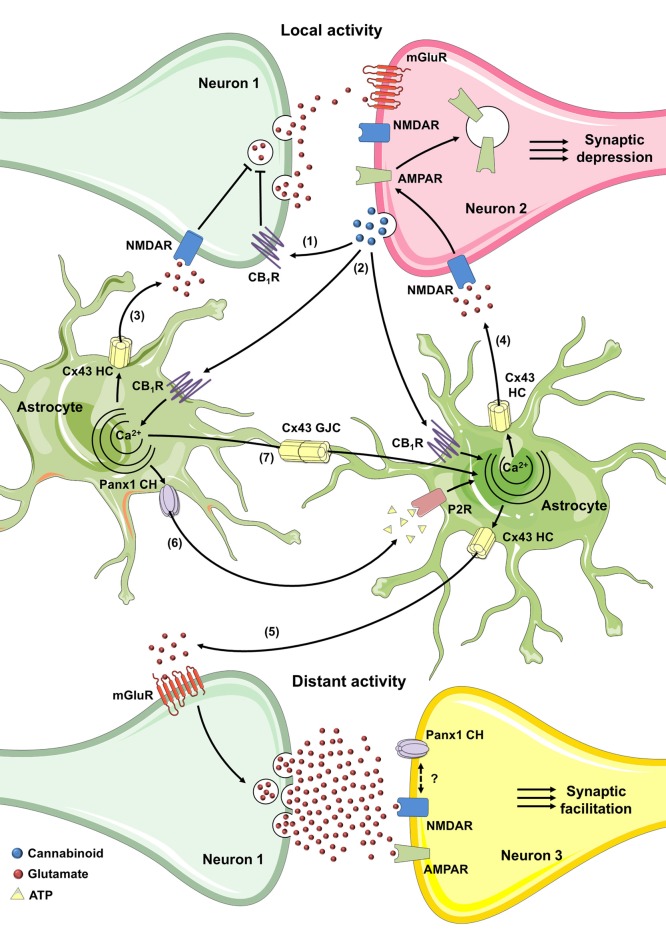
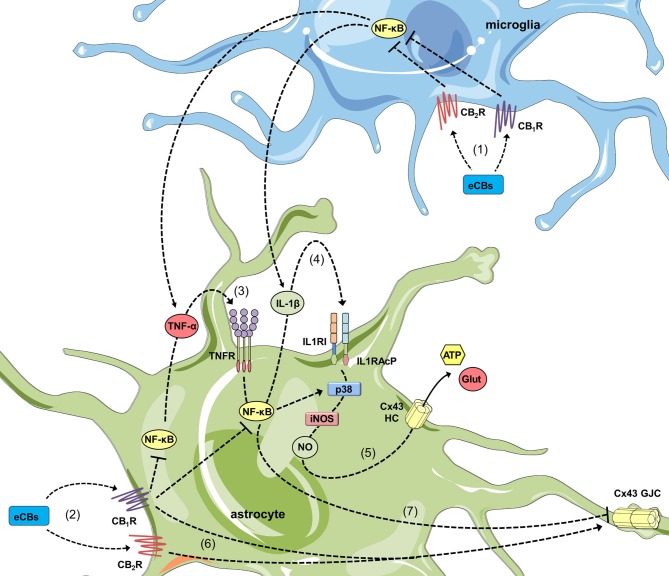
The formation of gap junctions was initially thought to be the central role of connexins, however, recent evidence had brought to light the high relevance of unopposed hemichannels as an independent mechanism for the selective release of biomolecules during physiological and pathological conditions. In the healthy brain, the physiological opening of astrocyte hemichannels modulates basal excitatory synaptic transmission. At the other end, the release of potentially neurotoxic compounds through astroglial hemichannels and pannexons has been insinuated as one of the functional alterations that negatively affect the progression of multiple brain diseases. Recent insights in this matter have suggested encannabinoids (eCBs) as molecules that could regulate the opening of these channels during diverse conditions. In this review, we discuss and hypothesize the possible interplay between the eCB system and the hemichannel/pannexon-mediated signaling in the inflamed brain and during event of synaptic plasticity. Most findings indicate that eCBs seem to counteract the activation of major neuroinflammatory pathways that lead to glia-mediated production of TNF-α and IL-1β, both well-known triggers of astroglial hemichannel opening. In contrast to the latter, in the normal brain, eCBs apparently elicit the Ca-activation of astrocyte hemichannels, which could have significant consequences on eCB-dependent synaptic plasticity.
缝隙连接的形成最初被认为是连接蛋白的核心作用,然而,最近的证据揭示了无配对半通道作为生理和病理条件下生物分子选择性释放的独立机制具有高度相关性。在健康大脑中,星形胶质细胞半通道的生理性开放调节基础兴奋性突触传递。另一方面,通过星形胶质细胞半通道和泛连接蛋白释放潜在的神经毒性化合物被认为是对多种脑部疾病进展产生负面影响的功能改变之一。最近对此问题的见解表明,内源性大麻素(eCBs)作为在不同条件下可调节这些通道开放的分子。在本综述中,我们讨论并假设了eCB系统与半通道/泛连接蛋白介导的信号在炎症大脑和突触可塑性事件中的可能相互作用。大多数研究结果表明,eCBs似乎能抵消主要神经炎症途径的激活,这些途径会导致胶质细胞介导的肿瘤坏死因子-α(TNF-α)和白细胞介素-1β(IL-1β)的产生,而这两种物质都是星形胶质细胞半通道开放的众所周知的触发因素。与后者相反,在正常大脑中,eCBs显然会引发星形胶质细胞半通道的钙激活,这可能对依赖eCB的突触可塑性产生重大影响。