• 文献检索
  • 文档翻译
  • 深度研究
  • 学术资讯
  • Suppr Zotero 插件Zotero 插件
  • 邀请有礼
  • 套餐&价格
  • 历史记录
应用&插件
Suppr Zotero 插件Zotero 插件浏览器插件Mac 客户端Windows 客户端微信小程序
定价
高级版会员购买积分包购买API积分包
服务
文献检索文档翻译深度研究API 文档MCP 服务
关于我们
关于 Suppr公司介绍联系我们用户协议隐私条款
关注我们

Suppr 超能文献

核心技术专利:CN118964589B侵权必究
粤ICP备2023148730 号-1Suppr @ 2026

文献检索

告别复杂PubMed语法,用中文像聊天一样搜索,搜遍4000万医学文献。AI智能推荐,让科研检索更轻松。

立即免费搜索

文件翻译

保留排版,准确专业,支持PDF/Word/PPT等文件格式,支持 12+语言互译。

免费翻译文档

深度研究

AI帮你快速写综述,25分钟生成高质量综述,智能提取关键信息,辅助科研写作。

立即免费体验

基于生物力学的瑜伽运动方案对膝骨关节炎的疗效:一项随机对照试验。

Efficacy of a biomechanically-based yoga exercise program in knee osteoarthritis: A randomized controlled trial.

机构信息

Department of Kinesiology, McMaster University, Hamilton, Ontario, Canada.

School of Rehabilitation Sciences, McMaster University, Hamilton, Ontario, Canada.

出版信息

PLoS One. 2018 Apr 17;13(4):e0195653. doi: 10.1371/journal.pone.0195653. eCollection 2018.

DOI:10.1371/journal.pone.0195653
PMID:29664955
原文链接:https://pmc.ncbi.nlm.nih.gov/articles/PMC5903657/
Abstract

OBJECTIVE

Certain exercises could overload the osteoarthritic knee. We developed an exercise program from yoga postures with a minimal knee adduction moment for knee osteoarthritis. The purpose was to compare the effectiveness of this biomechanically-based yoga exercise (YE), with traditional exercise (TE), and a no-exercise attention-equivalent control (NE) for improving pain, self-reported physical function and mobility performance in women with knee osteoarthritis.

DESIGN

Single-blind, three-arm randomized controlled trial.

SETTING

Community in Southwestern Ontario, Canada.

PARTICIPANTS

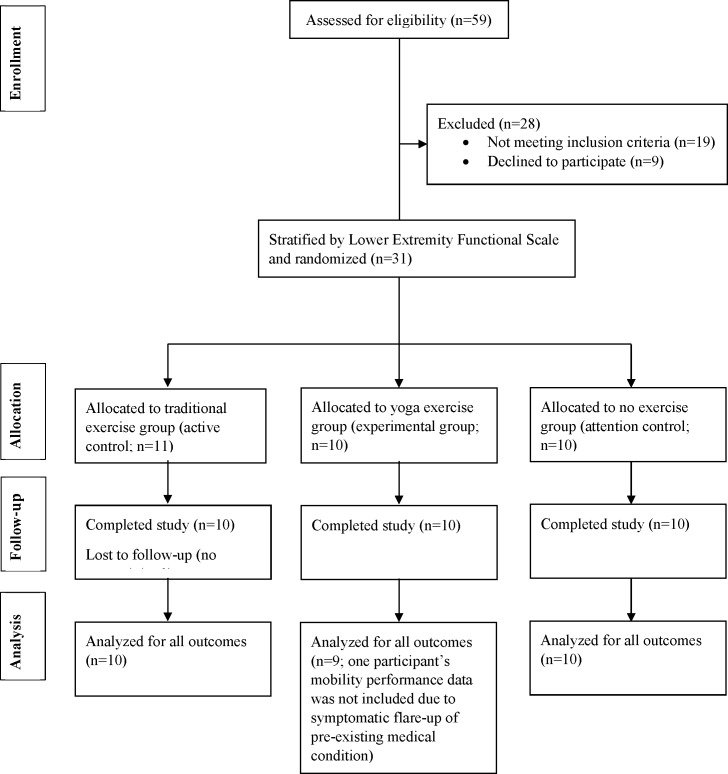
A convenience sample of 31 women with symptomatic knee osteoarthritis was recruited through rheumatology, orthopaedic and physiotherapy clinics, newspapers and word-of-mouth.

INTERVENTIONS

Participants were stratified by disease severity and randomly allocated to one of three 12-week, supervised interventions. YE included biomechanically-based yoga exercises; TE included traditional leg strengthening on machines; and NE included meditation with no exercise. Participants were asked to attend three 1-hour group classes/sessions each week.

MEASUREMENTS

Primary outcomes were pain, self-reported physical function and mobility performance. Secondary outcomes were knee strength, depression, and health-related quality of life. All were assessed by a blinded assessor at baseline and immediately following the intervention.

RESULTS

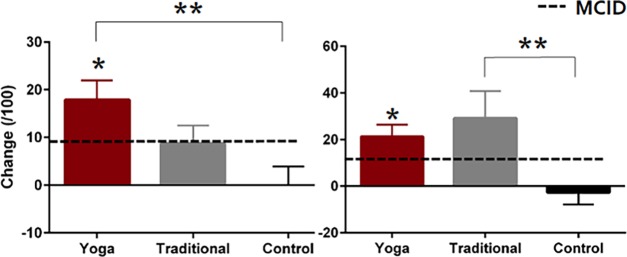
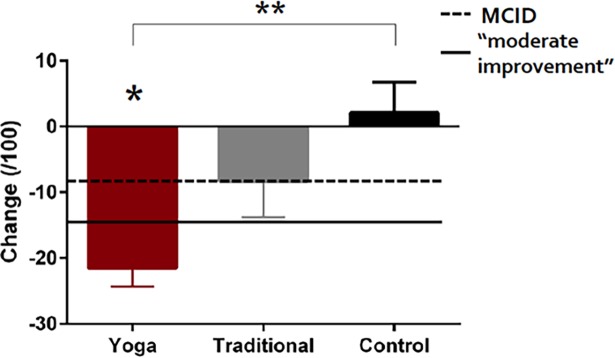
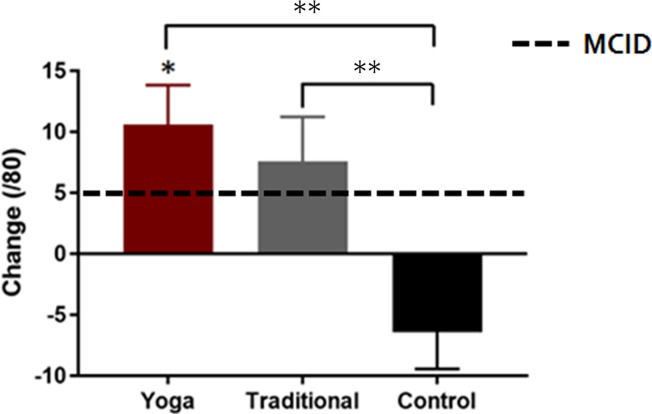
The YE group demonstrated greater improvements in KOOS pain (mean difference of 22.9 [95% CI, 6.9 to 38.8; p = 0.003]), intermittent pain (mean difference of -19.6 [95% CI, -34.8 to -4.4; p = 0.009]) and self-reported physical function (mean difference of 17.2 [95% CI, 5.2 to 29.2; p = 0.003]) compared to NE. Improvements in these outcomes were similar between YE and TE. However, TE demonstrated a greater improvement in knee flexor strength compared to YE (mean difference of 0.1 [95% CI, 0.1 to 0.2]. Improvements from baseline to follow-up were present in quality of life score for YE and knee flexor strength for TE, while both also demonstrated improvements in mobility. No improvement in any outcome was present in NE.

CONCLUSIONS

The biomechanically-based yoga exercise program produced clinically meaningful improvements in pain, self-reported physical function and mobility in women with clinical knee OA compared to no exercise. While not statistically significant, improvements in these outcomes were larger than those elicited from the traditional exercise-based program. Though this may suggest that the yoga program may be more efficacious for knee OA, future research studying a larger sample is required.

TRIAL REGISTRATION

ClinicalTrials.gov (NCT02370667).

摘要
https://cdn.ncbi.nlm.nih.gov/pmc/blobs/744c/5903657/2bcb570ee145/pone.0195653.g004.jpg
https://cdn.ncbi.nlm.nih.gov/pmc/blobs/744c/5903657/bac0a94f050a/pone.0195653.g001.jpg
https://cdn.ncbi.nlm.nih.gov/pmc/blobs/744c/5903657/630b6e060bf9/pone.0195653.g002.jpg
https://cdn.ncbi.nlm.nih.gov/pmc/blobs/744c/5903657/998e90d123f3/pone.0195653.g003.jpg
https://cdn.ncbi.nlm.nih.gov/pmc/blobs/744c/5903657/2bcb570ee145/pone.0195653.g004.jpg
https://cdn.ncbi.nlm.nih.gov/pmc/blobs/744c/5903657/bac0a94f050a/pone.0195653.g001.jpg
https://cdn.ncbi.nlm.nih.gov/pmc/blobs/744c/5903657/630b6e060bf9/pone.0195653.g002.jpg
https://cdn.ncbi.nlm.nih.gov/pmc/blobs/744c/5903657/998e90d123f3/pone.0195653.g003.jpg
https://cdn.ncbi.nlm.nih.gov/pmc/blobs/744c/5903657/2bcb570ee145/pone.0195653.g004.jpg

目的

某些运动可能会使骨关节炎的膝盖超负荷。我们从瑜伽姿势中开发了一个运动方案,该方案的膝关节内收力矩最小,适用于膝骨关节炎。目的是比较这种基于生物力学的瑜伽运动(YE)与传统运动(TE)和无运动等效对照组(NE)在改善疼痛,自我报告的身体功能和膝关节骨关节炎女性的活动能力方面的有效性。

设计

单盲,三臂随机对照试验。

地点

加拿大安大略省西南部社区。

参与者

通过风湿病,骨科和物理治疗诊所,报纸和口口相传,招募了 31 名有症状的膝骨关节炎的便利样本妇女。

干预措施

根据疾病严重程度对参与者进行分层,并随机分配到三个为期 12 周,监督的干预措施之一。YE 包括基于生物力学的瑜伽运动;TE 包括在机器上进行传统的腿部强化运动;NE 包括无运动的冥想。要求参与者每周参加三次 1 小时的小组课/课程。

测量

主要结果是疼痛,自我报告的身体功能和活动能力。次要结果是膝关节力量,抑郁和健康相关的生活质量。所有这些都由盲法评估者在基线和干预后立即进行评估。

结果

与 NE 相比,YE 组在 KOOS 疼痛(平均差异 22.9 [95%CI,6.9 至 38.8;p = 0.003]),间歇性疼痛(平均差异-19.6 [95%CI,-34.8 至-4.4;p = 0.009)和自我报告的身体功能(平均差异 17.2 [95%CI,5.2 至 29.2;p = 0.003])方面均有更大的改善。YE 与 TE 相比,这些结果的改善相似。但是,TE 与 YE 相比,膝关节伸肌力量的改善更大(平均差异为 0.1 [95%CI,0.1 至 0.2])。YE 的生活质量评分和 TE 的膝关节伸肌力量从基线到随访均有改善,而两者均改善了活动能力。NE 没有任何结果改善。

结论

与不运动相比,基于生物力学的瑜伽运动方案可使临床膝关节 OA 女性的疼痛,自我报告的身体功能和活动能力得到临床意义上的改善。虽然没有统计学意义,但这些结果的改善大于从传统运动方案中得出的改善。尽管这可能表明瑜伽方案对膝骨关节炎更有效,但需要进一步研究更大样本量的研究。

试验注册

ClinicalTrials.gov(NCT02370667)。

相似文献

1
Efficacy of a biomechanically-based yoga exercise program in knee osteoarthritis: A randomized controlled trial.基于生物力学的瑜伽运动方案对膝骨关节炎的疗效:一项随机对照试验。
PLoS One. 2018 Apr 17;13(4):e0195653. doi: 10.1371/journal.pone.0195653. eCollection 2018.
2
A Yoga Strengthening Program Designed to Minimize the Knee Adduction Moment for Women with Knee Osteoarthritis: A Proof-Of-Principle Cohort Study.一项旨在将膝骨关节炎女性的膝关节内收力矩降至最低的瑜伽强化计划:一项原理验证队列研究。
PLoS One. 2015 Sep 14;10(9):e0136854. doi: 10.1371/journal.pone.0136854. eCollection 2015.
3
Physical Therapist-Delivered Pain Coping Skills Training and Exercise for Knee Osteoarthritis: Randomized Controlled Trial.物理治疗师提供的膝关节骨关节炎疼痛应对技能训练与运动:随机对照试验
Arthritis Care Res (Hoboken). 2016 May;68(5):590-602. doi: 10.1002/acr.22744.
4
Immediate efficacy of neuromuscular exercise in patients with severe osteoarthritis of the hip or knee: a secondary analysis from a randomized controlled trial.神经肌肉锻炼对重度髋或膝骨关节炎患者的即时疗效:一项随机对照试验的二次分析
J Rheumatol. 2014 Jul;41(7):1385-94. doi: 10.3899/jrheum.130642. Epub 2014 Jun 15.
5
The effect on knee-joint load of instruction in analgesic use compared with neuromuscular exercise in patients with knee osteoarthritis: study protocol for a randomized, single-blind, controlled trial (the EXERPHARMA trial).膝关节骨关节炎患者使用镇痛药指导与神经肌肉锻炼对膝关节负荷的影响:一项随机、单盲、对照试验的研究方案(EXERPHARMA试验)
Trials. 2014 Nov 15;15:444. doi: 10.1186/1745-6215-15-444.
6
A physiotherapist-delivered integrated exercise and pain coping skills training intervention for individuals with knee osteoarthritis: a randomised controlled trial protocol.物理治疗师提供的综合运动和疼痛应对技能训练干预措施用于膝骨关节炎患者:一项随机对照试验方案。
BMC Musculoskelet Disord. 2012 Jul 24;13:129. doi: 10.1186/1471-2474-13-129.
7
Efficacy of Hip Strengthening Exercises Compared With Leg Strengthening Exercises on Knee Pain, Function, and Quality of Life in Patients With Knee Osteoarthritis.髋部强化锻炼与腿部强化锻炼对膝骨关节炎患者膝关节疼痛、功能及生活质量影响的疗效比较
Clin J Sport Med. 2015 Nov;25(6):509-17. doi: 10.1097/JSM.0000000000000170.
8
Train High Eat Low for Osteoarthritis study (THE LO study): protocol for a randomized controlled trial.骨关节炎的“高训练低饮食”研究(THE LO研究):一项随机对照试验的方案
J Physiother. 2015 Oct;61(4):217. doi: 10.1016/j.jphys.2015.05.020. Epub 2015 Aug 29.
9
Comparison of weight bearing functional exercise and non-weight bearing quadriceps strengthening exercise on pain and function for people with knee osteoarthritis and obesity: protocol for the TARGET randomised controlled trial.比较负重功能锻炼和非负重股四头肌强化锻炼对膝骨关节炎合并肥胖患者疼痛和功能的影响:TARGET 随机对照试验方案。
BMC Musculoskelet Disord. 2019 Jun 18;20(1):291. doi: 10.1186/s12891-019-2662-5.
10
Managing knee osteoarthritis with yoga or aerobic/strengthening exercise programs in older adults: a pilot randomized controlled trial.针对老年人,采用瑜伽或有氧/强化运动计划管理膝骨关节炎:一项试点随机对照试验。
Rheumatol Int. 2017 Mar;37(3):389-398. doi: 10.1007/s00296-016-3620-2. Epub 2016 Dec 2.

引用本文的文献

1
Efficacy of aerobic exercises for knee osteoarthritis: a network meta analysis of randomized clinical trials.有氧运动对膝骨关节炎的疗效:随机临床试验的网状Meta分析
J Orthop Surg Res. 2025 Jun 2;20(1):557. doi: 10.1186/s13018-025-05973-z.
2
Comparative efficacy of mind-body exercise for pain, function, quality of life in knee osteoarthritis: a systematic review and network meta-analysis.身心锻炼对膝关节骨关节炎疼痛、功能和生活质量的比较疗效:一项系统评价和网状荟萃分析
J Orthop Surg Res. 2025 Apr 17;20(1):384. doi: 10.1186/s13018-025-05682-7.
3
Yoga or Strengthening Exercise for Knee Osteoarthritis: A Randomized Clinical Trial.

本文引用的文献

1
The effects of therapeutic exercises on pain, muscle strength, functional capacity, balance and hemodynamic parameters in knee osteoarthritis patients: a randomized controlled study of supervised versus home exercises.治疗性运动对膝骨关节炎患者疼痛、肌肉力量、功能能力、平衡及血流动力学参数的影响:一项关于监督性运动与家庭运动的随机对照研究
Rheumatol Int. 2017 Mar;37(3):399-407. doi: 10.1007/s00296-016-3646-5. Epub 2017 Jan 11.
2
Role of Osteoarthritis, Comorbidity, and Pain in Determining Functional Limitations in Older Populations: European Project on Osteoarthritis.骨关节炎、合并症及疼痛在老年人群功能受限判定中的作用:欧洲骨关节炎项目
Arthritis Care Res (Hoboken). 2016 Jun;68(6):801-10. doi: 10.1002/acr.22755.
3
瑜伽或强化运动对膝关节骨关节炎的影响:一项随机临床试验
JAMA Netw Open. 2025 Apr 1;8(4):e253698. doi: 10.1001/jamanetworkopen.2025.3698.
4
Effects of mind-body therapies in knee osteoarthritis: a systematic review and network meta-analysis.身心疗法对膝骨关节炎的影响:一项系统评价和网状Meta分析
Arch Med Sci. 2023 Mar 26;21(1):179-196. doi: 10.5114/aoms/161576. eCollection 2025.
5
The Effects of Yoga on Fall-Related Physical Functions for Older Women: A Systematic Review of Randomized Controlled Trials.瑜伽对老年女性跌倒相关身体功能的影响:随机对照试验的系统评价
Healthcare (Basel). 2025 Jan 9;13(2):124. doi: 10.3390/healthcare13020124.
6
Exercise for osteoarthritis of the knee.膝关节骨关节炎的运动疗法
Cochrane Database Syst Rev. 2024 Dec 3;12(12):CD004376. doi: 10.1002/14651858.CD004376.pub4.
7
Building the Case for Telehealth Yoga for Minors With Arthritis and Chronic Pain: A Perspective.为患有关节炎和慢性疼痛的未成年人开展远程医疗瑜伽的理由:一种观点
Glob Adv Integr Med Health. 2024 May 17;13:27536130241255696. doi: 10.1177/27536130241255696. eCollection 2024 Jan-Dec.
8
Comparative Efficacy of Various Exercise Therapies and Combined Treatments on Inflammatory Biomarkers and Morphological Measures of Skeletal Muscle among Older Adults with Knee Osteoarthritis: A Network Meta-Analysis.多种运动疗法及联合治疗对膝骨关节炎老年人炎症生物标志物和骨骼肌形态学指标的比较疗效:一项网状Meta分析
Biomedicines. 2024 Jul 9;12(7):1524. doi: 10.3390/biomedicines12071524.
9
Key characteristics of effective yoga interventions for managing osteoarthritis: a systematic review and meta-analysis.有效瑜伽干预管理骨关节炎的关键特征:系统评价和荟萃分析。
Rheumatol Int. 2024 Sep;44(9):1647-1677. doi: 10.1007/s00296-024-05652-y. Epub 2024 Jun 27.
10
The impact of Yoga on patients with knee osteoarthritis: A systematic review and meta-analysis of randomized controlled trials.瑜伽对膝骨关节炎患者的影响:一项随机对照试验的系统评价和荟萃分析。
PLoS One. 2024 May 16;19(5):e0303641. doi: 10.1371/journal.pone.0303641. eCollection 2024.
A Yoga Strengthening Program Designed to Minimize the Knee Adduction Moment for Women with Knee Osteoarthritis: A Proof-Of-Principle Cohort Study.
一项旨在将膝骨关节炎女性的膝关节内收力矩降至最低的瑜伽强化计划:一项原理验证队列研究。
PLoS One. 2015 Sep 14;10(9):e0136854. doi: 10.1371/journal.pone.0136854. eCollection 2015.
4
Investigation of depression, anxiety and quality of life in patients with knee osteoarthritis: a comparative study.膝关节骨关节炎患者的抑郁、焦虑及生活质量调查:一项对比研究
Rev Bras Reumatol. 2015 Sep-Oct;55(5):434-8. doi: 10.1016/j.rbr.2015.03.001. Epub 2015 Jul 4.
5
Identifying yoga-based knee strengthening exercises using the knee adduction moment.利用膝关节内收力矩识别基于瑜伽的膝关节强化练习。
Clin Biomech (Bristol). 2015 Oct;30(8):820-6. doi: 10.1016/j.clinbiomech.2015.06.007. Epub 2015 Jun 16.
6
External knee adduction and flexion moments during gait and medial tibiofemoral disease progression in knee osteoarthritis.膝关节骨关节炎患者步态期间的膝关节外展和屈曲力矩与胫股关节内侧疾病进展
Osteoarthritis Cartilage. 2015 Jul;23(7):1099-106. doi: 10.1016/j.joca.2015.02.005. Epub 2015 Feb 10.
7
Efficacy of Hip Strengthening Exercises Compared With Leg Strengthening Exercises on Knee Pain, Function, and Quality of Life in Patients With Knee Osteoarthritis.髋部强化锻炼与腿部强化锻炼对膝骨关节炎患者膝关节疼痛、功能及生活质量影响的疗效比较
Clin J Sport Med. 2015 Nov;25(6):509-17. doi: 10.1097/JSM.0000000000000170.
8
The effect of mindfulness-based stress reduction on disease activity in people with rheumatoid arthritis: a randomised controlled trial.基于正念减压疗法对类风湿关节炎患者疾病活动度的影响:一项随机对照试验。
Ann Rheum Dis. 2015 Feb;74(2):472-4. doi: 10.1136/annrheumdis-2014-205946. Epub 2014 Nov 18.
9
Baseline knee adduction and flexion moments during walking are both associated with 5 year cartilage changes in patients with medial knee osteoarthritis.行走过程中的基线膝关节内收和屈曲力矩均与内侧膝关节骨关节炎患者的5年软骨变化相关。
Osteoarthritis Cartilage. 2014 Nov;22(11):1833-9. doi: 10.1016/j.joca.2014.08.009. Epub 2014 Aug 27.
10
Efficacy of rehabilitation programs for improving muscle strength in people with hip or knee osteoarthritis: a systematic review with meta-analysis.康复计划对改善髋或膝骨关节炎患者肌肉力量的疗效:一项系统评价与荟萃分析
Osteoarthritis Cartilage. 2014 Nov;22(11):1752-73. doi: 10.1016/j.joca.2014.07.005. Epub 2014 Jul 24.