Steck Nicole, Junker Christoph, Zwahlen Marcel
Institute of Social and Preventive Medicine (ISPM), University of Bern, Bern, Switzerland.
Federal Statistical Office, Neuchâtel, Switzerland.
BMJ Open. 2018 Apr 17;8(4):e020992. doi: 10.1136/bmjopen-2017-020992.
To determine whether the strong increase in assisted suicides in Switzerland since 2008 is linked to a shift in the socioeconomic factors associated with assisted suicide and its related diagnoses.
In a population-based longitudinal study, we investigated assisted suicides in Switzerland over the period 2003-2014. Two groups of younger (25-64 years) and older (65-94 years) persons were analysed separately and compared. We calculated crude rates and used Cox proportional hazard and logistic regression models to examine associations of assisted dying with gender, marital status, education, religion, neighbourhood socioeconomic status and other variables, and investigated trends over time.
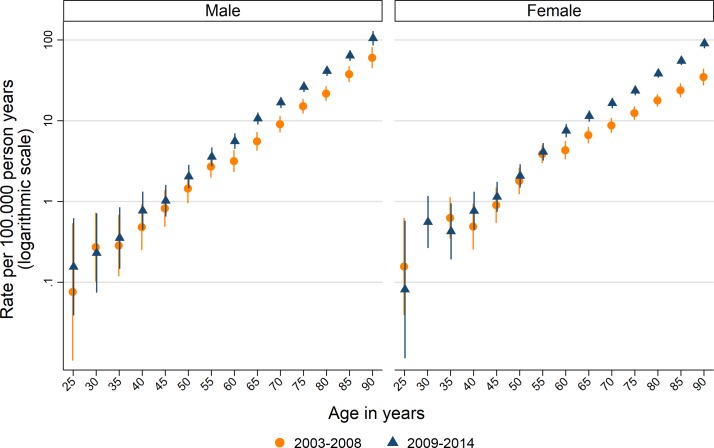
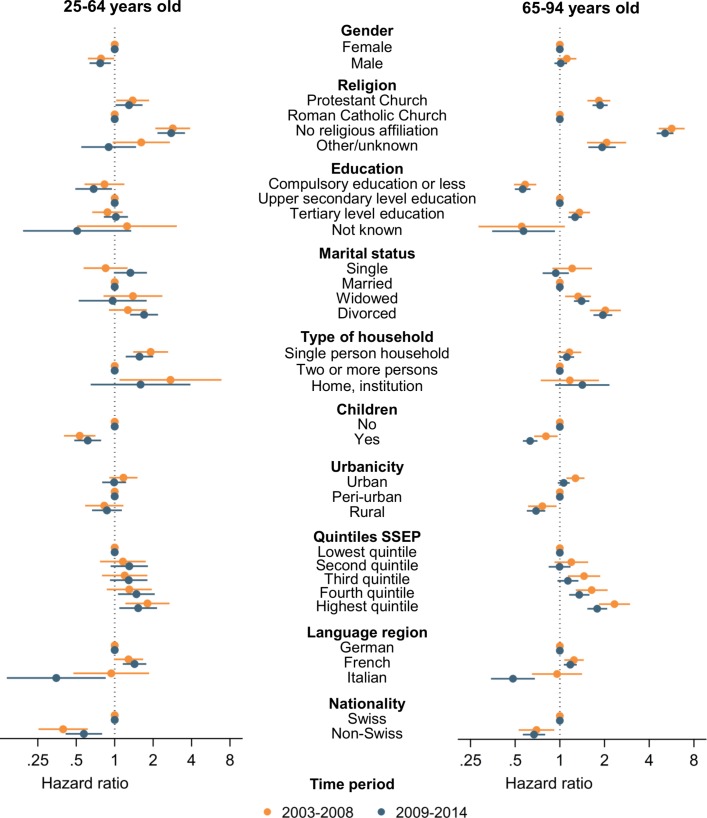
We identified 3941 assisted suicides among 6 237 997 Swiss residents, 80% of which occurred in the older age group. Crude rates of assisted suicide more than tripled during the study period from 3.60 to 11.21 per 100 000 person-years; the increase was more pronounced in the older age group. Cancer was the most common underlying diagnosis (41.8%), but the percentage dying assisted was highest among patients with diseases of the nervous system (5.25% in the younger and 1.23% in the older age group). The factors associated with assisted suicide did not change during the study period. Female gender, higher education, having no religious affiliation, no children and a Swiss passport, living in a neighbourhood with a higher socioeconomic index and living in the French-speaking part of Switzerland were associated with a higher rate.
The study results do not indicate any shift in socioeconomic factors associated with assisted suicide, but a more pronounced increase in incidence among the elderly.
确定自2008年以来瑞士协助自杀事件的大幅增加是否与协助自杀及其相关诊断的社会经济因素变化有关。
在一项基于人群的纵向研究中,我们调查了2003年至2014年期间瑞士的协助自杀事件。分别对两组年龄较小(25 - 64岁)和年龄较大(65 - 94岁)的人群进行分析和比较。我们计算了粗发病率,并使用Cox比例风险模型和逻辑回归模型来检验协助死亡与性别、婚姻状况、教育程度、宗教信仰、邻里社会经济地位及其他变量之间的关联,并研究随时间的趋势。
在6237997名瑞士居民中,我们识别出3941起协助自杀事件,其中80%发生在老年人群体中。在研究期间,协助自杀的粗发病率从每10万人年3.60例增至11.21例,增长了两倍多;老年人群体中的增长更为显著。癌症是最常见的潜在诊断疾病(41.8%),但神经系统疾病患者的协助死亡率最高(年轻人群体中为5.25%,老年人群体中为1.23%)。在研究期间,与协助自杀相关的因素没有变化。女性、受过高等教育、无宗教信仰、无子女且持有瑞士护照、居住在社会经济指数较高的社区以及居住在瑞士法语区与较高的协助自杀率相关。
研究结果并未表明与协助自杀相关的社会经济因素有任何变化,但老年人中的发病率增长更为显著。