Western University, London, Ontario, Canada.
London Health Sciences Centre Trauma Program, London, Ontario, Canada.
J Palliat Care. 2022 Jul;37(3):359-365. doi: 10.1177/08258597211053088. Epub 2021 Nov 6.
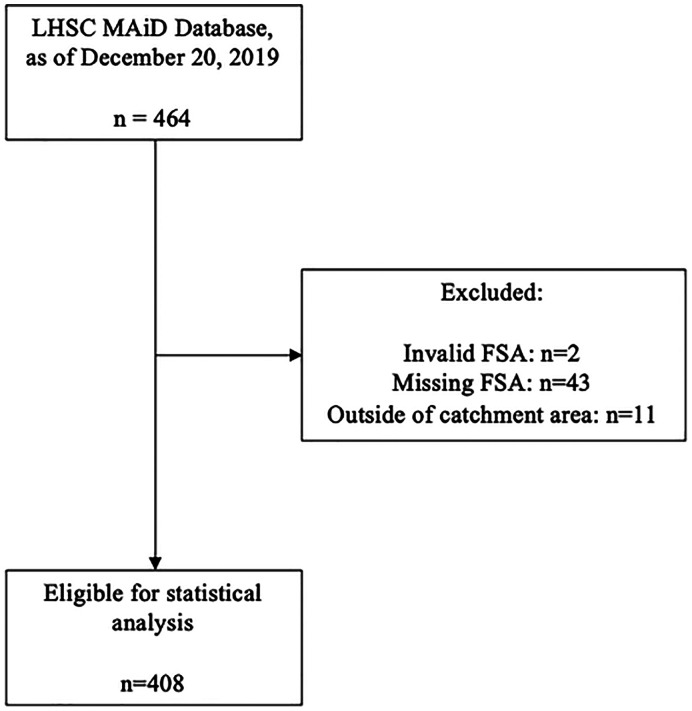
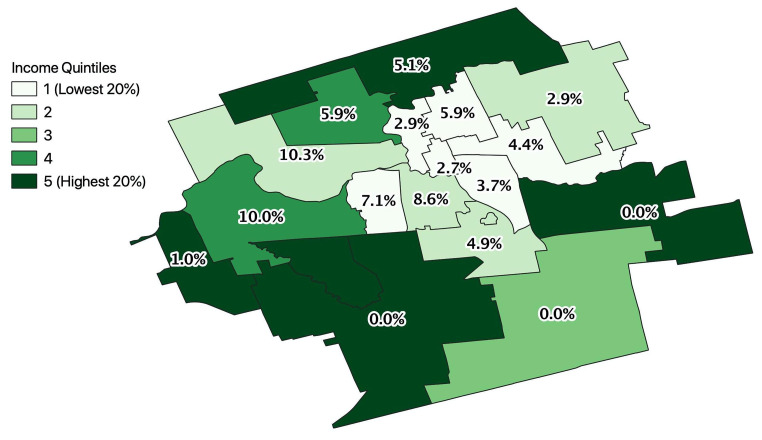
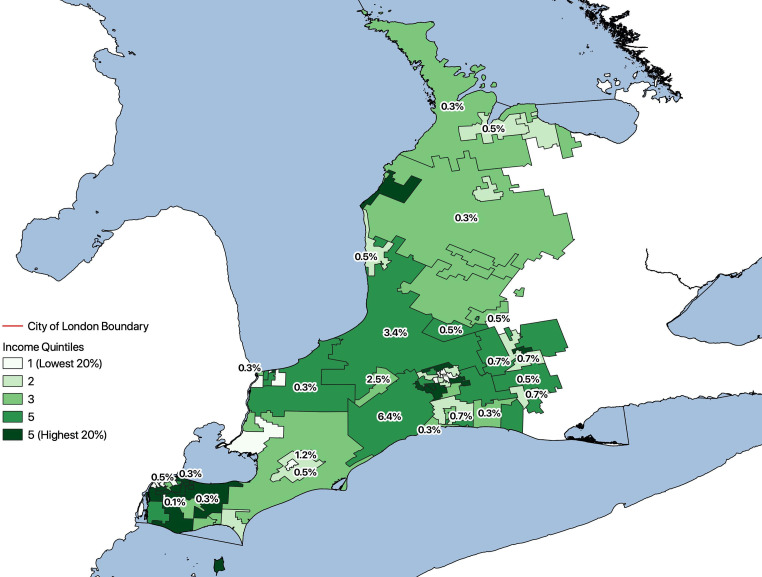
Concerns that medical assistance in dying (MAiD) may harm vulnerable groups unable to access medical treatments and social supports have arisen since the legalization of MAiD on June 17, 2016; however, there is little research on the topic. The purpose of this study is to investigate the socioeconomic status (SES) of patients who request MAiD at the London Health Sciences Centre (LHSC). A retrospective analysis of patients from the LHSC MAiD database between June 6, 2016 and December 20, 2019 was conducted. Patients were linked to income data from the 2016 Canadian Census, and their corresponding income quintile was a proxy for SES. Geographic information system (GIS) mapping software was used to visualize the distribution of income and MAiD requests. 39.4% of the LHSC catchment area was classified as low SES. Two hundred thirty-seven (58.1%) MAiD requests came from low SES patients and 171 (41.9%) requests came from high SES patients. Two hundred fifty-nine (63.5%) patients who requested a MAiD assessment did not receive MAiD following their request. Of the 237 lower SES patients, 150 (63.3% [95% CI 57.2-69.3]) did not receive MAiD. Of the 171 higher SES patients, 109 (63.7% [95% CI 56.5-70.9]) did not receive MAiD. A disproportionate number of requests for a MAiD assessment at LHSC came from lower SES patients; however, similar proportions of patients who requested MAiD from each SES group received aid in dying. Future research should explore why a disproportionately high number of low SES patients request MAiD at LHSC.
自 2016 年 6 月 17 日医疗辅助死亡(MAiD)合法化以来,人们一直担心 MAiD 可能会伤害那些无法获得医疗和社会支持的弱势群体;然而,关于这个主题的研究很少。本研究旨在调查伦敦健康科学中心(LHSC)申请 MAiD 的患者的社会经济地位(SES)。对 2016 年 6 月 6 日至 2019 年 12 月 20 日期间 LHSC MAiD 数据库中的患者进行了回顾性分析。患者的收入数据与 2016 年加拿大人口普查相关联,其相应的收入五分位数是 SES 的代表。地理信息系统(GIS)制图软件用于可视化收入和 MAiD 请求的分布。LHSC 流域的 39.4%被归类为低 SES。237(58.1%)例 MAiD 请求来自低 SES 患者,171(41.9%)例请求来自高 SES 患者。259(63.5%)名请求 MAiD 评估的患者在请求后未获得 MAiD。在 237 名低 SES 患者中,150 名(63.3%[95%CI57.2-69.3])未获得 MAiD。在 171 名高 SES 患者中,109 名(63.7%[95%CI56.5-70.9])未获得 MAiD。LHSC 评估 MAiD 的请求中,相当数量来自低 SES 患者;然而,来自每个 SES 组的请求 MAiD 的患者比例相似,都获得了协助死亡。未来的研究应该探讨为什么来自低 SES 的患者不成比例地高数量请求 LHSC 的 MAiD。