Gaspar Adrian, Maestri Sandra, Silva Joaquin, Brandi Hugo, Luque Daniel, Koron Neža, Vižintin Zdenko
Espacio Gaspar Clinic, Olascoaga 881, 5500, Mendoza, Argentina.
Uroclinica Mendoza, Paso de Los Andes, 5500, Mendoza, Argentina.
Lasers Surg Med. 2018 Oct;50(8):802-807. doi: 10.1002/lsm.22826. Epub 2018 Apr 18.
Genitourinary syndrome of menopause (GSM) combines the conditions of vulvovaginal atrophy (VVA) and urinary tract dysfunction, which is a result of urethral atrophy. There are several treatment methods available for the management of vulvovaginal symptoms of GSM, whereas urinary tract dysfunction often remains overlooked and undertreated. The objective of this pilot study was to assess the safety and efficacy of intraurethral Er:YAG laser treatment of urinary symptoms of GSM.
Patients with diagnosed GSM, having less than 5% of vaginal superficial cells in the cytology, vaginal pH higher than 5, with urinary symptoms of GSM (dysuria, frequency, urgency) and impaired continence due to urethral atrophy, received two sessions of intraurethral Er:YAG laser with a 3-week interval in-between the sessions. Laser energy was delivered in non-ablative way using Erbium SMOOTH™ mode technology and a 4-mm thick cannula. Therapeutic efficacy was determined using ICIQ-SF, the 1-hour pad test and VAS scores. Occurrence of adverse effects was followed at every visit. Follow ups (FU) were at 3 and 6 months.
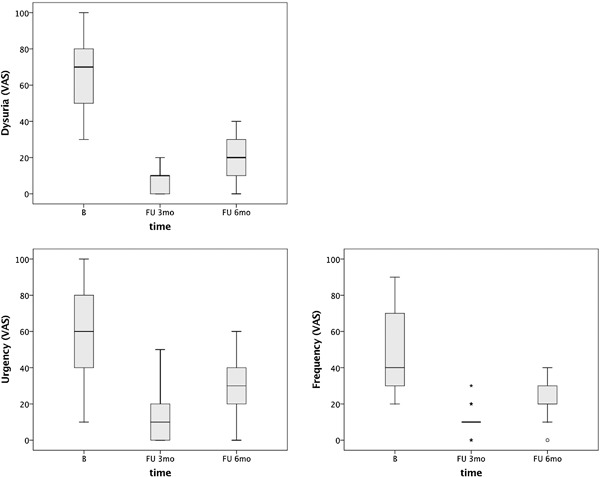
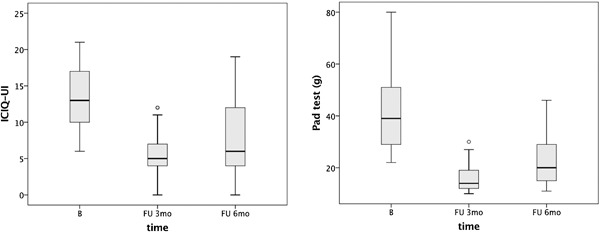
29 female patients fulfilling the inclusion criteria were included in this pilot study and received two sessions of the intraurethral non-ablative Erbium SMOOTH™ laser therapy. Significant improvement was observed in all measured parameters at both FU. ICIQ-SF improved by an average of 64% at 3 months FU and by 40% at 6 months. The 1-hour pad test showed a reduction of the quantity of leaked urine by 59% at 3 months FU and by 42% at 6 months FU. All urinary symptoms of GSM improved. Dysuria dropped to 13% and 31% of baseline values at three and 6 months respectively, urinary urgency dropped to 23% and 47% and frequency dropped to 22% and 43% after 3 and 6 months, respectively. Adverse effects were mild and transient.
Our findings suggest that intraurethral Er:YAG laser is an efficacious and safe modality for treatment of urinary symptoms of GSM, however, prospective, randomized, and controlled trials with larger number of patients are needed to better assess the long-term effect of this novel procedure. Lasers Surg. Med. 50:802-807, 2018. © 2018 The Authors. Lasers in Surgery and Medicine Published by Wiley Periodicals, Inc.
更年期泌尿生殖综合征(GSM)合并外阴阴道萎缩(VVA)和泌尿道功能障碍,后者是尿道萎缩的结果。有多种治疗方法可用于管理GSM的外阴阴道症状,而泌尿道功能障碍往往仍被忽视且治疗不足。本初步研究的目的是评估铒激光(Er:YAG)尿道内治疗GSM泌尿症状的安全性和有效性。
确诊为GSM的患者,细胞学检查阴道表层细胞少于5%,阴道pH值高于5,伴有GSM泌尿症状(排尿困难、尿频、尿急)且因尿道萎缩导致尿失禁,接受两期尿道内Er:YAG激光治疗,两期治疗间隔3周。使用Erbium SMOOTH™模式技术和4毫米厚的套管以非消融方式输送激光能量。使用国际咨询问卷-简表(ICIQ-SF)、1小时护垫试验和视觉模拟评分(VAS)来确定治疗效果。每次就诊时跟踪不良反应的发生情况。随访时间为3个月和6个月。
29名符合纳入标准的女性患者纳入本初步研究,并接受了两期尿道内非消融Erbium SMOOTH™激光治疗。在两次随访时,所有测量参数均有显著改善。在3个月随访时,ICIQ-SF平均改善64%,6个月时改善40%。1小时护垫试验显示,3个月随访时尿液渗漏量减少59%,6个月随访时减少42%。GSM的所有泌尿症状均有改善。排尿困难在3个月和6个月时分别降至基线值的13%和31%,尿急在3个月和6个月后分别降至23%和47%,尿频分别降至22%和43%。不良反应轻微且短暂。
我们的研究结果表明,铒激光尿道内治疗是一种治疗GSM泌尿症状的有效且安全的方法,然而,需要更多患者参与的前瞻性、随机对照试验来更好地评估这一新技术的长期效果。《激光外科与医学》50:802 - 807,2018年。© 2018作者。《激光在外科与医学中的应用》由威利期刊公司出版