Department of Oral and Craniofacial Sciences, School of Dentistry, University of Missouri-Kansas City (UMKC), MO, USA.
Department of Dental Materials Science, Aichi Gakuin University School of Dentistry, Nagoya, Japan.
J Bone Miner Res. 2018 Aug;33(8):1513-1519. doi: 10.1002/jbmr.3449. Epub 2018 May 22.
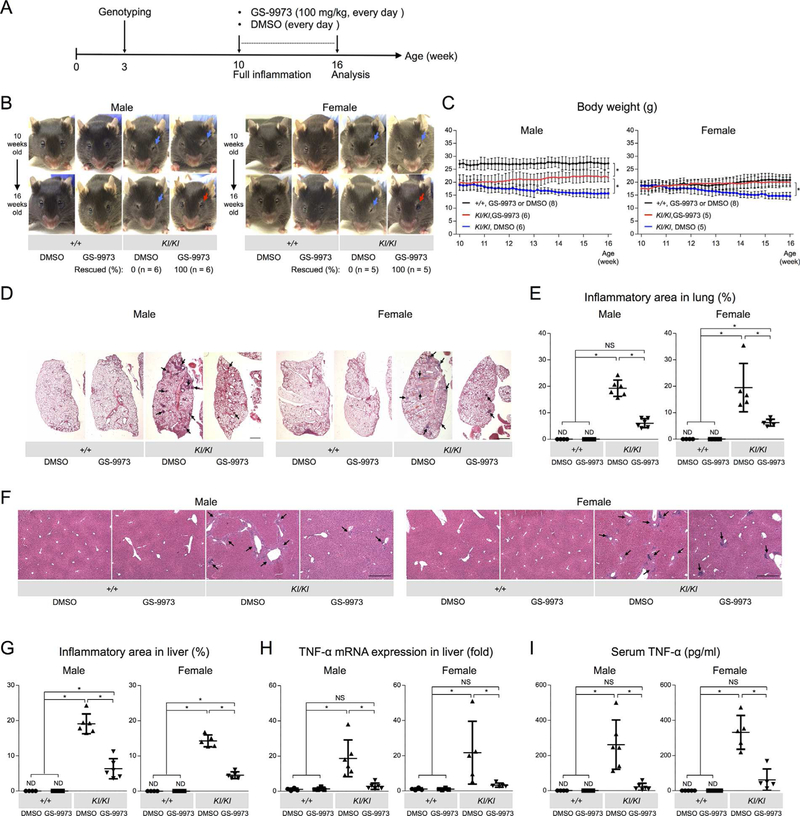
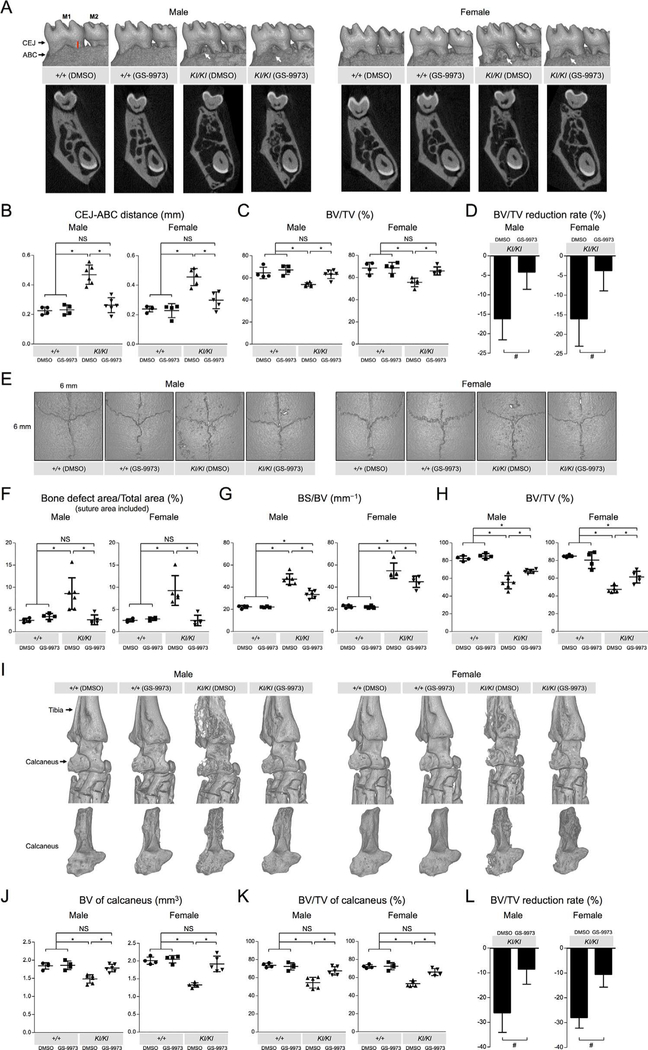
Cherubism is a craniofacial disorder characterized by maxillary and mandibular bone destruction. Gain-of-function mutations in the SH3-domain binding protein 2 (SH3BP2) are responsible for the excessive bone resorption caused by fibrous inflammatory lesions. A homozygous knock-in (KI) mouse model for cherubism (Sh3bp2 ) develops autoinflammation resulting in systemic bone destruction. Although administration of the TNF-α blocker etanercept to neonatal Sh3bp2 mice prevented the disease onset, this therapy was not effective for adult Sh3bp2 mice or human cherubism patients who already had lesions. Because genetic ablation of spleen tyrosine kinase (SYK) in myeloid cells rescues Sh3bp2 mice from inflammation, we examined whether SYK inhibitor administration can improve fully developed cherubism symptoms in adult Sh3bp2 mice. Entospletinib (GS-9973) was intraperitoneally injected into 10-week-old Sh3bp2 mice every day for 6 weeks. Treatment with GS-9973 improved facial swelling and histomorphometric analysis of lung and liver tissue showed that GS-9973 administration significantly reduced inflammatory infiltrates associated with decreased levels of serum TNF-α. Micro-computed tomography (μCT) analysis showed that GS-9973 treatment reduced bone erosion in mandibles, calvariae, and ankle and elbow joints of Sh3bp2 mice compared to Sh3bp2 mice treated with dimethyl sulfoxide (DMSO). Taken together, the results demonstrate that administration of the SYK inhibitor ameliorates an already established cherubism phenotype in mice, suggesting that pharmacological inhibition of SYK may be a treatment option for cherubism patients with active disease progression. © 2018 American Society for Bone and Mineral Research.
cherubism 是一种颅面骨疾病,其特征为上颌骨和下颌骨破坏。纤维炎性病变导致的过度骨吸收是由 SH3 结构域结合蛋白 2(SH3BP2)的功能获得性突变引起的。 cherubism 的纯合敲入(KI)小鼠模型(Sh3bp2 )会发生自身炎症,从而导致全身性骨破坏。虽然在新生 Sh3bp2 小鼠中给予 TNF-α 阻滞剂依那西普可预防疾病发作,但这种疗法对成年 Sh3bp2 小鼠或已经有病变的 cherubism 患者无效。由于髓细胞中的脾酪氨酸激酶(SYK)的基因缺失可使 Sh3bp2 小鼠免于炎症,因此我们研究了 SYK 抑制剂的给药是否可以改善成年 Sh3bp2 小鼠中完全发育的 cherubism 症状。将 Entospletinib(GS-9973)每天腹膜内注射到 10 周龄的 Sh3bp2 小鼠中,持续 6 周。GS-9973 治疗可改善面部肿胀,对肺和肝组织的组织形态计量学分析表明,GS-9973 给药可显著减少与血清 TNF-α 水平降低相关的炎症浸润。微计算机断层扫描(μCT)分析表明,与 DMSO 处理的 Sh3bp2 小鼠相比,GS-9973 治疗可减少 Sh3bp2 小鼠下颌骨、颅骨、踝关节和肘关节的骨侵蚀。总之,这些结果表明,SYK 抑制剂的给药可改善小鼠中已建立的 cherubism 表型,这表明针对 SYK 的药理学抑制可能是疾病进展期 cherubism 患者的一种治疗选择。