Ruth L. and David S. Gottesman Institute for Stem Cell and Regenerative Medicine Research, Albert Einstein College of Medicine, Bronx, NY 10461, USA; Department of Cell Biology, Albert Einstein College of Medicine, Bronx, NY 10461, USA.
Ruth L. and David S. Gottesman Institute for Stem Cell and Regenerative Medicine Research, Albert Einstein College of Medicine, Bronx, NY 10461, USA; Department of Cell Biology, Albert Einstein College of Medicine, Bronx, NY 10461, USA; Departmentof Medicine, Albert Einstein College of Medicine, Bronx, NY 10461, USA.
Immunity. 2018 Apr 17;48(4):632-648. doi: 10.1016/j.immuni.2018.03.024.
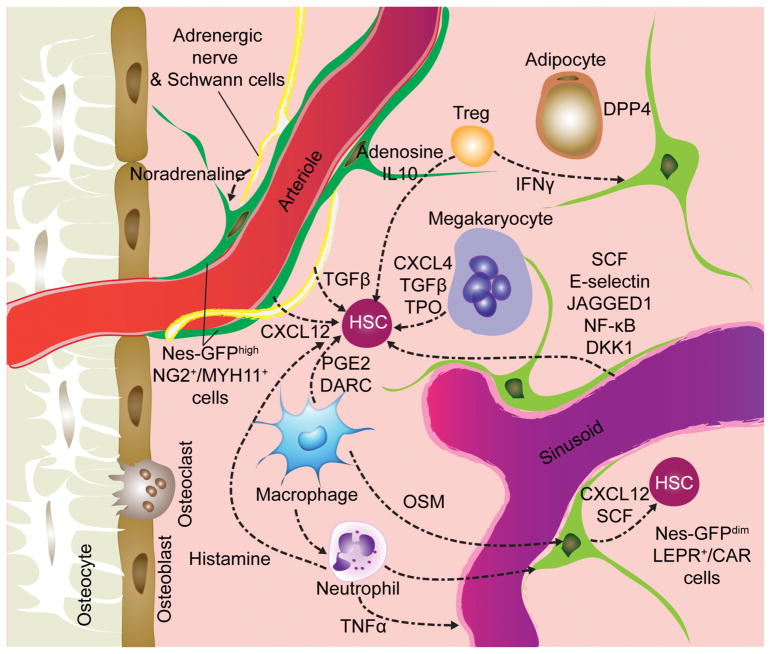
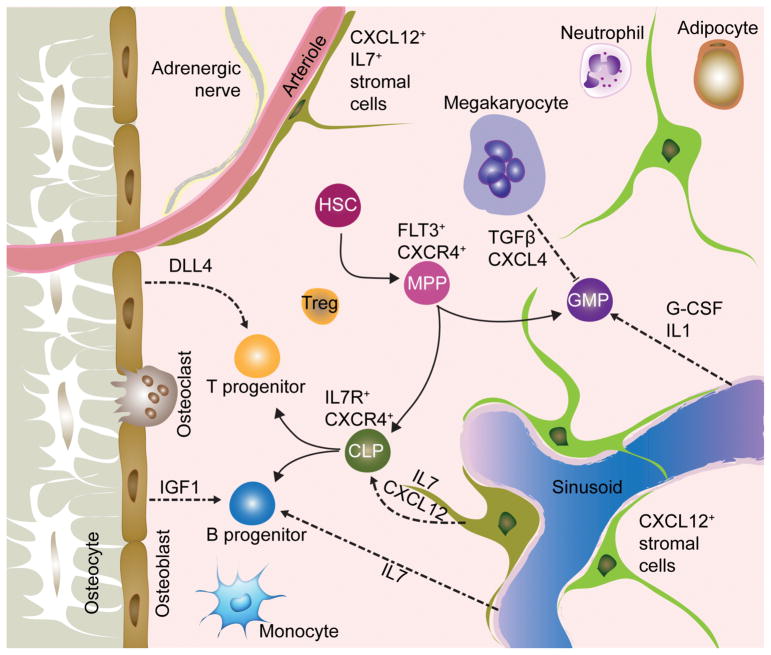
Steady-state hematopoietic stem cells' (HSCs) self-renewal and differentiation toward their mature progeny in the adult bone marrow is tightly regulated by cues from the microenvironment. Recent insights into the cellular and molecular constituents have uncovered a high level of complexity. Here, we review emerging evidence showing how HSCs and their progeny are regulated by an interdependent network of mesenchymal stromal cells, nerve fibers, the vasculature, and also other hematopoietic cells. Understanding the interaction mechanisms in these intricate niches will provide great opportunities for HSC-related therapies and immune modulation.
稳态造血干细胞(HSCs)在成人骨髓中的自我更新和向其成熟后代的分化受到来自微环境的信号的严格调控。最近对细胞和分子成分的深入了解揭示了高度的复杂性。在这里,我们回顾了新出现的证据,展示了 HSCs 及其后代如何受到间充质基质细胞、神经纤维、血管以及其他造血细胞的相互依存的网络的调节。了解这些复杂生态位中的相互作用机制将为与 HSC 相关的治疗和免疫调节提供巨大机会。