Wu Justine P, Damschroder Laura J, Fetters Michael D, Zikmund-Fisher Brian J, Crabtree Benjamin F, Hudson Shawna V, Ruffin Mack T, Fucinari Juliana, Kang Minji, Taichman L Susan, Creswell John W
Department of Family Medicine, University of Michigan, Ann Arbor, MI, United States.
VA Center for Clinical Management Research, Ann Arbor, MI, United States.
JMIR Res Protoc. 2018 Apr 18;7(4):e107. doi: 10.2196/resprot.9249.
Women with chronic medical conditions, such as diabetes and hypertension, have a higher risk of pregnancy-related complications compared with women without medical conditions and should be offered contraception if desired. Although evidence based guidelines for contraceptive selection in the presence of medical conditions are available via the United States Medical Eligibility Criteria (US MEC), these guidelines are underutilized. Research also supports the use of decision tools to promote shared decision making between patients and providers during contraceptive counseling.
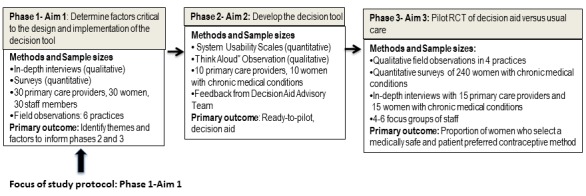
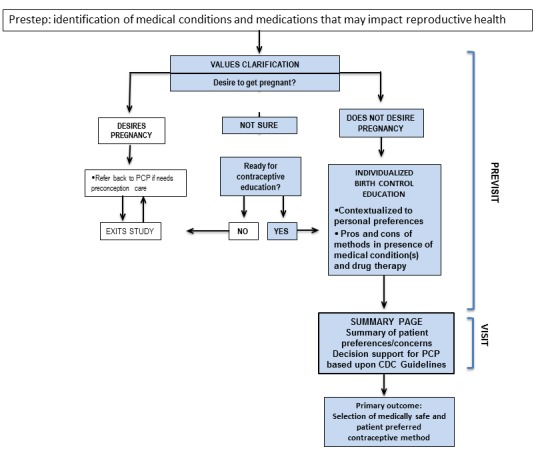
The overall goal of the MiHealth, MiChoice project is to design and implement a theory-driven, Web-based tool that incorporates the US MEC (provider-level intervention) within the vehicle of a contraceptive decision tool for women with chronic medical conditions (patient-level intervention) in community-based primary care settings (practice-level intervention). This will be a 3-phase study that includes a predesign phase, a design phase, and a testing phase in a randomized controlled trial. This study protocol describes phase 1 and aim 1, which is to determine patient-, provider-, and practice-level factors that are relevant to the design and implementation of the contraceptive decision tool.
This is a mixed methods implementation study. To customize the delivery of the US MEC in the decision tool, we selected high-priority constructs from the Consolidated Framework for Implementation Research and the Theoretical Domains Framework to drive data collection and analysis at the practice and provider level, respectively. A conceptual model that incorporates constructs from the transtheoretical model and the health beliefs model undergirds patient-level data collection and analysis and will inform customization of the decision tool for this population. We will recruit 6 community-based primary care practices and conduct quantitative surveys and semistructured qualitative interviews with women who have chronic medical conditions, their primary care providers (PCPs), and clinic staff, as well as field observations of practice activities. Quantitative survey data will be summarized with simple descriptive statistics and relationships between participant characteristics and contraceptive recommendations (for PCPs), and current contraceptive use (for patients) will be examined using Fisher exact test. We will conduct thematic analysis of qualitative data from interviews and field observations. The integration of data will occur by comparing, contrasting, and synthesizing qualitative and quantitative findings to inform the future development and implementation of the intervention.
We are currently enrolling practices and anticipate study completion in 15 months.
This protocol describes the first phase of a multiphase mixed methods study to develop and implement a Web-based decision tool that is customized to meet the needs of women with chronic medical conditions in primary care settings. Study findings will promote contraceptive counseling via shared decision making and reflect evidence-based guidelines for contraceptive selection.
ClinicalTrials.gov NCT03153644; https://clinicaltrials.gov/ct2/show/NCT03153644 (Archived by WebCite at http://www.webcitation.org/6yUkA5lK8).
患有糖尿病和高血压等慢性疾病的女性,与无疾病的女性相比,发生妊娠相关并发症的风险更高,若有需求应提供避孕措施。尽管通过美国医学适用标准(US MEC)可获取针对患有疾病时避孕选择的循证指南,但这些指南未得到充分利用。研究还支持使用决策工具,以促进在避孕咨询过程中患者与医疗服务提供者之间的共同决策。
MiHealth、MiChoice项目的总体目标是设计并实施一种基于理论的网络工具,该工具在社区基层医疗环境(实践层面干预)中,将US MEC(医疗服务提供者层面干预)纳入针对患有慢性疾病女性的避孕决策工具(患者层面干预)之中。这将是一项分为三个阶段的研究,包括预设计阶段、设计阶段以及随机对照试验中的测试阶段。本研究方案描述了第一阶段和目标1,即确定与避孕决策工具的设计和实施相关的患者、医疗服务提供者及实践层面的因素。
这是一项混合方法实施研究。为了在决策工具中定制US MEC的提供方式,我们分别从实施研究综合框架和理论领域框架中选取了高优先级的构建要素,以推动实践和医疗服务提供者层面的数据收集与分析。一个整合了跨理论模型和健康信念模型构建要素的概念模型为患者层面的数据收集与分析提供支撑,并将为针对该人群的决策工具定制提供依据。我们将招募6家社区基层医疗实践机构,对患有慢性疾病的女性、她们的初级保健提供者(PCP)、诊所工作人员进行定量调查和半结构化定性访谈,并对实践活动进行实地观察。定量调查数据将用简单描述性统计进行汇总,参与者特征与避孕建议(针对PCP)以及当前避孕措施使用情况(针对患者)之间的关系将使用Fisher精确检验进行分析。我们将对访谈和实地观察的定性数据进行主题分析。数据整合将通过比较、对比和综合定性与定量研究结果来实现,以为干预措施的未来开发和实施提供依据。
我们目前正在招募实践机构,并预计在15个月内完成研究。
本方案描述了一项多阶段混合方法研究的第一阶段,该研究旨在开发并实施一种基于网络的决策工具,该工具经过定制以满足基层医疗环境中患有慢性疾病女性的需求。研究结果将通过共同决策促进避孕咨询,并反映避孕选择的循证指南。
ClinicalTrials.gov NCT03153644;https://clinicaltrials.gov/ct2/show/NCT03153644(由WebCite存档于http://www.webcitation.org/6yUkA5lK8)