Oh Tak Kyu, Kim Kwhanmien, Jheon Sanghoon, Do Sang-Hwan, Hwang Jung-Won, Kim Jin Hee, Jeon Young-Tae, Song In-Ae
Department of Anesthesiology and Pain Medicine, Seoul National University Bundang Hospital, Seongnam, Korea.
Department of Thoracic and Cardiovascular Surgery, Seoul National University Bundang Hospital, Seongnam, Korea.
J Pain Res. 2018 Apr 6;11:667-673. doi: 10.2147/JPR.S157957. eCollection 2018.
The relationship between chronic smoking history and postoperative pain remains controversial. This study aimed to elucidate this relationship in non-small cell lung cancer (NSCLC) patients who underwent video-assisted thoracic surgery (VATS) lobectomy.
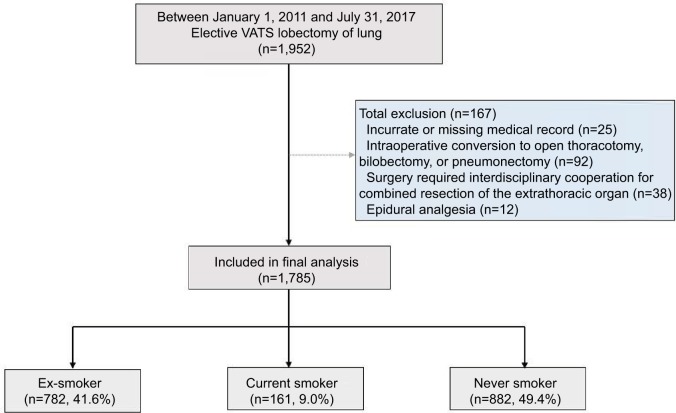
This retrospective observational study included NSCLC patients treated with VATS lobectomy between January 2011 and July 2017. Demographic and clinical information, including preoperative smoking history, was collected. The primary goal was to investigate the relationship between smoking history and postoperative pain outcomes (oral morphine equivalent [OME] consumption and pain score). Multivariate linear regression analysis was performed, and <0.05 was considered as statistically significant.
A total of 1,785 patients were included in the final analysis. Multivariate linear regression analysis revealed that total smoking amount (in packs), status as current smoker, and cessation time did not have an association with OME consumption (mg) or pain scores on postoperative days 0-2 (>0.05). However, patients who had never smoked consumed less morphine equivalent analgesics (mg) on postoperative days 0-2 (coefficient: -17.48, 95% CI [-33.83, -1.13], =0.036) compared to patients who had a history of smoking.
Patients who had never smoked had lower opioid analgesics consumption on the days immediately following surgery, while being a current smoker or the total amount of smoking in packs did not affect postoperative pain outcomes after VATS lung lobectomy.
慢性吸烟史与术后疼痛之间的关系仍存在争议。本研究旨在阐明接受电视辅助胸腔镜手术(VATS)肺叶切除术的非小细胞肺癌(NSCLC)患者中的这种关系。
这项回顾性观察研究纳入了2011年1月至2017年7月期间接受VATS肺叶切除术治疗的NSCLC患者。收集了包括术前吸烟史在内的人口统计学和临床信息。主要目标是研究吸烟史与术后疼痛结局(口服吗啡当量[OME]消耗量和疼痛评分)之间的关系。进行了多变量线性回归分析,P<0.05被认为具有统计学意义。
最终分析共纳入1785例患者。多变量线性回归分析显示,吸烟总量(以包计)、当前吸烟者状态和戒烟时间与术后0至2天的OME消耗量(mg)或疼痛评分无关联(P>0.05)。然而,与有吸烟史的患者相比,从未吸烟的患者在术后0至2天消耗的吗啡当量镇痛药(mg)更少(系数:-17.48,95%可信区间[-33.83,-1.13],P=0.036)。
从未吸烟的患者在手术后即刻的阿片类镇痛药消耗量较低,而当前吸烟者或吸烟总量(以包计)并不影响VATS肺叶切除术后的疼痛结局。