Ginzburg Samara B, Deutsch Susan, Bellissimo Jaclyn, Elkowitz David E, Stern Joel Nh, Lucito Robert
Department of Science Education, Zucker School of Medicine at Hofstra/Northwell, Hempstead, NY, USA.
Adv Med Educ Pract. 2018 Apr 9;9:221-226. doi: 10.2147/AMEP.S155731. eCollection 2018.
The evolution of health care systems in response to societal and financial pressures has changed care delivery models, which presents new challenges for physicians. Leadership training is increasingly being recognized as an essential component of medical education training to prepare physicians to meet these needs. Unfortunately, most medical schools do not include leadership training. It has been suggested that a longitudinal and integrated approach to leadership training should be sought. We hypothesized that integration of leadership training into our hybrid problem-based learning (PBL)/case-based learning (CBL) program, Patient-Centered Explorations in Active Reasoning, Learning and Synthesis (PEARLS), would be an effective way for medical students to develop leadership skills without the addition of curricular time.
We designed a unique leadership program in PEARLS in which 98 medical students participated during each of their six courses throughout the first 2 years of school. A program director and trained faculty facilitators educated students and coached them on leadership development throughout this time. Students were assessed by their facilitator at the end of every course on development of leadership skills related to teamwork, meaningful self-assessment, process improvement, and thinking outside the box.
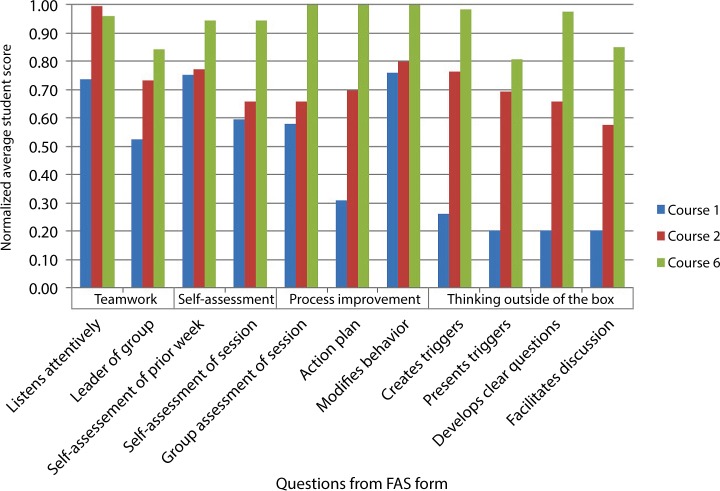
Students consistently improved their performance from the first to the final course in all four leadership parameters evaluated. The skills that demonstrated the greatest change were those pertaining to thinking outside the box and process improvement.
Incorporation of a longitudinal and integrated approach to leadership training into an existing PBL/CBL program is an effective way for medical students to improve their leadership skills without the addition of curricular time. These results offer a new, time-efficient option for leadership development in schools with existing PBL/CBL programs.
医疗保健系统为应对社会和经济压力而不断演变,这改变了护理提供模式,给医生带来了新的挑战。领导力培训日益被视为医学教育培训的重要组成部分,以使医生能够满足这些需求。不幸的是,大多数医学院校并未纳入领导力培训。有人建议应寻求一种纵向且综合的领导力培训方法。我们假设将领导力培训融入我们基于问题的学习(PBL)/基于案例的学习(CBL)混合项目“以患者为中心的主动推理、学习与综合探索”(PEARLS)中,将是医学生在不增加课程时间的情况下培养领导技能的有效途径。
我们在PEARLS中设计了一个独特的领导力项目,98名医学生在入学后的前两年里,在他们的六门课程中每门课程都参与该项目。项目主任和经过培训的教师指导人员在此期间对学生进行教育,并就领导力发展对他们进行指导。在每门课程结束时,由指导人员对学生在与团队合作、有意义的自我评估、流程改进以及跳出框框思考相关的领导技能发展方面进行评估。
在所有评估的四个领导力参数方面,学生从第一门课程到最后一门课程的表现持续提高。变化最大的技能是那些与跳出框框思考和流程改进相关的技能。
将纵向且综合的领导力培训方法纳入现有的PBL/CBL项目,是医学生在不增加课程时间的情况下提高领导技能的有效途径。这些结果为拥有现有PBL/CBL项目的学校提供了一种新的、节省时间的领导力发展选择。