Gorochowski Thomas E, Grierson Claire S, di Bernardo Mario
BrisSynBio, Life Sciences Building, Bristol BS8 1TQ, UK.
School of Biological Sciences, University of Bristol, Life Sciences Building, Tyndall Avenue, Bristol BS8 1TQ, UK.
Sci Adv. 2018 Mar 28;4(3):eaap9751. doi: 10.1126/sciadv.aap9751. eCollection 2018 Mar.
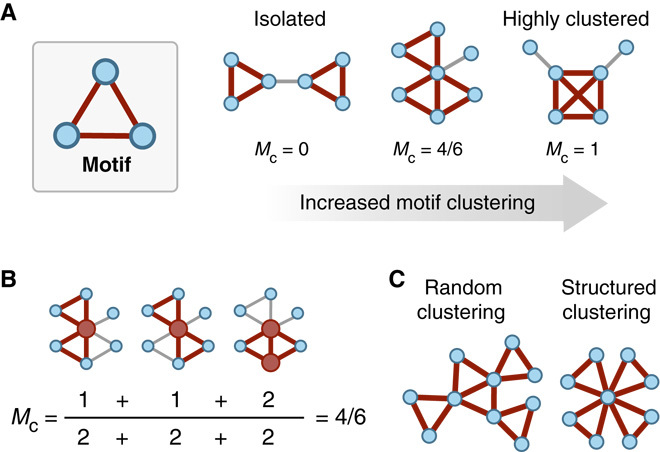
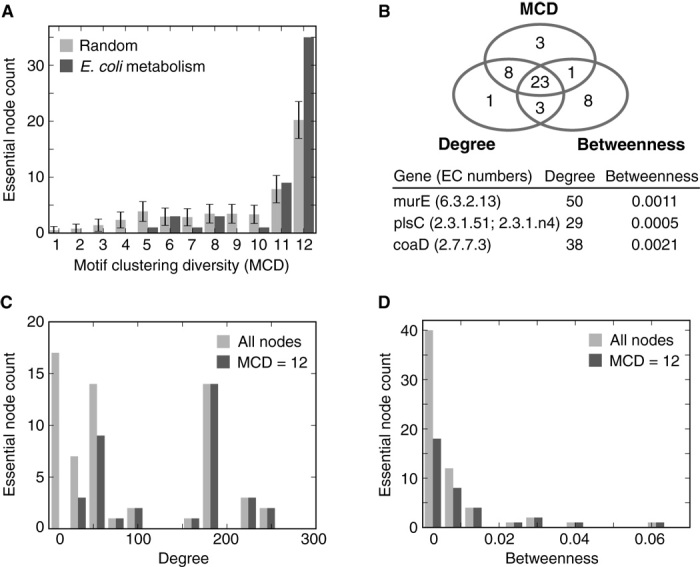
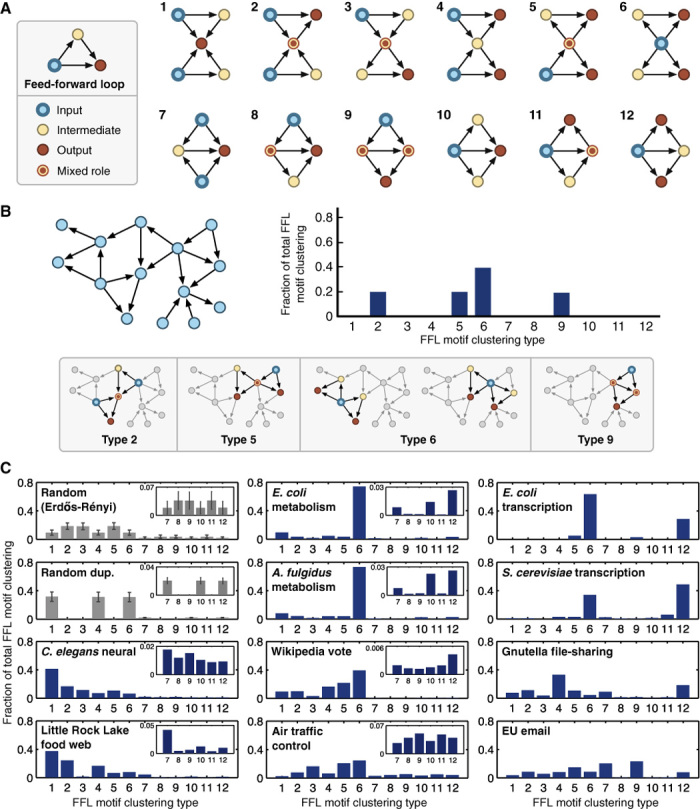
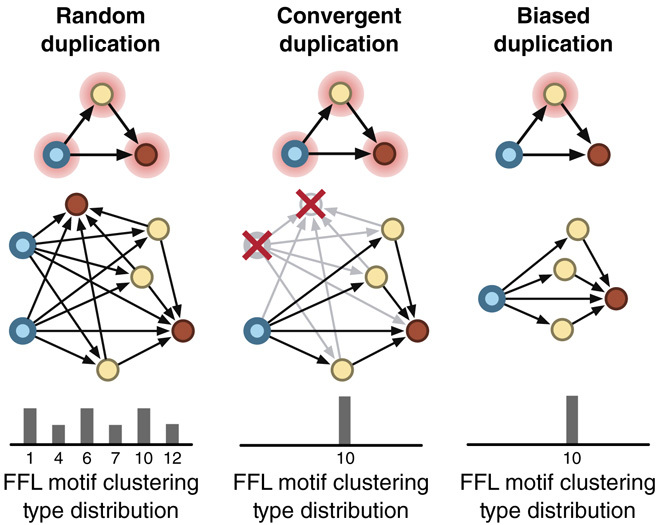
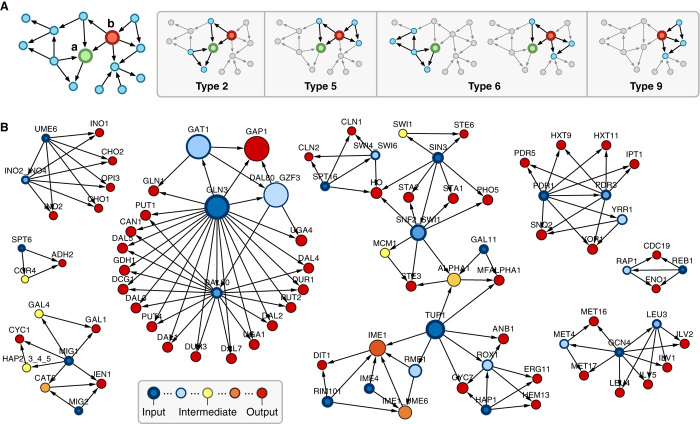
Network motifs are significantly overrepresented subgraphs that have been proposed as building blocks for natural and engineered networks. Detailed functional analysis has been performed for many types of motif in isolation, but less is known about how motifs work together to perform complex tasks. To address this issue, we measure the aggregation of network motifs via methods that extract precisely how these structures are connected. Applying this approach to a broad spectrum of networked systems and focusing on the widespread feed-forward loop motif, we uncover striking differences in motif organization. The types of connection are often highly constrained, differ between domains, and clearly capture architectural principles. We show how this information can be used to effectively predict functionally important nodes in the metabolic network of . Our findings have implications for understanding how networked systems are constructed from motif parts and elucidate constraints that guide their evolution.
网络基序是显著过度呈现的子图,已被提议作为自然网络和工程网络的构建模块。已经对许多类型的基序单独进行了详细的功能分析,但对于基序如何协同执行复杂任务却知之甚少。为了解决这个问题,我们通过精确提取这些结构如何连接的方法来测量网络基序的聚集情况。将这种方法应用于广泛的网络系统,并聚焦于广泛存在的前馈环基序,我们发现了基序组织方面的显著差异。连接类型通常受到高度限制,在不同领域之间存在差异,并且清晰地体现了架构原则。我们展示了如何利用这些信息有效地预测[具体代谢网络名称]代谢网络中功能重要的节点。我们的发现对于理解网络系统如何由基序部分构建以及阐明指导其进化的限制具有重要意义。