Yang Xiaohan, Medford June I, Markel Kasey, Shih Patrick M, De Paoli Henrique C, Trinh Cong T, McCormick Alistair J, Ployet Raphael, Hussey Steven G, Myburg Alexander A, Jensen Poul Erik, Hassan Md Mahmudul, Zhang Jin, Muchero Wellington, Kalluri Udaya C, Yin Hengfu, Zhuo Renying, Abraham Paul E, Chen Jin-Gui, Weston David J, Yang Yinong, Liu Degao, Li Yi, Labbe Jessy, Yang Bing, Lee Jun Hyung, Cottingham Robert W, Martin Stanton, Lu Mengzhu, Tschaplinski Timothy J, Yuan Guoliang, Lu Haiwei, Ranjan Priya, Mitchell Julie C, Wullschleger Stan D, Tuskan Gerald A
Biosciences Division, Oak Ridge National Laboratory, Oak Ridge, TN 37831, USA.
The Center for Bioenergy Innovation, Oak Ridge National Laboratory, Oak Ridge, TN 37831, USA.
Biodes Res. 2020 Dec 5;2020:8051764. doi: 10.34133/2020/8051764. eCollection 2020.
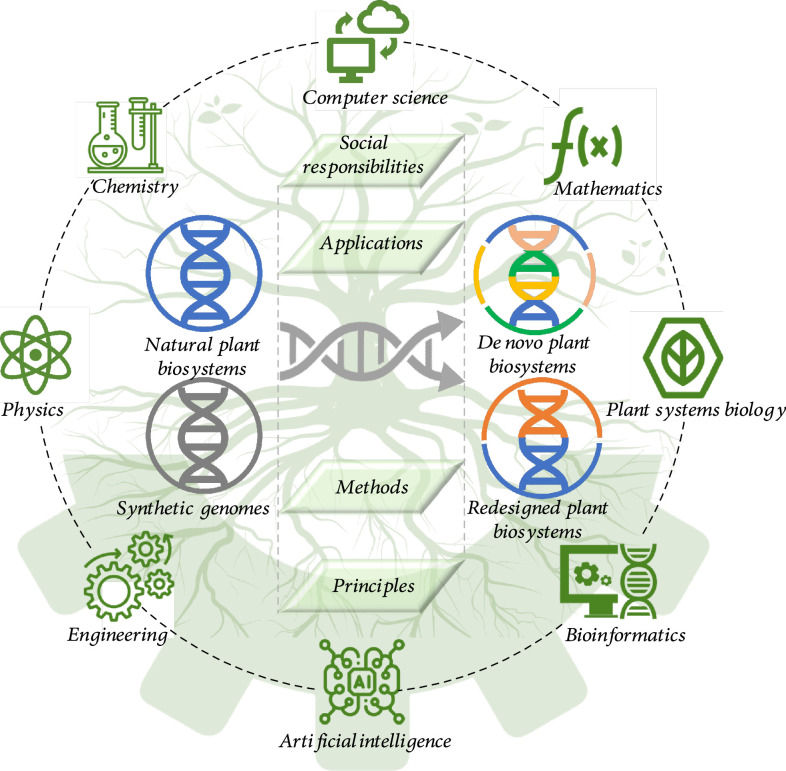
Human life intimately depends on plants for food, biomaterials, health, energy, and a sustainable environment. Various plants have been genetically improved mostly through breeding, along with limited modification via genetic engineering, yet they are still not able to meet the ever-increasing needs, in terms of both quantity and quality, resulting from the rapid increase in world population and expected standards of living. A step change that may address these challenges would be to expand the potential of plants using biosystems design approaches. This represents a shift in plant science research from relatively simple trial-and-error approaches to innovative strategies based on predictive models of biological systems. Plant biosystems design seeks to accelerate plant genetic improvement using genome editing and genetic circuit engineering or create novel plant systems through synthesis of plant genomes. From this perspective, we present a comprehensive roadmap of plant biosystems design covering theories, principles, and technical methods, along with potential applications in basic and applied plant biology research. We highlight current challenges, future opportunities, and research priorities, along with a framework for international collaboration, towards rapid advancement of this emerging interdisciplinary area of research. Finally, we discuss the importance of social responsibility in utilizing plant biosystems design and suggest strategies for improving public perception, trust, and acceptance.
人类的生活在食物、生物材料、健康、能源和可持续环境等方面与植物密切相关。各种植物大多通过育种得到了基因改良,同时通过基因工程进行了有限的修饰,但由于世界人口的快速增长和预期的生活水平,它们在数量和质量上仍无法满足不断增长的需求。一个可能应对这些挑战的重大转变是利用生物系统设计方法来拓展植物的潜力。这代表着植物科学研究从相对简单的试错方法转向基于生物系统预测模型的创新策略。植物生物系统设计旨在利用基因组编辑和基因电路工程加速植物基因改良,或通过合成植物基因组创造新的植物系统。从这个角度出发,我们提出了一个涵盖理论、原理和技术方法的植物生物系统设计全面路线图,以及在基础和应用植物生物学研究中的潜在应用。我们强调了当前的挑战、未来的机遇和研究重点,以及促进这一新兴跨学科研究领域快速发展的国际合作框架。最后,我们讨论了在利用植物生物系统设计中社会责任的重要性,并提出了提高公众认知、信任和接受度的策略。