School of Communication Engineering, Jilin University, Changchun 130025, China.
Sensors (Basel). 2018 Apr 19;18(4):1265. doi: 10.3390/s18041265.
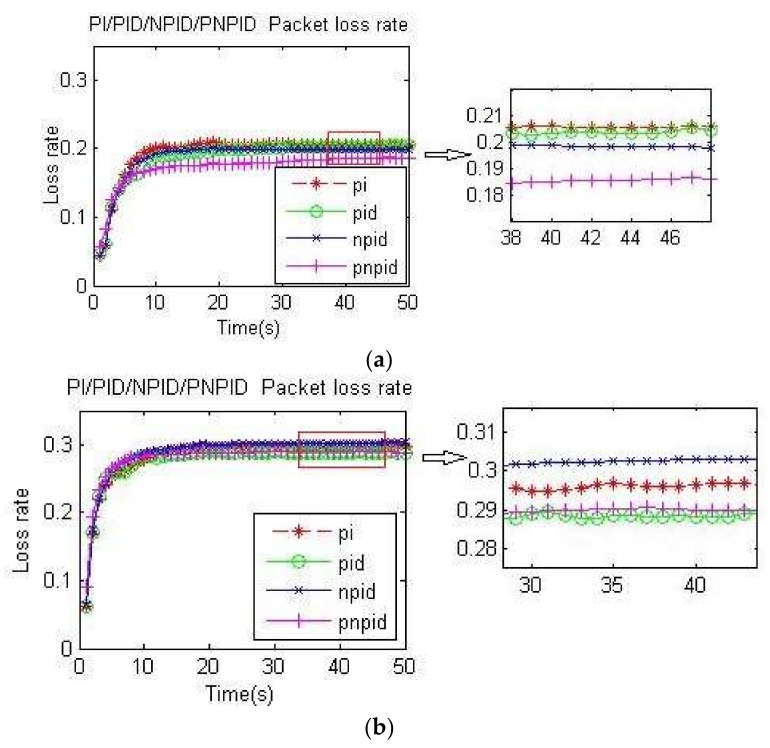
Aiming at the problem of network congestion caused by the large number of data transmissions in wireless routing nodes of wireless sensor network (WSN), this paper puts forward an algorithm based on standard particle swarm⁻neural PID congestion control (PNPID). Firstly, PID control theory was applied to the queue management of wireless sensor nodes. Then, the self-learning and self-organizing ability of neurons was used to achieve online adjustment of weights to adjust the proportion, integral and differential parameters of the PID controller. Finally, the standard particle swarm optimization to neural PID (NPID) algorithm of initial values of proportion, integral and differential parameters and neuron learning rates were used for online optimization. This paper describes experiments and simulations which show that the PNPID algorithm effectively stabilized queue length near the expected value. At the same time, network performance, such as throughput and packet loss rate, was greatly improved, which alleviated network congestion and improved network QoS.
针对无线传感器网络(WSN)无线路由节点因数据传输量大导致网络拥塞的问题,提出了一种基于标准粒子群⁻神经 PID 拥塞控制(PNPID)的算法。首先,将 PID 控制理论应用于无线传感器节点的队列管理中。然后,利用神经元的自学习和自组织能力,实现 PID 控制器的比例、积分和微分参数的在线调整。最后,采用标准粒子群优化算法对神经 PID(NPID)算法的比例、积分和微分参数以及神经元学习率进行在线优化。文中描述了实验和仿真,结果表明 PNPID 算法能有效将队列长度稳定在期望值附近。同时,大大提高了网络性能,如吞吐量和丢包率,缓解了网络拥塞,提高了网络 QoS。