NYU School of Medicine, Department of Population Health, New York, NY, 10016, USA.
NYC Health + Hospitals, Bellevue Hospital, New York, NY, USA.
BMC Public Health. 2018 Apr 19;18(1):521. doi: 10.1186/s12889-018-5419-4.
Type 2 diabetes mellitus (DM) affects 9.4% of US adults and children, while another 33.9% of Americans are at risk of DM. Health care institutions face many barriers to systematically delivering the preventive care needed to decrease DM incidence. Community health workers (CHWs) may, as frontline public health workers bridging clinic and community, help overcome these challenges. This paper presents the protocol for a pragmatic, cluster-randomized trial integrating CHWs into two primary care clinics to support DM prevention for at-risk patients.
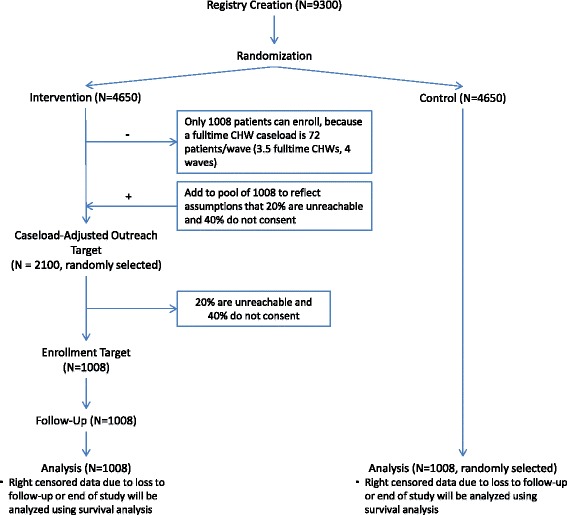
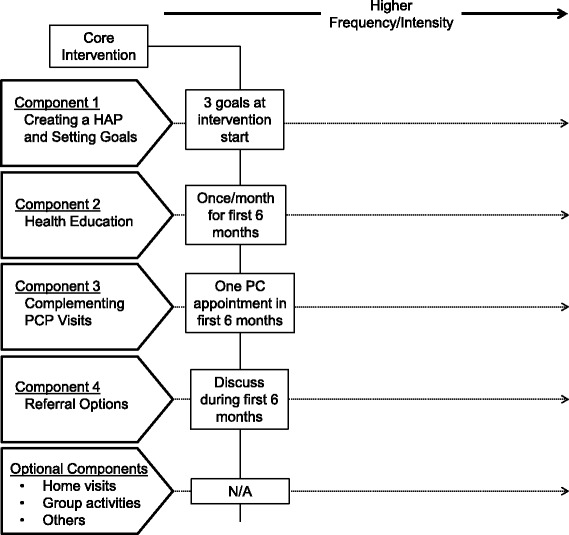
The trial will randomize 15 care teams, stratified by practice site (Bellevue Hospital and Manhattan VA), totaling 56 primary care physicians. The study cohort will consist of ~ 2000 patients who are 18-75 years of age, actively enrolled in a primary care team, able to speak English or Spanish, and have at least one glycosylated hemoglobin (HbA1c) result in the prediabetic range (5.7-6.4%) since 2012. Those with a current DM diagnosis or DM medication prescription (other than metformin) are ineligible. The intervention consists of four core activities - setting health goals, health education, activation for doctor's appointments, and referrals to DM prevention programs - adjustable according to the patient's needs and readiness. The primary outcome is DM incidence. Secondary outcomes include weight loss, HbA1C, and self-reported health behaviors. Clinical variables and health behaviors will be obtained through electronic medical records and surveys, respectively. Implementation outcomes, namely implementation fidelity and physicians' perspectives about CHW integration into the clinic, will be assessed using interviews and CHW activity logs and analyzed for the influence of moderating organizational factors.
This is the first rigorous, pragmatic trial to test the effectiveness of integrating CHWs into primary care for DM prevention reaching a population-based sample. Our study's limitations include language-based eligibility and the use of HbA1c as a measure of DM risk. It will measure both clinical and implementation outcomes and potentially broaden the evidence base for CHWs and patient-centered medical home implementation. Further, the intervention's unique features, notably patient-level personalization and referral to existing programs, may offer a scalable model to benefit patients at-risk of DM.
Clinicaltrials.gov NCT03006666 (Received 12/27/2016).
2 型糖尿病影响了 9.4%的美国成年人和儿童,而另有 33.9%的美国人有患糖尿病的风险。医疗机构在系统提供预防保健方面面临着许多障碍,以降低糖尿病的发病率。社区卫生工作者(CHWs)作为连接诊所和社区的第一线公共卫生工作者,可能有助于克服这些挑战。本文介绍了一项实用的、基于群组的随机试验的方案,该试验将 CHWs 纳入两个初级保健诊所,以支持高危患者的糖尿病预防。
试验将对 15 个护理团队进行随机分组,按实践地点(贝尔维尤医院和曼哈顿 VA)分层,共有 56 名初级保健医生。研究队列将包括约 2000 名年龄在 18-75 岁之间、积极参加初级保健团队的患者,他们能够讲英语或西班牙语,并且自 2012 年以来至少有一次糖化血红蛋白(HbA1c)结果处于糖尿病前期范围(5.7-6.4%)。目前患有糖尿病诊断或糖尿病药物处方(除二甲双胍以外)的患者不符合条件。干预措施包括四项核心活动-设定健康目标、健康教育、预约激活和转介至糖尿病预防计划-可根据患者的需求和准备情况进行调整。主要结局是糖尿病的发病率。次要结局包括体重减轻、HbA1C 和自我报告的健康行为。临床变量和健康行为将分别通过电子病历和调查获得。实施结果,即实施一致性和医生对 CHW 融入诊所的看法,将通过访谈和 CHW 活动日志进行评估,并分析调节组织因素的影响。
这是第一项严格的、实用的试验,旨在测试将 CHW 整合到初级保健中以预防糖尿病的有效性,该试验针对基于人群的样本。我们研究的局限性包括基于语言的资格和使用糖化血红蛋白作为衡量糖尿病风险的指标。它将测量临床和实施结果,并可能为 CHW 和以患者为中心的医疗家庭实施扩大证据基础。此外,该干预措施的独特特征,特别是患者层面的个性化和转介到现有的计划,可能提供一个可扩展的模式,使处于糖尿病风险的患者受益。
Clinicaltrials.gov NCT03006666(2016 年 12 月 27 日收案)。