Department of Critical Care Medicine, School of Medicine, University of Pittsburgh, Pittsburgh, Pennsylvania, USA.
Department of Neurology, School of Medicine, University of Pittsburgh, Pittsburgh, Pennsylvania, USA.
J Neurol Neurosurg Psychiatry. 2018 Nov;89(11):1152-1162. doi: 10.1136/jnnp-2017-317741. Epub 2018 Apr 19.
encodes sulfonylurea receptor 1, a key regulatory protein of cerebral oedema in many neurological disorders including traumatic brain injury (TBI). Sulfonylurea-receptor-1 inhibition has been promising in ameliorating cerebral oedema in clinical trials. We evaluated whether tag single-nucleotide polymorphisms predicted oedema and outcome in TBI.
DNA was extracted from 485 prospectively enrolled patients with severe TBI. 410 were analysed after quality control. tag single-nucleotide polymorphisms (SNPs) were identified (Hapmap, r>0.8, minor-allele frequency >0.20) and sequenced (iPlex-Gold, MassArray). Outcomes included radiographic oedema, intracranial pressure (ICP) and 3-month Glasgow Outcome Scale (GOS) score. Proxy SNPs, spatial modelling, amino acid topology and functional predictions were determined using established software programs.
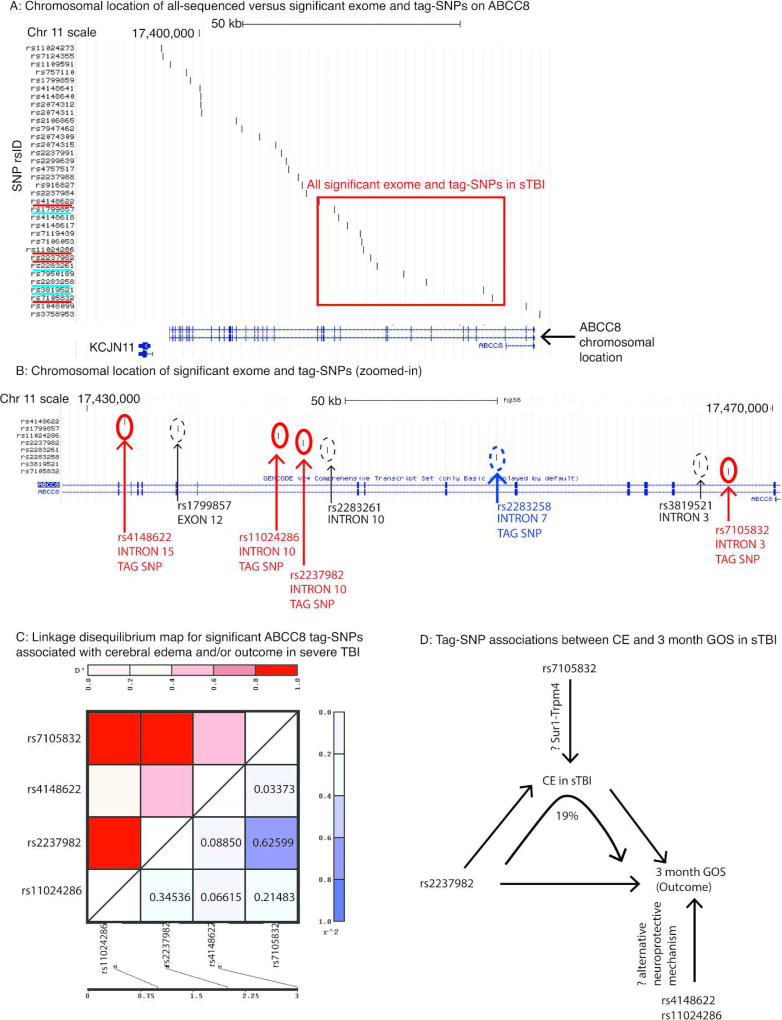
Wild-type rs7105832 and rs2237982 alleles and genotypes were associated with lower average ICP (β=-2.91, p=0.001; β=-2.28, p=0.003) and decreased radiographic oedema (OR 0.42, p=0.012; OR 0.52, p=0.017). Wild-type rs2237982 also increased favourable 3-month GOS (OR 2.45, p=0.006); this was partially mediated by oedema (p=0.03). Different polymorphisms predicted 3-month outcome: variant rs11024286 increased (OR 1.84, p=0.006) and wild-type rs4148622 decreased (OR 0.40, p=0.01) the odds of favourable outcome. Significant tag and concordant proxy SNPs regionally span introns/exons 2-15 of the 39-exon gene.
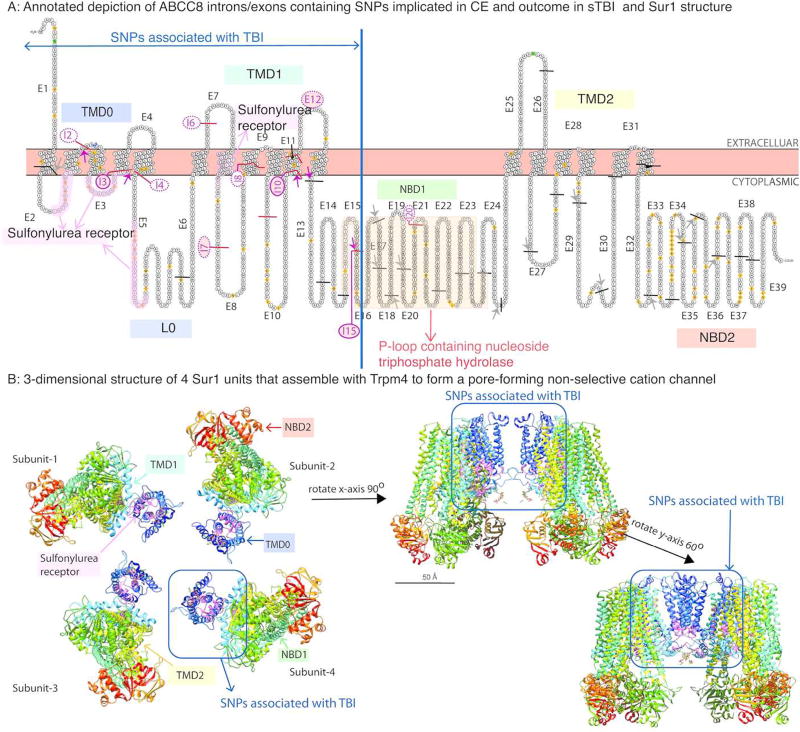
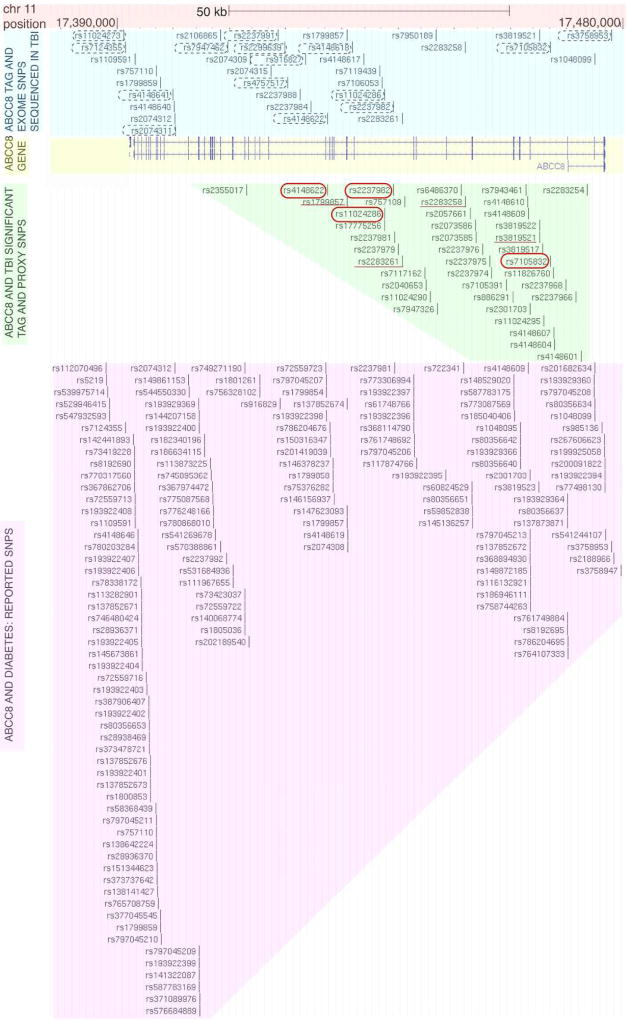
This study identifies four tag SNPs associated with cerebral oedema and/or outcome in TBI, tagging a region including 33 polymorphisms. In polymorphisms predictive of oedema, variant alleles/genotypes confer increased risk. Different variant polymorphisms were associated with favourable outcome, potentially suggesting distinct mechanisms. Significant polymorphisms spatially clustered flanking exons encoding the sulfonylurea receptor site and transmembrane domain 0/loop 0 (juxtaposing the channel pore/binding site). This, if validated, may help build a foundation for developing future strategies that may guide individualised care, treatment response, prognosis and patient selection for clinical trials.
编码磺酰脲受体 1,这是许多神经疾病(包括创伤性脑损伤)中脑水肿的关键调节蛋白。磺酰脲受体-1 抑制在临床试验中改善脑水肿方面具有广阔前景。我们评估了 tag 单核苷酸多态性是否可预测 TBI 中的水肿和结局。
从 485 例前瞻性纳入的严重 TBI 患者中提取 DNA。经质量控制后,对 410 例进行分析。识别 tag 单核苷酸多态性(Hapmap,r>0.8,次要等位基因频率>0.20)并进行测序(iPlex-Gold,MassArray)。结局包括放射性水肿、颅内压(ICP)和 3 个月格拉斯哥结局量表(GOS)评分。使用既定的软件程序确定代理 SNP、空间建模、氨基酸拓扑和功能预测。
野生型 rs7105832 和 rs2237982 等位基因和基因型与较低的平均 ICP(β=-2.91,p=0.001;β=-2.28,p=0.003)和减少放射性水肿(OR 0.42,p=0.012;OR 0.52,p=0.017)相关。野生型 rs2237982 也增加了 3 个月的良好 GOS(OR 2.45,p=0.006);这部分通过水肿介导(p=0.03)。不同的多态性预测 3 个月的结局:变异 rs11024286 增加(OR 1.84,p=0.006),野生型 rs4148622 减少(OR 0.40,p=0.01),有利结局的可能性。在与水肿相关的显著标记和一致的代理 SNP 区域跨越基因的 39 个外显子中的内含子/外显子 2-15。
本研究确定了四个与 TBI 中的脑水肿和/或结局相关的 tag SNPs,标记了一个包括 33 个多态性的区域。在与水肿相关的多态性中,变异等位基因/基因型增加了风险。不同的变异多态性与良好的结局相关,可能提示不同的机制。空间显著的多态性聚类在磺酰脲受体位点和跨膜域 0/环 0(毗邻通道孔/结合位点)的侧翼外显子。如果得到验证,这可能有助于为开发未来的策略奠定基础,这些策略可能有助于指导个体化护理、治疗反应、预后和临床试验中的患者选择。