Beyster Center for Genomics of Psychiatric Diseases, University of California San Diego, La Jolla, CA 92093, USA.
Department of Psychiatry, University of California San Diego, La Jolla, CA 92093, USA.
Science. 2018 Apr 20;360(6386):327-331. doi: 10.1126/science.aan2261.
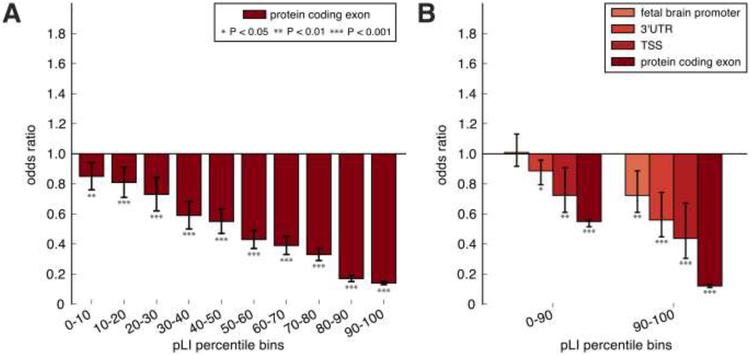
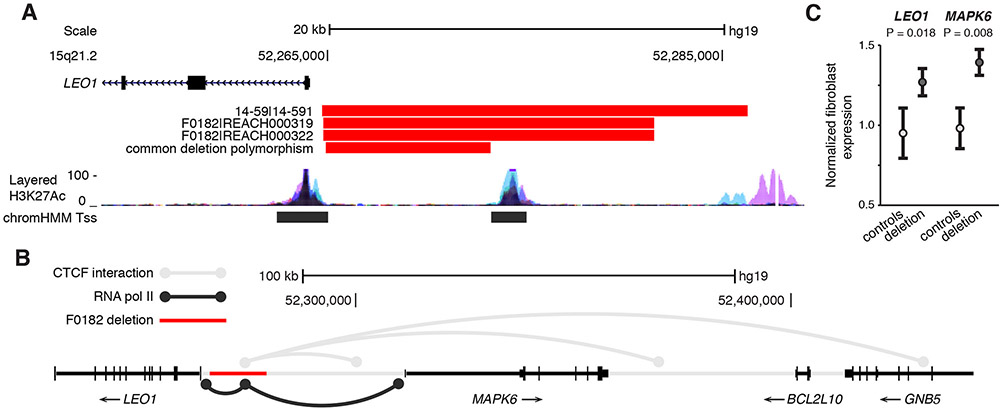
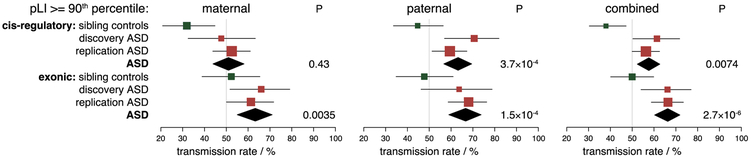
The genetic basis of autism spectrum disorder (ASD) is known to consist of contributions from de novo mutations in variant-intolerant genes. We hypothesize that rare inherited structural variants in cis-regulatory elements (CRE-SVs) of these genes also contribute to ASD. We investigated this by assessing the evidence for natural selection and transmission distortion of CRE-SVs in whole genomes of 9274 subjects from 2600 families affected by ASD. In a discovery cohort of 829 families, structural variants were depleted within promoters and untranslated regions, and paternally inherited CRE-SVs were preferentially transmitted to affected offspring and not to their unaffected siblings. The association of paternal CRE-SVs was replicated in an independent sample of 1771 families. Our results suggest that rare inherited noncoding variants predispose children to ASD, with differing contributions from each parent.
自闭症谱系障碍(ASD)的遗传基础已知包括变体不耐受基因中的新生突变的贡献。我们假设这些基因的顺式调控元件(CRE-SV)中的罕见遗传结构变体也会导致 ASD。我们通过评估 2600 个受 ASD 影响的家庭的 9274 名受试者的全基因组中 CRE-SV 的自然选择和传递扭曲的证据来研究这一点。在 829 个家庭的发现队列中,结构变体在启动子和非翻译区中被耗尽,并且父系 CRE-SV 优先传递给受影响的后代,而不是他们未受影响的兄弟姐妹。1771 个家庭的独立样本中复制了父系 CRE-SV 的关联。我们的研究结果表明,罕见的遗传非编码变体使儿童易患 ASD,每个父母的贡献不同。